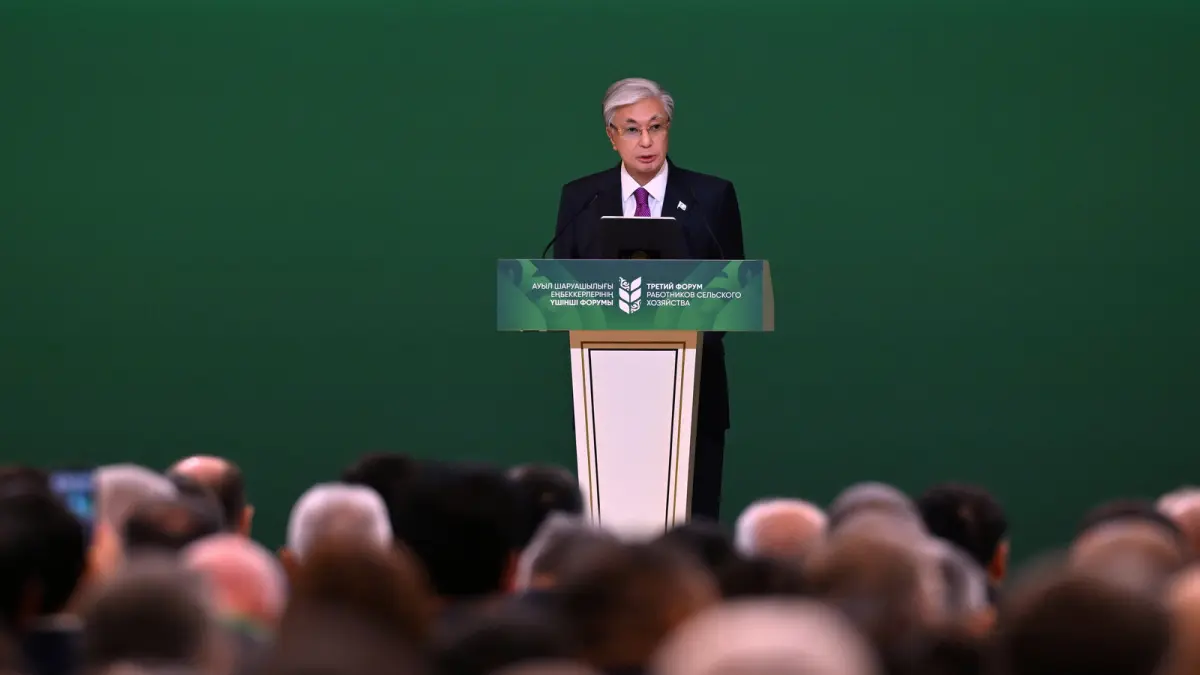
Astana, 21 November. President Kassym-Jomart Tokayev on 20 November, at the 3rd Forum of Agricultural Workers, instructed the Government to carry out a comprehensive review of the documents drawn up to support villages and the farm sector, and acknowledged that earlier reports had embellished the state of affairs in the countryside.
“The thing is, in the past we were painted a beautiful, almost perfect picture,” the Head of State said.
The forum was held in Astana. According to Akorda’s report, besides the President the speakers were Minister of Agriculture Aidarbek Saparov and heads of farms and companies. The floor went to Alexander Kasitsyn, director of Galitskoye LLP, Zharas Kanapin, director of the Ramadan dairy farm, and Alexander Rudakov, president of the EKO-kultura agricultural holding. Philipp Schmidt-Holzmann, vice-president of Valmont Industries, and Nursultan Zharylgapov, chairman of the Ulytau Meat and Ulytau Sheep cooperatives, also spoke. At the end of the forum Tokayev presented state awards to people working in the sector.
The President summed up the year in figures. Despite unfavourable weather, 24.5 million tonnes of crops were harvested. Over seven years food production grew by 28%, 1,630 investment projects worth 2.7 trillion tenge were launched, and exports of agro-industrial products doubled to almost $7 billion, 52% of them processed goods. Last year the country held a national agricultural census for the first time in 20 years.
Tokayev was blunt about the reports of past years. After the “beautiful picture”, he said, officials looked for “convenient excuses, saying we had not been given accurate statistics”, and the issue was put off. He asked separately about the Auyl Amanaty (“Village Legacy”) soft-loan programme: 150 billion tenge has been allocated to it, which made it possible to give jobs to more than 22,000 people in rural areas. “Of course, that is a good figure. But the main question is whether we have managed to keep these 22,000 jobs to this day,” the President said. Under the Auyl – El Besigi (“The Village is the Cradle of the Nation”) programme, by his account, 921 projects worth 173 billion tenge were carried out in almost 500 villages, and water supply systems were modernised in 277 settlements.
The President also spoke of those who own land but do not live in the countryside. “However, there are businessmen who earn money from farmland while living in big cities or even abroad. They do not even visit their farms,” he said. “Then measures must be taken, though, of course, in accordance with the law.”
Tokayev grouped his instructions into five priorities: quality of rural life, financing, livestock, crop farming and water, and deep processing. The only deadline he named concerns money: by the end of the first quarter of 2027 the Government, together with the Baiterek holding and the financial regulators, is to propose a single line of investment instruments for the farm sector. He urged commercial banks to lend more to rural areas, including over long terms, with repayment schedules matched to the production cycle and grace periods on the principal. “Quite often farmers sell their harvests right after reaping at a knock-down, cheap price,” he said of those rushing to make the first payment on a loan, and called the situation unacceptable. The Government and the Agency for Regulation and Development of the Financial Market (ARDFM) were told to prepare proposals on farm insurance with incentives for voluntary cover.
On water the President gave his own figures. Water-saving technologies are now used on 700,000 hectares, less than half of irrigated land. “By 2030 coverage is to be brought to 1.3 million hectares,” Tokayev said. Reconstruction and repair of 4,600 km of irrigation canals has begun; about a thousand kilometres will be commissioned by the end of the year, improving water supply to 200,000 hectares. “Some experts call 2027 potentially the hottest year in the history of observations,” the President noted, linking climate to food security.
On fertilisers, Tokayev said their application had for the first time reached 65% of the scientifically justified need, compared with 20% a few years ago. “A situation in which about half of the fertiliser used is imported is unacceptable,” he added. In livestock, according to the President, 71 commercial dairy farms have been launched and 33 feedlots built; Kazakhstan has also received foot-and-mouth-disease-free status under a resolution of the World Organisation for Animal Health. The Government was told to remove barriers to exports of livestock products and to modernise herd records, laboratory diagnostics and the veterinary service.
At the end of his speech the President returned to the wider theme of state order. “For me, ‘Law and Order’ is the fundamental principle in building a Just Kazakhstan,” he said, announcing that a special commission would start work to monitor compliance with the law in the People’s Construction programme.
What it means: The President did not simply set farmers new tasks; he cast doubt on the data used to judge earlier programmes and ordered them rechecked. Money for the countryside stays, but results will now be asked for: whether jobs were kept, how much water was saved, whose land it is and who works it.
Who benefits: According to the President, the review should remove duplicated programmes, while long-term loans and farm insurance should spare farmers from selling their harvest cheaply to meet a first payment. For landowners who do not live in villages or visit their farms, the Head of State promised measures “in accordance with the law”.
Background: Financial control has found violations in farm subsidies before. In January 2026 Finance Minister Madi Takiyev reported to Prime Minister Olzhas Bektenov the preliminary results of an audit of state support for agriculture. Of roughly 1.2 trillion tenge in 2023–2024, violations were found in about 300 billion tenge, and direct losses came to 32 billion tenge.
We have also reported that HORSCH and CLAAS machinery worth 281.4 billion tenge was produced in Kazakhstan and that a feedlot for 50,000 head opened in Turkestan Region.



