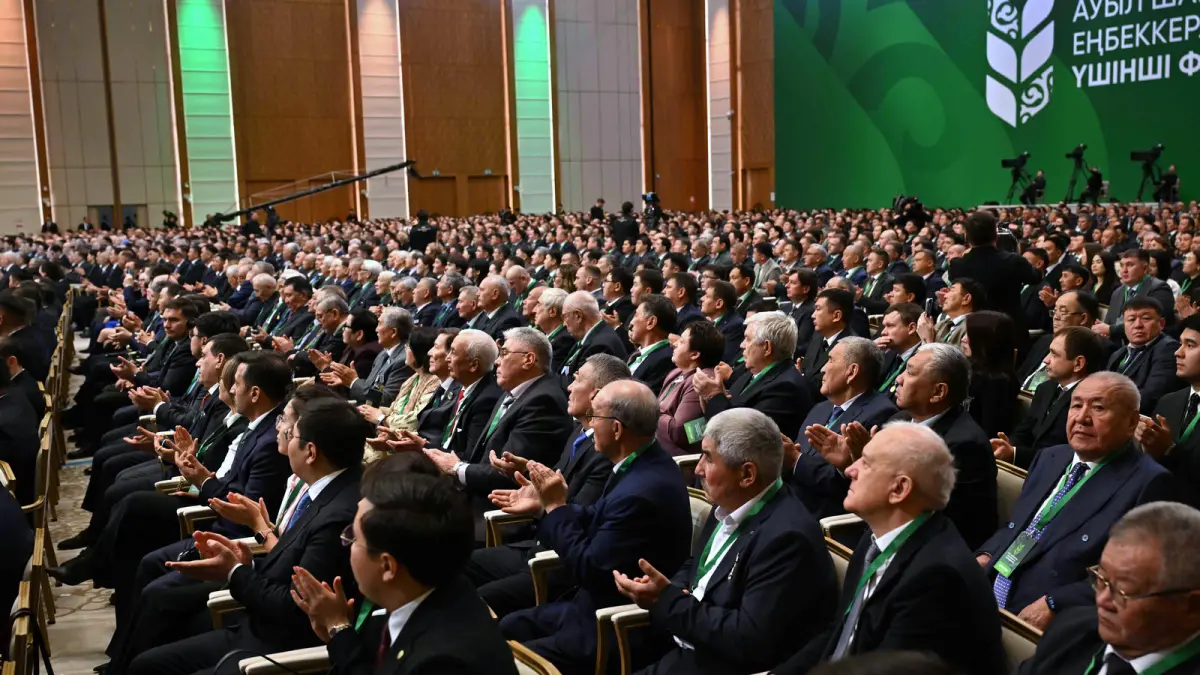
The Head of State came to the farmers’ forum not only with praise but with an audit. “The thing is, in the past we were painted a beautiful, almost perfect picture,” Kassym-Jomart Tokayev said at the 3rd Forum of Agricultural Workers on 20 November, and instructed the Government to go back over every document written to support the countryside. Behind that sentence lies a question the state has been asking itself for several years: why, as more money goes into agriculture, is there ever less confidence in the figures?
The countryside in figures
- 24.5 million tonnes
the 2026 harvest - almost $7 billion
agro-industrial exports - 150 billion tenge
for the Auyl Amanaty programme - 700,000 ha
irrigated land with water-saving technology - 1.3 million ha
the water-saving target for 2030
According to Akorda
- 24.5 million tonnes
A report nobody believes any more
The remark about the “beautiful picture” was made not behind closed doors but at an open forum where farmers, processors and Minister of Agriculture Aidarbek Saparov spoke. The President also described what followed the embellished reports: officials then looked for “convenient excuses, saying we had not been given accurate statistics”, and simply shelved the issue. He removed the statistics excuse himself on the spot: last year the country held a national agricultural census for the first time in 20 years, so pointing to a lack of figures is no longer possible.
The President’s doubt has a documentary history. As early as December 2024 the Supreme Audit Chamber, as summarised by BES.media from its chairman Alikhan Smailov’s speech to the Mazhilis, reported that more than 40% of the targets of the Concept for the Development of the Agro-Industrial Complex had not been met. The subsidy rules had changed more than 70 times in five years, there were 67 types of subsidy in 17 areas, and 3,000 recipients of 5.4 billion tenge had nothing to do with farming at all.
In January 2026 the Finance Ministry returned to the subject. Finance Minister Madi Takiyev reported the preliminary results of an audit to Prime Minister Olzhas Bektenov: of roughly 1.2 trillion tenge in state support for agriculture in 2023–2024, violations were found in about 300 billion tenge, and direct losses came to 32 billion tenge. In eleven regions the same livestock had been fictitiously resold to collect subsidies worth 808.1 million tenge. The Prime Minister then ordered end-to-end digital monitoring and payment of subsidies according to actual output.
The instruction of 20 November therefore continues work begun by financial control. What is new is that the President publicly linked unreliable reports to the quality of the programmes themselves: what is to be checked is not only how the money was spent but whether the programmes are needed in their present form and whether they duplicate one another.
Twenty-two thousand questions
Tokayev took his most telling example from his own programme. Auyl Amanaty (“Village Legacy”), which lends villagers money to start a business, has been allocated 150 billion tenge, and this, the President said, made it possible to give jobs to more than 22,000 people in rural areas. The terms are generous. According to a guide from the Mamlyutka town administration, the rate is no higher than 2.5% a year and the term up to five years, or up to seven for farming and processing. Loans go up to 2,500 MCI, and up to 8,000 MCI for processing and cooperatives, with a grace period on the principal of up to a year.
“Of course, that is a good figure. But the main question is whether we have managed to keep these 22,000 jobs to this day,” the President asked. That question is the change of approach. A programme report usually ends with the number of loans issued and jobs created at the moment of lending; the Head of State is demanding a look at what remains a year or two later. The same yardstick applies to the Auyl – El Besigi (“The Village is the Cradle of the Nation”) programme: in almost 500 villages, by the President’s figures, 921 projects worth 173 billion tenge have been carried out. The number of facilities is known; how much life in those villages has changed is still to be measured.
The words about landowners belong to the same series. “However, there are businessmen who earn money from farmland while living in big cities or even abroad. They do not even visit their farms,” Tokayev said, warning that measures would be taken “in accordance with the law”. An owner who never visits his field is the same “beautiful picture”, only on the ground: on paper the farm exists, but who works it and how cannot be seen from a big city, let alone from abroad.
Loans, harvests and knock-down prices
The President named money for the countryside as the second priority and put the problem in a farmer’s terms. “Quite often farmers sell their harvests right after reaping at a knock-down, cheap price,” he said, explaining that they do so to meet the first payment on a loan. The mechanism is clear to anyone who has borrowed for sowing: the repayment schedule follows the bank’s calendar rather than the field’s, and in autumn, when there is most grain on the market and prices are lowest, the farm is forced to sell.
Hence instructions that concern not audits but how the money is arranged. Commercial banks were urged to lend more to rural areas, including over long terms, with schedules matched to the production cycle and grace periods on the principal. Together with the Baiterek holding and the financial regulators, the Government is to propose a single line of investment instruments by the end of the first quarter of 2027, the only deadline named outright in the speech. With the Agency for Regulation and Development of the Financial Market, the Government will prepare proposals on farm insurance so that farmers insure in advance and voluntarily rather than after a drought. A digital model for assessing farmers’ creditworthiness and a special long-term financing programme with international financial institutions were also mentioned.
Water that soaks into the sand
The weightiest figures in the speech concern water. Water-saving technologies are now used on 700,000 hectares, less than half of irrigated land, and by 2030 coverage is to be brought to 1.3 million hectares. Reconstruction and repair of 4,600 km of irrigation canals has begun, and about a thousand kilometres will be commissioned by the end of the year. “Some experts call 2027 potentially the hottest year in the history of observations,” the President noted, and the reminder explains the hurry.
Why canals matter more than new hectares is clear from the reply of the Ministry of Water Resources and Irrigation to a request from BES.media. Water losses in transport were 47% in 2025: almost half of what is drawn from rivers for the fields never reaches them. By 2030 the ministry expects to cut losses to 25% by renewing about 14,450 km of canals, saving about 2 billion cubic metres a year. In an April statement the same ministry said that agriculture takes 65% of the roughly 25 billion cubic metres the country uses each year, and that 42 new reservoirs are to be built and 37 reconstructed by 2030. Here water saving is not an environmental virtue but a condition of the harvest: without it, each new irrigated hectare simply spreads the same shortage over more fields.
That is why the water instruction is tied to energy. The Government and regional administrations are to match the expansion of irrigation with water reserves, the state of the canals and the capacity of power grids: the pump that lifts water to a field needs electricity.
Figures of success and their price
The results the President cited at the start of his speech sound impressive. The 2026 harvest is 24.5 million tonnes despite unfavourable weather; food production has grown by 28% over seven years; agro-industrial exports have doubled to almost $7 billion, 52% of them processed goods. The Ministry of Agriculture reported back in March that exports in 2025 had come to $7 billion, of which $3.6 billion was processed products.
The same figures explain why the President did not stop at congratulations. Fertiliser application has for the first time reached 65% of the scientifically justified need, but about half of the fertiliser used is imported, a situation he called unacceptable. The country has gained foot-and-mouth-disease-free status, yet meat exports still face barriers, which the Government has been told to remove along with modernising the veterinary service and herd records. Success on paper and success in the field, by the logic of the speech, must coincide, and such a check now has something to rest on: the data of the agricultural census.
A commission for the building programme
The speech ended not on farming but on the state. The President recalled the “Law and Order” principle and announced that a special commission would begin monitoring compliance with it in the People’s Construction programme announced in his recent State of the Nation Address. For the countryside this means that roads, canals and water pipes built through the programme will be built under separate oversight.
Seen in this light, the words about the “beautiful picture” sound less like a reproach to the past than a rule for the future. Reports on the countryside will now be checked against what can be seen on the spot: whether the job survived, whether the water reached the field, whether the owner works the land.



