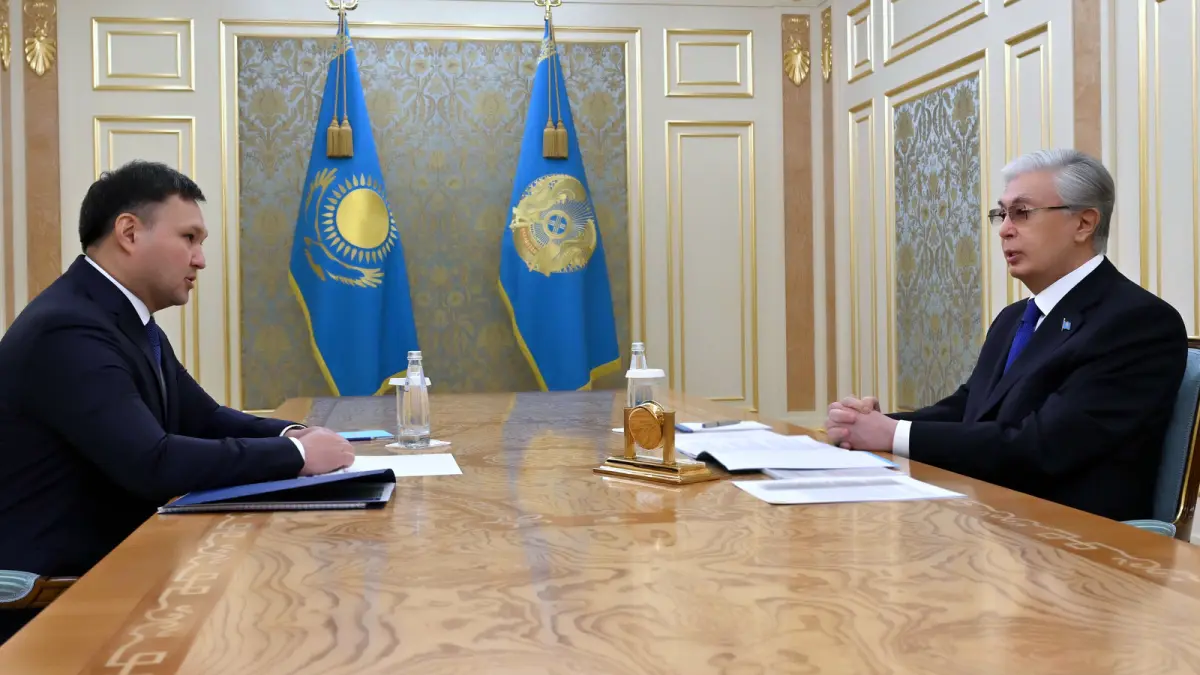
Astana, 23 November. President Kassym-Jomart Tokayev received Askhat Khasenov, Chairman of the Management Board of the national company KazMunayGas (KMG), the Akorda reported.
Khasenov reported on the company’s results for the first ten months of 2026 and on projects meant to raise marketable gas production from 2.6 to 4.5 billion cubic metres.
According to Khasenov, KMG’s market capitalisation now stands at 22 trillion tenge, and its financial position allows it to carry out investment projects worth 16.7 trillion tenge. Marketable gas is gas that has been treated and is ready for sale to consumers. Growth from 2.6 to 4.5 billion cubic metres means an increase of almost three quarters, and the Akorda describes it as a short-term goal. To get there, KMG is building gas facilities in Atyrau, Aktobe and West Kazakhstan regions and studying additional export routes.
The second part of the report dealt with exploration. KMG has adopted an exploration programme for 2026–2030: its 23 projects provide for seismic surveys over 60,000 line kilometres and the drilling of 26 exploration wells. The company puts their total geological resource potential at 4.7 billion tonnes of fuel equivalent. Resource potential is a preliminary estimate of what may lie underground, not proven reserves; fuel equivalent is a unit that allows oil and gas to be added up by their heating value. Additional exploration is under way at producing fields, and the West Karasor field in Atyrau region and the Coastal Zone of Karazhanbas in Mangystau region have already been put into commercial development. Khasenov said that “digital twins”, computer models of the fields built with the use of artificial intelligence, are being introduced.
The third part concerned refining. In ten months Kazakhstan’s refineries processed 14.9 million tonnes of oil, and output of light petroleum products, that is petrol, diesel fuel and jet fuel, will rise by 800,000 tonnes this year compared with last year. The company continues to expand the Shymkent refinery to 12 million tonnes and the Pavlodar petrochemical plant from 6 to 9 million tonnes a year. Khasenov also described petrochemical projects in Atyrau region: polyethylene production and the construction of a gas separation complex.
After hearing the report, the head of state instructed the company to continue systematic work on exploration and investment projects. The Akorda gives neither the date by which KMG expects to reach 4.5 billion cubic metres of marketable gas nor the cost of the gas projects.
What it means: The national oil company is betting on gas and refining: it expects to raise output of gas ready for sale almost 1.7 times and is expanding the Shymkent and Pavlodar plants. It is looking for new reserves in 23 exploration projects, but the 4.7 billion tonnes is so far an estimate of potential, not discovered fields.
Who benefits: Atyrau, Aktobe and West Kazakhstan regions, where the gas facilities are being built, and the domestic fuel market, which will receive an extra 800,000 tonnes of light petroleum products. The statement does not say whether the new gas will go to domestic consumers or for export.
Background: In early November Khasenov put KMG’s reserves at 785 million tonnes of oil under the state classification, which he said would last more than 45 years of production. According to the company’s 2025 report, proved and probable reserves under the international PRMS system stood at 724 million tonnes of oil equivalent.
We have also reported on Khasenov’s estimate of KMG reserves at 785 million tonnes of oil, enough for 45 years.



