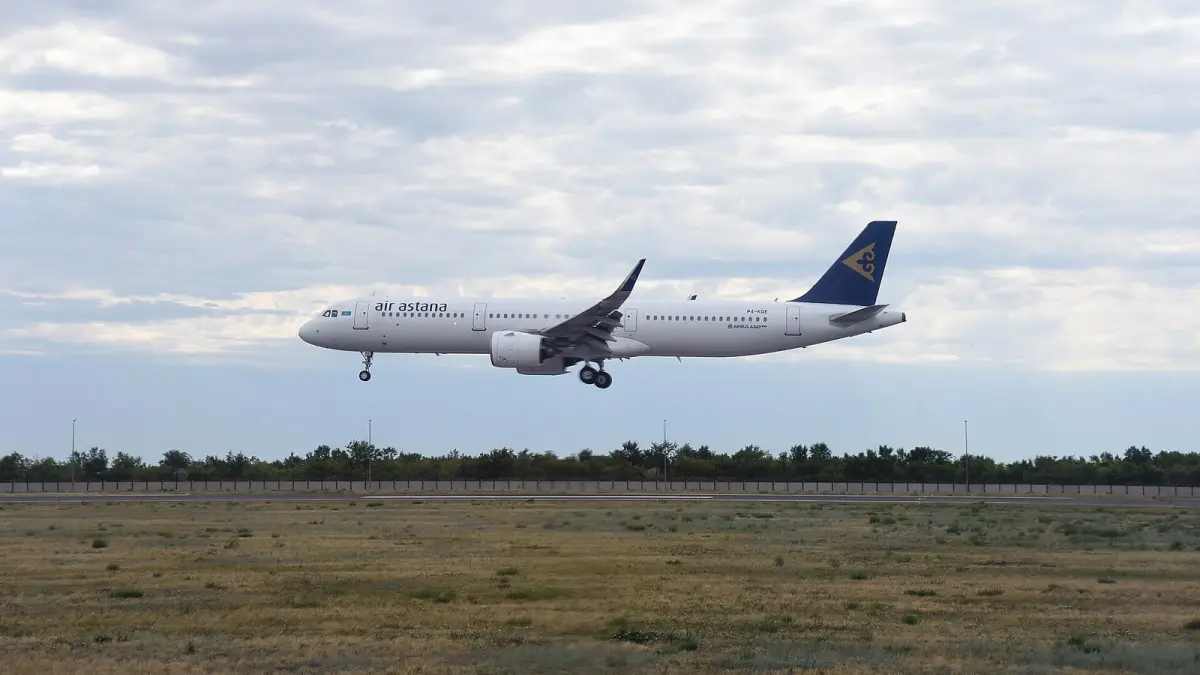
Astana, 23 November. Nursultan Nazarbayev International Airport has proposed raising the fee for parking aircraft at their home base from 72.05 to 1,473.74 tenge per tonne of maximum take-off weight per day from 2027, according to the minutes of a public hearing published by the Civil Aviation Committee.
Air Astana asked for the rate to stay as it is.
The hearing took place in Astana on 9 November and was chaired by the head of tariff regulation at the Civil Aviation Committee of the Ministry of Transport. It concerned the price cap on the basing service for domestic flights: the airport rents parking stands to airlines for which Astana is the home base. The current rate of 72.05 tenge per tonne of maximum take-off weight per day was approved by the former Agency for the Regulation of Natural Monopolies and has applied since 1 December 2006. Under the law on natural monopolies the airport filed an application for five years at once. It is asking for 1,473.74 tenge in 2027, 1,532 tenge in 2028, 1,618 tenge in 2029, 1,717 tenge in 2030 and 1,822.50 tenge in 2031, all excluding VAT.
In twenty years the rate has not moved by a single tenge, and now the airport proposes to catch up in one step.
The airport justified its application by losses. According to its chief tariff specialist A. Temirkhanova, in 2025 the service brought in 22.6 million tenge of revenue against 549 million tenge of costs, a loss of 526 million tenge. Over twenty years the prices of materials and fuel and lubricants have risen, and so have wages. The rate also includes an investment programme for 2027–2031. The airport wants to buy special equipment worth 174 million tenge excluding VAT: a runway friction tester, an asphalt paver, a compressor, a crack-routing machine and mowers. Of that sum, 18 million tenge would come from the basing fee.
Air Astana disagreed with the calculations. The company’s tariff director A. Shaikenova calculated that the average rate including the investment programme would rise from 72.05 to 1,641.44 tenge, an increase of 2,178%. The airport allocated 17% of its airfield costs to parking stands, splitting them by aircraft tonnage. The airline believes that under paragraph 39 of the Tariff Formation Rules costs must first be divided in proportion to area, and that parking stands account for about 4–5% of the airfield pavement. According to Shaikenova, airlines already pay part of these costs in the take-off and landing fee, so the new application means “double payment for the same costs”.
The airline also reminded the hearing of its plans for Astana. According to Air Astana, eight new international routes were opened from the capital in 2026 and seven in 2025, flights now serve 32 international destinations, and the number of weekly international flights has risen by 17% over the year. The number of the group’s aircraft based in Astana rose from 13 in 2024 to 16 in summer 2026, it should reach 19 by the end of the year, and by 2027 the value of aviation assets based in Astana will exceed $2 billion, the group estimates. Shaikenova said that “a tariff increase of more than 2,000% is an extremely negative factor for long-term cooperation and the implementation of joint plans”, and the airline asked for the current rate to be kept.
The airport’s director of economics and budget planning G. Beisembiyeva replied that, as a natural monopoly, the airport keeps separate accounts and allocates costs by volume of services: 80% to take-off and landing, 17% to parking stands and 2% to lighting-standard parking. “We understand that a tariff increase of more than 2,000% looks shocking. At the same time, in money terms the amounts involved are, in our estimate, insignificant,” she said. She attributed the sharp rise to the fact that the rate had not been indexed even to inflation for years, and to the Supreme Audit Chamber’s requirement that the airport break even. The application is being considered by the Civil Aviation Committee.
What it means: The capital’s airport wants airlines to pay their own way for parking their aircraft, a service whose revenue now covers less than a twentieth of its costs. The main payer, Air Astana, disputes above all the method: by its reckoning, three to four times more costs have been assigned to parking than the rules allow.
Who benefits: The airport, which wants to cover a loss of 526 million tenge a year. The airlines whose aircraft are based in Astana will pay, first of all the Air Astana group; FlyArystan also took part in the hearing. The parties did not say at the hearing whether the increase would affect ticket prices.
Background: Both sides noted at the hearing that the state has not regulated the take-off and landing service since 16 March 2026. Parking at the home airfield for domestic flights remained on the list of regulated services approved by an order of the Minister of Transport of 16 March 2026. In its explanatory note the airport also refers to a directive of the Supreme Audit Chamber of 12 March.



