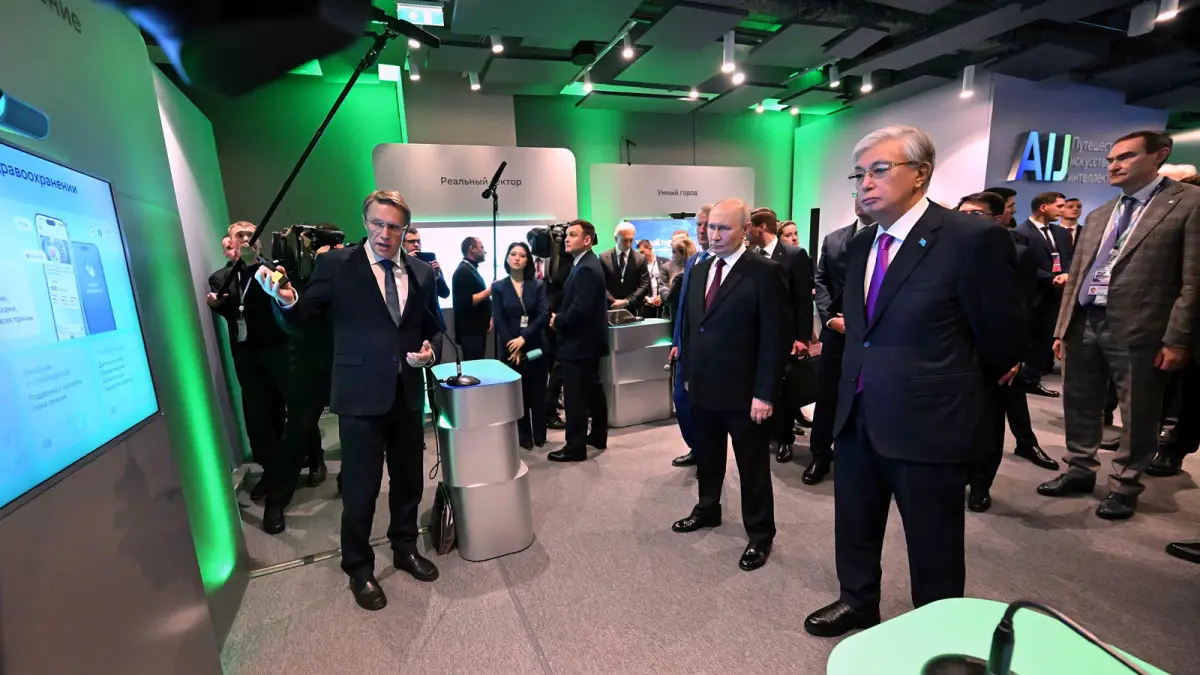
Thursday in Kazakhstan was a day of talk about how to arrange life anew — from the state to the border. President Kassym-Jomart Tokayev said in Moscow that he was convinced technology would become the main focus of the partnership with Russia. In Astana a commission was formed and told to write a plan for reforming public administration. The Kurultai took up border villages, and the Interior Ministry acknowledged that a device to protect people from domestic violence is still only being tested. By night a highway had been closed in two regions because of the weather.
The day in figures
- 21 people
on the Commission on Public Administration Reform - 50 and 25 km
the strips along the border in the bill on border territories - 2,851
electronic bracelets with GPS and GSM in use in the country - about 240 km
the stretch of the Aktobe–Atyrau highway closed since the evening
According to Akorda, the Kurultai, the Interior Ministry and the Ministry of Emergency Situations
- 21 people
Moscow: technology instead of declarations
At the plenary session of the AI Journey conference, Tokayev said he was convinced that cooperation in advanced technology would become the main focus of the Kazakh-Russian partnership. The talk was not about abstractions but about concrete bottlenecks. Computing runs into electricity, which is why Kazakhstan is building the Balkhash nuclear power plant together with Rosatom. Freight runs into paperwork, and in October the two countries ran a pilot shipment with an electronic waybill. Schools need to teach children to judge machines’ ready-made answers critically. Of Kazakh projects, Tokayev named Smart Cargo, AI Jol and the AI Challenge initiative, which is meant to bring enterprises and developers together around production tasks.
Russian President Vladimir Putin, speaking at the same session, proposed updating the National Strategy for the Development of Artificial Intelligence, which runs to 2036, and approving a national action plan. He also recalled the main risk Moscow sees — dependence on other people’s technology: Russia, he said, is betting on sovereign foundation models. Which of these arrangements will turn into signed agreements has not been reported so far. We wrote the day before about the meeting of the two presidents in the Kremlin ahead of the conference, and about the e-government ranking in which Kazakhstan rose to 16th place, in our piece on what the UN actually measured.
Astana: a commission that has to write the plan
Tokayev signed the decree “On Measures to Further Improve the System of Public Administration” and approved the membership of the Commission on Public Administration Reform under the President. It is chaired by Roman Sklyar, head of the Presidential Administration; his deputy is Aset Irgaliyev, adviser to the President and chairman of the Agency for Strategic Planning and Reforms. The Agency will be the working body: it prepares the materials for the meetings.
The commission has 21 members. Besides leaders of the Presidential Administration and the government, it includes the akims of Astana, Almaty and the Akmola and Atyrau regions, four Kurultai deputies and two members of Kazakhstan’s People’s Council (Halyk Kenesi). Its aim is to work out approaches and consider proposals for a Comprehensive Plan for Public Administration Reform; the plan itself does not exist yet and has still to be written. At the other end of the same work is the Expert Group on Strategic Development under the President: according to the agency, it held its first working meeting under the chairmanship of Vice President Yerlan Karin. Irgaliyev presented methodological approaches to a document with long-term guidelines and priorities for the country. So the reform now has two venues: one writes a strategic document, the other a plan for rebuilding administration.
The Kurultai: the border as a territory of development
The Kurultai’s Committee on Regional and Infrastructure Development, chaired by Amirbek Ospanbekov, considered the bill “On the Development of Border Territories.” Its aim, Ospanbekov said, is to create a self-sufficient economy in the border areas where people can work permanently and start their own business. Deputy Yerlan Sayir explained how the bill is built: a legal status and a register; administrative units within 50 km of the border would count as border territories, and remote villages within 25 km would get special support measures. The list of measures is long: from loans, subsidies and guarantees to higher coefficients on the salaries of civil servants in such villages.
Deputies asked about criteria: which villages count as border villages and whether villages where problems have piled up can be added to the list. The report does not say how much money will be needed — and without that the most generous measures remain a wish list. The working group led by Deputy Turarbek Tlemisov will take up the questions next.
The Interior Ministry: a signal that must reach the police
Interior Minister Yerzhan Sadenov, replying to a parliamentary inquiry from the Adilet faction, said that the ministry is conducting technical tests of a device that will automatically alert the police when a person capable of violence comes near the victim. The tests check how it responds when the distance falls to 20 metres and how the signal reaches the police operational control centre. Shymkent and five regions — Akmola, Almaty, Mangystau, Turkistan and Zhetysu — have been chosen for the pilot.
The inquiry was prompted by two cases: in July a 20-year-old woman died of stab wounds in Abai Region, and in September in Astana a former husband killed a mother of two. Deputies pointed to France, where a bracelet keeps people from coming close to each other. Deputy Aizhan Aimaganova noted at the same time that a signal alone will not protect a person: the police need a plan of action. The ministry replied that this is part of the pilot: the signal is registered automatically, the nearest patrol is sent to the scene, and the measures taken are recorded in a digital system. The country already has 2,851 electronic bracelets with GPS and GSM, which are used to monitor people on the preventive register. The report gives no start date for the pilot and no number of devices. In neighbouring Kyrgyzstan, a bill is under discussion in the same days under which the arrest for physical violence in the family would rise from 3–7 to 7–14 days. At the same time, as a lawyer notes in a report by the Kabar agency, what decides the matter is not the severity of the punishment but whether protection orders are enforced.
Roads, weather and sport
From 9 p.m. on 26 November, traffic has been closed to all vehicles on the “Russian border – Aktobe – Kandyagash – Dossor – Atyrau” highway in the Aktobe and Atyrau regions — a stretch of about 240 km. The road is expected to reopen at about 9 a.m. on 27 November, the Ministry of Emergency Situations said. On Friday, according to the ministry’s forecast, Astana will see snow, ground blizzards and ice, with gusts of wind at night and in the morning reaching 23–28 m/s in places. A sharp cold snap is expected in the south of the country. The ministry warned of blizzards in 16 regions the day before.
The Foundation Board of the World Anti-Doping Agency (WADA) met in Astana, the National Olympic Committee reported. Minister of Tourism and Sports Yerbol Myrzabosynov said: “For Kazakhstan, clean sport is above all fairness and equal opportunities. Every athlete must achieve victory through honest work.” In Kontiolahti the first stage of the Biathlon World Cup began: in the men’s individual race Asset Duisenov started with number three; the women’s 15 km individual race takes place on 27 November, and the stage ends on 29 November.
What lies ahead
The first question of the morning is whether the highway in Aktobe Region will reopen by 9 a.m., as planned. The Biathlon World Cup stage in Finland lasts until 29 November. From 27 to 29 November Astana hosts the final of the World Taekwondo Grand Prix series: Kazakhstan is hosting it for the first time, and 128 athletes will compete for medals in eight Olympic weight categories. What Astana and Moscow will sign after the conference, and which of the commissions and bills will reach plenary sessions, the coming weeks will show.



