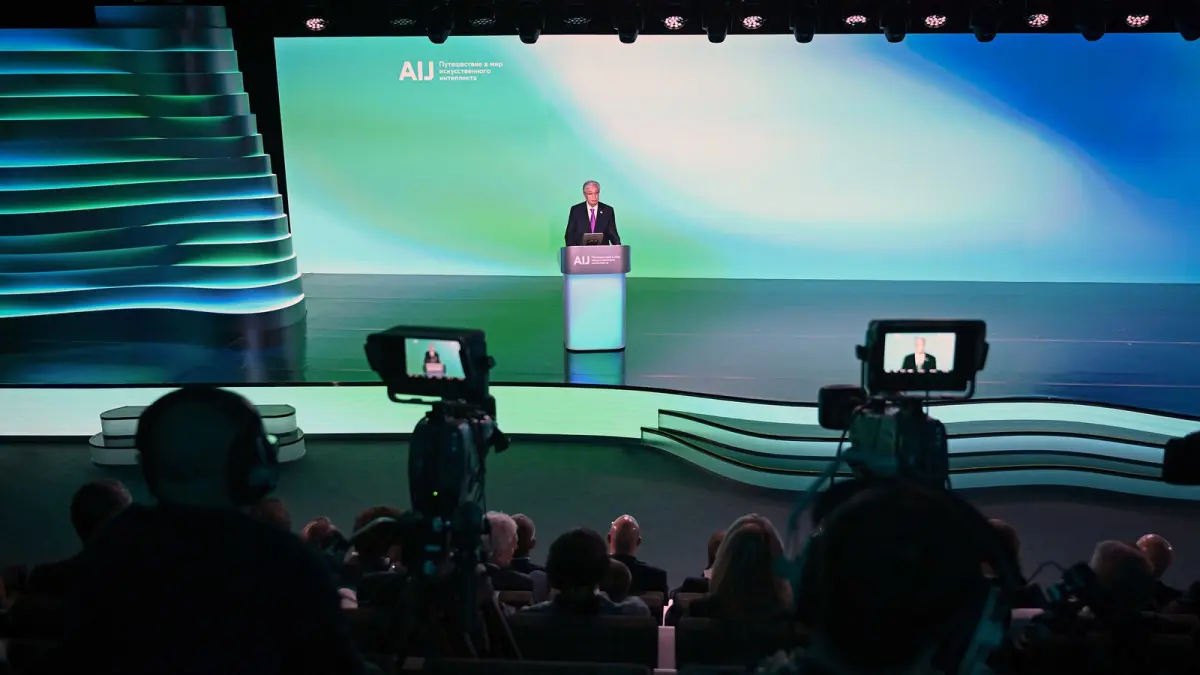
Moscow, 27 November, . President Kassym-Jomart Tokayev of Kazakhstan spoke on 26 November at the plenary session of the AI Journey international artificial intelligence conference and said he was convinced that cooperation in advanced technologies would become the main area of the Kazakh–Russian strategic partnership, Akorda reported.
The speech in figures
- $2.7 trillion
estimate of global AI spending in 2026, according to Tokayev - 88%
of organisations use AI every day, according to the Stanford University study Tokayev cited - 16th place
Kazakhstan in the UN e-government ranking - 950 billion kWh
global data centre consumption by 2030, an IEA forecast as relayed by Tokayev - 9
branches of Russian universities in Kazakhstan
Based on Akorda data and the website of the Russian president
- $2.7 trillion
The conference is organised by Sberbank. Russian President Vladimir Putin and German Gref, chairman of Sberbank’s management board, also spoke at the plenary session.
Sber turns 185 this year; Tokayev, as Putin told it, asked whether it had been called that back then, and was told that in those days there were savings banks.
Artificial intelligence, Tokayev said, has stopped being merely a tool for automating individual processes and has become part of technological infrastructure. He cited estimates that global spending on AI this year could reach about $2.7 trillion, of which more than $1.5 trillion will go to digital infrastructure. In a Stanford University study, 88% of the organisations surveyed said they use AI every day; two years ago the figure was 55%. He also spoke of a “fundamentally new geotechnological map of the world” and warned that attempts to restrict scientific cooperation and to concentrate critical technologies in a narrow circle of players threaten to deepen technological inequality.
Of Kazakhstan, the President said that the current year has been declared the Year of Digitalisation and Artificial Intelligence, the nationwide Digital Qazaqstan strategy has been approved, and the law “On Artificial Intelligence” and the Digital Code have been adopted. More than 90% of public services are available online, and almost two-thirds of citizens — 13 million users — are registered in the eGov Mobile app. In the UN survey published a week earlier, the country ranked 16th for e-government development, up eight places in two years. IT services exports exceeded $1 billion last year; the Astana Hub technology park, he said, has 2,700 start-ups and companies, whose combined revenue since 2019 has reached almost $7 billion. Tokayev named Higgsfield as Kazakhstan’s first “unicorn”: the company, in his words, “raised” $10 billion in a year. The developments of Sber and Yandex, he said, cannot fail to impress unbiased people; both companies are widely present on the Kazakh market, and Yandex, in his words, “is essentially the largest employer in Kazakhstan”.
He then moved on to specific areas of cooperation with Russia. In energy, Tokayev said, the growth of computing is increasing the load on grids: according to the International Energy Agency’s forecast, by 2030 data centres could consume 950 billion kilowatt-hours worldwide, more than twice as much as in 2024. That is why Kazakhstan decided to build several nuclear power plants; the first, Balkhash, is being built together with Russia, with Rosatom in the lead role. In logistics, he recalled the digital projects Smart Cargo and AI Jol, which were shown at the Forum of Interregional Cooperation in Omsk, and a pilot road shipment between the two countries in October with an electronic consignment note. In the future, he said, one could speak of a digital transport corridor. In education, nine branches of Russian universities operate in Kazakhstan, and a school complex “Kazakhstan — Sirius” has been under construction in Astana since May; the same project is under way in Almaty. For schoolchildren and teachers, he proposed preparing joint projects on the benefits of responsible use of AI under the AI Journey Junior education programme.
Separately, Tokayev named risks: AI is used for digital fraud, spreading false information, misuse of personal data and attacks on civilian infrastructure. He recalled the Aqaba Process summit, which was held in Astana on 6 November at the initiative of King Abdullah II of Jordan. The AI Challenge initiative, which he put forward at the recent Digital Bridge forum in Astana, is meant to bring enterprises and developers together to solve production problems; Tokayev hopes this approach will also be in demand in partnership with Russia. At the end of his speech he returned to the outcome of the summit in China: the day before, he said, he had congratulated Putin on the adoption of the declaration of the “Big Three” and called Russia’s recognition in that status “a result of its leader’s work”.
In his speech, Putin proposed updating Russia’s National Strategy for the Development of Artificial Intelligence, which runs to 2036, and approving a National Plan of Action; he instructed the Commission on the Development of AI Technologies to take this on. Possession of the newest AI alone, in his words, no longer guarantees technological superiority: it is necessary to ensure that people and autonomous systems work together and to rebuild management and production processes, the economy and the social sphere around that. Russia, he stressed, is betting on sovereign foundation models; at the conference Sber showed its fourth-generation GigaChat.
Before the plenary session the presidents toured an exhibition: the Kazakh zone was presented in six areas — “Technological Nation”, Startup City, GovTech, Aitu, AI in transport and fintech; the Russian zone showed the use of technology in education, healthcare, urban planning, the judiciary and the oil industry. They then met winners of international AI olympiads — schoolchildren and students from Kazakhstan, Russia and India. Tokayev told them that the task of the older generation is to create conditions for the professional growth of talented young people, and that this task is of national importance.
What it means: Tokayev presented AI as a question of infrastructure and moved the discussion onto practical ground: computing runs up against electricity, shipments need electronic consignment notes and compatible systems, and schools need skills to evaluate ready-made machine answers critically. The political part of the speech was a plea not to allow new dividing lines in science and technology.
Who benefits: Tokayev himself spoke of the benefits: joint initiatives, in his words, should bring tangible results to citizens, companies and enterprises of both countries. Among the partnership’s participants he named Russia’s Sber and Yandex, which are widely present on the Kazakh market, and Rosatom, which is building the Balkhash plant. Neither the Akorda report nor the Russian president’s website says which agreements were signed at the conference.
Background: AI Journey is an annual international AI conference, held since 2016; this year it is hosted by Sber’s head office. We reported on Tokayev’s trip to the conference on 25 November.
We have also reported on how Tokayev and Putin met in the Kremlin ahead of the conference, on the President’s travel plans and on what the UN actually measured.



