Friday turned out to be a day of accounts and keys. A state holding set out how much money it will give the economy next year and by what figures its management will be judged. The tax service set about calculating the tax on citizens’ stock market income itself, and the custodian of the state crypto reserve explained for the first time how access to it works. On the same day Almaty discussed what data artificial intelligence will run on, and Kairat finally took three points in European competition.
The day in figures
- KZT 8 trillion
support for the economy from the Baiterek group in 2027 - 54%
share of non-state sources in the holding’s borrowing - KZT 14.19 billion
oil companies’ five-year cost of methane accounting - 1.76 billion
credit history update events a year at the First Credit Bureau - KZT 3.6 billion
inflows into the accounts of Kyrgyz money mules - 10 of 12
critical metals in Tajikistan’s subsoil
- KZT 8 trillion
Money with a report card
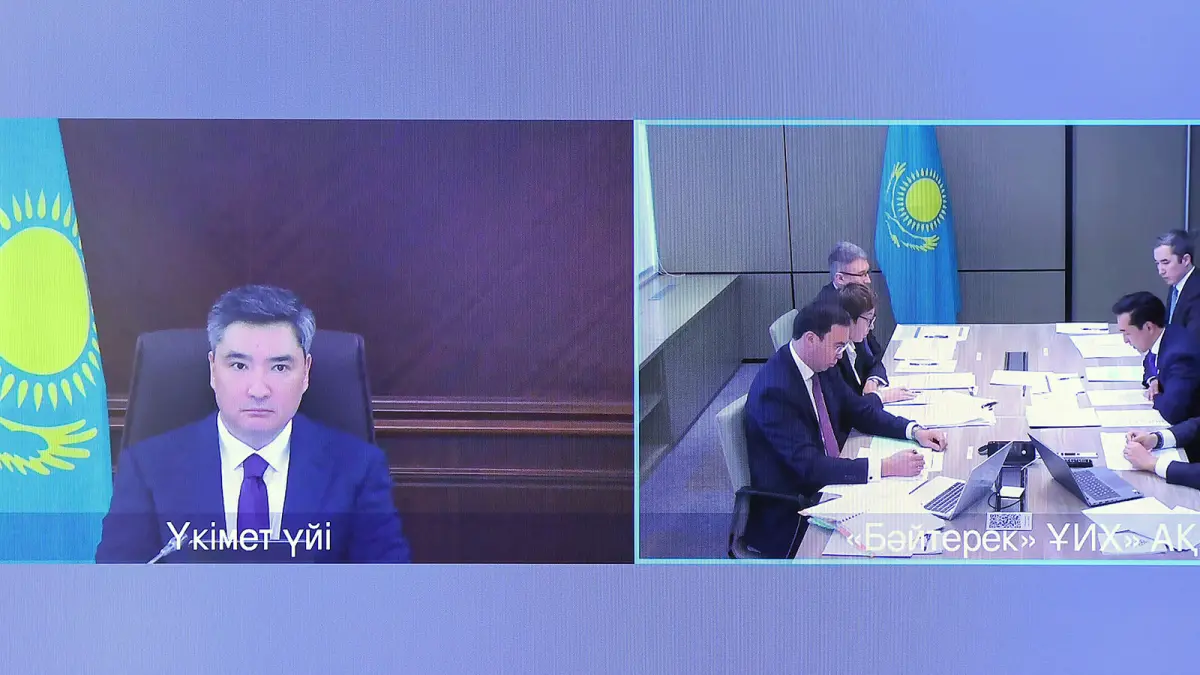
The board of directors of the Baiterek holding, chaired by Prime Minister Olzhas Bektenov, approved the 2027 budget: the holding’s group of companies plans to support the economy to the tune of KZT 8 trillion. Of this, the target for investment in fixed capital in manufacturing, infrastructure and agriculture is KZT 1.17 trillion, and about 2.7 million square metres of housing are expected to be commissioned with the holding’s participation.
Two conditions matter more than the sum. The holding intends to raise more than half of its borrowing, 54%, from non-state sources, that is, on the market rather than from the budget. And Baiterek’s management will now be judged not by the amount of money handed out but by the investment, revenue and exports of the companies it helped. Two days earlier the holding said it had earmarked KZT 4.1 trillion to support bank lending to business, and the day before the Government announced that Kazakh Invest would be moved into the holding and a single front office for investors created. Baiterek is becoming the main window through which the state hands out money and receives investors, and with that comes the question, asked more and more often, of what that money has produced.
The tax service is asking itself the same question from the other side. Finance Minister Madi Takiyev approved the rules of a pilot project for brokers. From 6 to 31 December they will give the State Revenue Committee data on citizens’ securities transactions in 2025 and on their holdings. Using these data, the Stock market Tax View application will calculate the tax on capital gains from securities and fill in part of the 270.00 declaration, which the investor will check in their personal account. The pilot is voluntary and short, but the direction is clear: the declaration will be prepared by the state rather than by the citizen.
Keys, data and other people’s accounts
Ivan Serdyuk, chairman of the board of the Central Securities Depository (KCSD), told BES.media how access to the National Crypto Reserve is protected. Whoever holds the private key controls the cryptocurrency, so to keep the key out of a single person’s hands, operations at the depository are split among several employees who may not even know each other. KCSD keeps the assets, while the National Bank’s National Investment Corporation manages the investments; in November the National Bank said that about USD 190 million of the reserve’s USD 700 million had been invested in hedge funds and exchange-traded funds.
At the CDO ExecLeaders Summit 2026 in Almaty, chief data officers of large companies discussed what data artificial intelligence systems will run on. Presidential Assistant Kuanyshbek Yesekeyev noted that data are now consumed not only by people but also by models and autonomous agents. The First Credit Bureau showed its scale, 1.76 billion credit history update events a year, and KAZ Minerals explained how it built the basis of a data governance system in two months. Artificial intelligence, it turns out, begins with someone tidying up the spreadsheets.
Digital money has a shadow side too. The Almaty region department of the Financial Monitoring Agency sent to court a case over a network of money mules whose accounts handled more than KZT 3.6 billion. According to investigators, three Almaty residents recruited citizens of Kyrgyzstan, opened accounts in their names and used a payment platform to serve online casinos and illegal cryptocurrency exchange, keeping 4% of the inflows. The people were brought in, while the accounts stayed with the organisers, and judging by the agency’s earlier cases, such schemes long ago crossed the borders of a single country.
Oil, methane and the neighbours
The Ministry of Ecology and Natural Resources proposes to oblige oil and gas companies to monitor methane leaks and report on them every year with independent verification, according to ministry documents reviewed by Kursiv.kz. Up to 402 companies could be covered, and the ministry puts the industry’s five-year costs at KZT 14.19 billion. There are two reasons: estimates of the country’s emissions range from 658,000 to 896,000 tonnes a year, and the European Union, the destination for CPC Blend crude, is tightening methane requirements for importers.
Neighbouring Tajikistan was offering investors its subsoil on the same day. Prime Minister Kokhir Rasulzoda said at a mining and metallurgical forum in Dushanbe that the country holds reserves of 10 of the 12 critical metals and that hydropower plants supply 98% of its electricity; Dushanbe wants to keep ore processing at home. Central Asia is competing ever more visibly for the same investors in green raw materials, and each country has its own argument: for Tajikistan it is cheap hydropower.
Thursday evening, meanwhile, belonged to football. Kairat beat Swedish side Mjällby 1-0 in the fourth round of the Conference League phase: Yerkin Tapalov scored, and goalkeeper Temirlan Anarbekov held on to the win at the end. Five points after four rounds do not guarantee a play-off place, but the two December matches, against Universitatea Craiova and Twente, will now be a fight rather than a formality.



