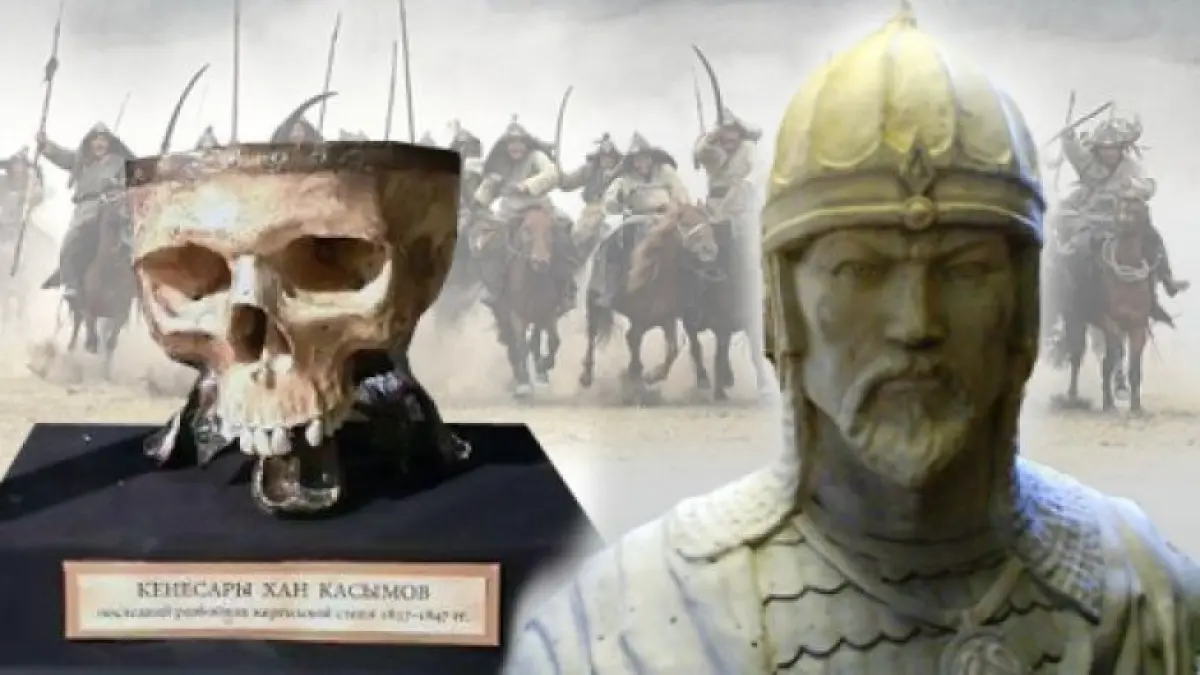
Kazakhstani philosopher Nurlan Amrekulov has reported that Russia's Ministry of Culture supports the idea of returning Khan Kenesary's head, VRK News reports.
“The reply to my Appeal (through the virtual reception) to V. V. Putin concerning Khan Kenesary's head, received from the Ministry of Culture of the Russian Federation (it came on the third day (!) after the appeal of 7.08.2018), showing the readiness of the authorities of the Russian Federation to return his head,” the philosopher wrote on 18 March in his Facebook.
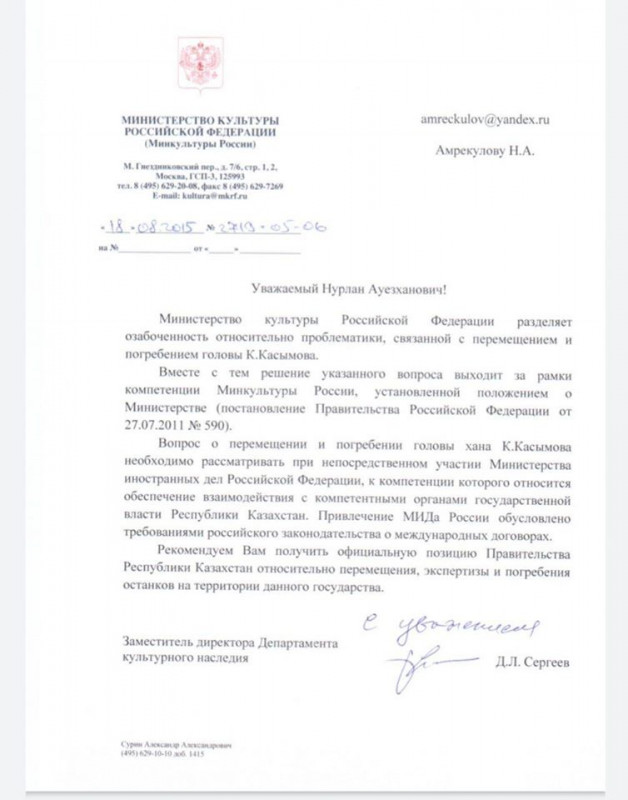
The date on the document is given as 2015. But this does not cancel the historical and nationwide relevance of the question of returning the khan's head to the homeland, to Kazakhstan.
The philosopher has repeatedly raised this subject in his various publications.
“...We will rise spiritually only when we pay due respect to all who laid down their lives for our independence and well-being. And above all to the last Kazakh khan Kenesary, who died for us together with all his kin. Can we expect his blessing (bata) if his desecrated remains have lain for 162 years without commemoration, who knows where, and his skull gathers dust in a foreign land? Can he forgive and bless the Kazakhs if not all the tribes supported him in the unequal heroic struggle for our Kazakh freedom? And has the fearless wolf spirit, the sun of our steppe statehood, not gone out with him?
Do we, after all this, have the right to prosper?
The desperate struggle of the Kazakh great martyr Kene, who consciously chose death over shameful slavery, is the highest example of courage and patriotism, an eternal inspiring example for us and all future generations of Kazakhs. Our sacred duty to him, to all ancestors and descendants is to return his desecrated head to the homeland and find his body (according to the historian Ye. Valikhanov, the clairvoyant healer Ak ana and others, it lies near the border with the Kyrgyz Republic). And on behalf of every Kazakh and every Kazakh clan (and better still on behalf of the whole Kyrgyz people), having made the appropriate sacrifices, to ask the spirit (aruak) for forgiveness in silence. Only by returning to the past, when the Kazakh people wavered and recoiled, abandoned their chosen “natural khan” and doomed him and 19 Chingizid sultans to humiliation, agonising execution and death, will we and every Kazakh clan atone for our guilt, be cleansed of shame and stand upright, be healed of the heavy trauma then inflicted on our national dignity and honour,” he writes in one of these articles.
It is worth noting that Nurlan Amrekulov, candidate of philosophical sciences, belongs to a narrow circle of Kazakh thinkers who realise that the process of globalisation is natural-historical. “The Manifesto of the Free Steppe” and many other works by Nurlan Amrekulov are a real contribution to the culture of the civilisation of neo-nomads. It is also worth noting that it was Amrekulov, together with the now deceased Nurbolat Masanov, whom a political science encyclopaedia once classed as forerunners and first founders of domestic political science.
A question unresolved for decades
Recall that the question of returning Khan Kenesary's remains to Kazakhstan has been raised many times. The archive of the State Historical Museum of Russia holds the 1950 resolution of the USSR Council of Ministers “On the Distribution of the USSR Museum Fund and Exhibits Reserved in Wartime”. Item 194 of the list of valuables attached to the document reads: “Head of the Kazakh khan Kene(sary) Kasymov, stored 1845(47), laboratory exhibit, SMF KNIO USSR”.
Kazakhstan, while still a Union republic, tried more than once to bring the head back to the homeland: in 1978, 1982, 1985, 1989 and repeatedly in the years of independence. The then prime minister of the republic Imangali Tasmagambetov made a similar request to the Russian leadership. No reply was ever received then.
For his part, the prominent Kazakhstani historian, participant in the first scientific historical-archaeological expedition of the National Academy of Sciences of Kazakhstan to search for Kenesary's remains in Kyrgyzstan, Doctor of Historical Sciences Zhaken Taimagambetov is sure that without state help it will be hard to bring the khan's head back from Russia to the homeland:
“According to my information, it lay in the archive of the Kunstkamera but was never exhibited. It seems to me that the Russians will not be against returning it to us. The khan's body must be committed to the earth. I think his burial place will become a place of pilgrimage…”.
Whoever wishes to know more about what uprising Kenesary Kasymov raised and what kind of historical figure he was can read this brilliant article by the well-known Kazakhstani sinologist and political analyst Adil Kaukenov.
But we will tell you how the khan nevertheless died and why the Kyrgyz executed him so cruelly.
Why and how the Kyrgyz executed Khan Kenesary
The Kyrgyz were the only one of the Central Asian peoples who never recognised the power of the Chingizids over them but were governed by their own rulers, who, though they did not bear such resounding titles, were their own. This tradition goes back to the 12th century, when the Mongols conquered them and then suppressed several Kyrgyz uprisings. So Kenesary's authority as a Chingizid did not help here either.
In addition, the Kyrgyz remembered the devastating raids on their lands by Kenesary's grandfather Khan Ablai and could not forgive this, still less humble themselves by recognising a descendant of Ablai as their khan. And they did not submit to Kenesary. In April 1847 Kenesary, with a 10,000-strong army, invaded the Kyrgyz lands, but the Kyrgyz manaps united against Kenesary.
The old Kyrgyz feuds were temporarily forgotten. The united detachments of the Sarybagysh, Solto and Bugu defeated the attackers. By his cruelty Kenesary alienated even his own associates. Kenesary's last battle with the Kyrgyz took place in the upper reaches of the Chu, near Tokmak, in the Almaly valley, against the united forces of the northern Kyrgyz manaps. The batyrs of the Senior Zhuz Toishybek, Suranshy and Saurik, having joined Kenesary's army with their detachments, took part in dozens of battles. However, Sultan Rustem and biy Sypatai secretly left the khan's headquarters at night with 12 thousand warriors. They did not simply leave but informed the Kyrgyz manaps. This was partly explained by their disagreement with the khan's actions, “unlawful” by the laws of the steppe, of which more below.
Before the battle the khan's associates suggested that he break out of the encirclement with a small light group, to which he replied: “If I myself, leading the army, take flight, I will no longer be able to be the khan of the people.” Kenesary stayed with his loyal warriors, was taken prisoner and died together with 32 Kazakh sultans.
Something is known about the circumstances of Kenesary's death. Immediately after capture the Kazakh sultans, together with their khan, ended up in one of the headquarters of Ormon Khan. Then Kene, still alive, was handed over to manap Zhantai. It is documented that for several days he was kept shackled in chains. It is also known that the high-born prisoner was dragged in an iron cage around the auls and subjected to inhuman torments. Many researchers confirm this. When the men's imagination for tortures and insults was exhausted, the prisoner was handed over to old women to mock.
First the ordinary sultans were executed, who were “boiled alive in a cauldron”. As said above, Kenesary ended up at the headquarters of Ormon Khan (leader of the Sary Bagysh clan), known for his harsh temper. His hatred of the Kazakh khan was such that he asked other clan leaders to behead Kenesary without arranging a meeting with him. There is an explanation for this — according to Kyrgyz data Kenesary was pathologically cruel to enemies and, above all, violated the ancient law by which envoys were inviolable. And for the tortured envoys and those killed on his orders during the raid he had to answer.
According to Kyrgyz historians, Kenesary's execution took place in the aul of Zhamby. By one version the executioner was Kalygul Alibekov, by another Taisara, brother of Ormonbek and Sultanbek, who fell in battle with the khan's detachments, by a third Kozhobek Tashtambekov. Archival sources name biy Chizhim.
The description of the execution according to Kazakh legends is as follows: “Kenisara was the first to be led out to execution. He looked then at the assembled people, at the distant mountains, at the high sky from which only the gentle rays of the cheerful sun poured — he looked around him and began to sing a song.
His song lasted long amid the assembled crowd, which listened long to its words, with neither strength nor wish to tear itself away from those commanding words that sank into the soul of everyone who heard them. And in his song he recalled his whole life in the native, free steppes, in the circle of his native aul, recalled his glorious deeds of daring, his robber raids and plunder, recalled the victims who were tortured, or the torments he devised for them, and his heart grew sad, conscience spoke in him and began to torment him, and before the assembled crowd he told of his sins, urging all who stood before him not to anger the Great kudai (god) as he had angered him, lest they earn for their sins the same heavy punishment that had now overtaken him. He finished his song.
The executioner set to work. With a practised hand, with a long knife, in one sweep of the arm he ripped open Kenesary's belly. The entrails fell out, and Kenesary fell dead, having breathed his last. The enemies took his corpse and mocked it for a long time. Then, ripping open his chest, they took out his heart and drew back from it with reverence. Kenesary's heart was covered with thick hair, and such a heart is found only in brave men.”
There is also another legend: “Before consigning him to a painful death, the Kyrgyz for forty nights laid the best beautiful girls with him in the hope of obtaining from him in this way descendants not inferior in wild courage to their worst enemy, the hero Kenesary Kasymov. Kenesary supposedly did not wish to have relations with any of the girls…”. But the Kyrgyz refute it, although in general such a thing is quite in the customs of the steppe.
Sultan Kambar Aslanov was the first to report to centurion Nyukhalov the “complete” defeat of Kenesary and attested that “this news of mine is true”. It was written by him in his own hand with the tamga attached. Some had “their hands cut off first and were killed afterwards”.
The “brutal murder” of captive Kazakhs by the “predatory people — the wild stony Kirghiz” was in its time also written about by Shokan (Chokan) Valikhanov (Ualikhanov), who can hardly be suspected of any sympathy for Kenesary, although, as a great-grandson of Abylai, he was related not only to Khan Kene but to many other sultans who ended their lives on the scaffold in the Tian Shan mountains. Still, it is worth repeating that it was precisely Valikhanov who was among the first to describe Kenesary as a “rebel running riot in the steppe”.
“By the will of almighty God and by order of the white tsar… your enemy Kenisara is dead…”. This excerpt from Aslanov's letter was the first notification to the Russian authorities. “The Kenisarians have broken up and scattered in all directions, each wherever he could,” the sultan wrote.
Time to gather spiritual strength
Although the Kazakhs carefully concealed the fact of Kenesary's death, soon the whole steppe was talking about it. About five days later the khan's son Zhapar galloped to the Kara Kamau tract with a small number of men and, confirming the news of the defeat, ordered the people to migrate at once to the Chu river and from there move to the Talas valley. Evidently Zhapar still did not believe in the death of his father, brothers and their sarbazes. For another month his small detachment stood awaiting the latest news. Receiving none, he moved at a quick pace towards the Karatau mountains beyond the Chu river.
The West Siberian governor-general Pyotr Gorchakov rewarded all the Kyrgyz manaps who distinguished themselves in the battle, and addressed a letter of thanks to Kenesary's killer, manap Kaligul Alibekov, and awarded him a silver medal.
The heads of the Kazakh warriors who fell in battle were sent as a gift to the khan of Kokand, and the head of Kenesary himself was sent as a gift to the Russian tsar in St Petersburg.
Perhaps just now — in a period when the fire of the world coronavirus pandemic is spreading — is the very time to raise again the question of returning Khan Kenesary's head to the homeland, but this time at the highest official level?
No one has cancelled the mystical prophecy.
Note: the head shown in the photograph is merely a dummy made by director Satybaldy Narymbetov for filming the film “Amanat” about Khan Kenesary.


