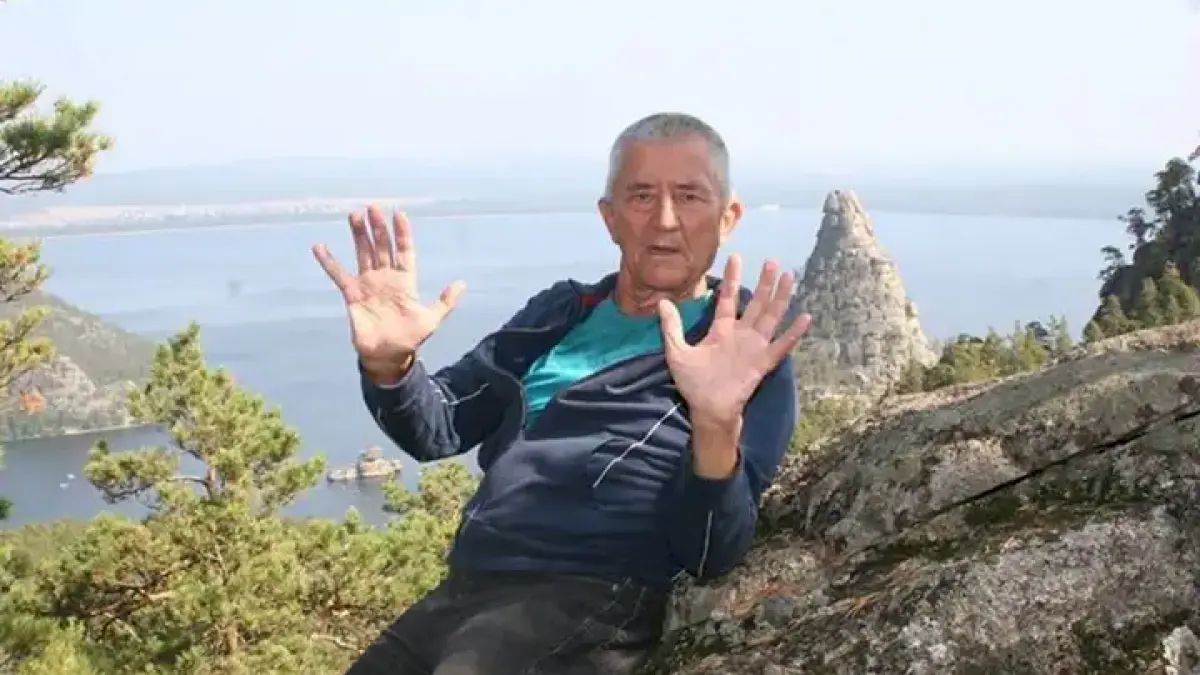
On 25 December Kazakhstan celebrates Psychologist's Day. This day was chosen as a professional holiday in honour of the opening of the first laboratory by Wundt (in 1879 Wundt founded the first laboratory of experimental psychology). That decision was taken at a meeting of the Association of Psychologists of Kazakhstan. Meanwhile, the VRK News agency presents to your attention an essay about a contemporary master of psychology, Mars Galeyevich Subkhankulov of Kokshetau, of whom practically every Kazakhstani psychotherapist has heard. And what he is doing in his 81st year could be called rather multicultural Zen and a feat of being-for-others.
***
I first made his acquaintance in absentia. It was simply that in December 1994, in the offices of the regional weekly newspaper “Okzhetpes-Express”, talk happened, quite by chance, to turn to a strange professor of psychology... Natasha, one of the correspondents, recalled with great pleasure how, crawling out of a tourist tent at dawn, her little daughter discovered with amazement a full glass of wild strawberries that one of their fellow hikers had set right in front of the entrance... Of course, it was Mars, generous with surprises, who had taken the trouble. Meanwhile new details of student life came pouring out of Natasha... She remembered how the eccentric “prof” behaved still more strangely in class: while the students were taking their seats in the lecture hall, the lecturer himself, in a well-worn little sweater, might quite easily be lying on one of the desks somewhere at the back, calmly waiting for the bell to ring... I did not wait for further details but got the phone number of the local landmark and called at once...
The door was opened for me by a closely cropped, slightly built man a little below average height in home sweatpants.
“Ah... well, come in, come in...” said the owner of the spacious four-room flat in a rapid patter, amiably offering me a pair of slippers.
What struck me at once was a staggering conglomerate of unusual things and trinkets in which this little flat seemed to have drowned once and for all. First to astonish me, and to lodge in my memory, was the “ship's wheel”. More exactly, it was an enormous, genuine spoked wheel from an arba cart, standing right in the hallway, a kind of attention-gripping and inexplicably acquired captain's element of the nomadic way of life. It plunged everyone who entered at once either into the boundless steppe distance or into ocean surf, and performed a sort of involuntary initiation into a special world — a world of soul seaweed, wormwood scents, cosmic adventures and the fiery, sparkling merriment of the spirit.
What did we talk about that first day? Mars Galeyevich treated me to his favourite home-made sea buckthorn butter and said that it was unseemly to forget the great traditions of the aksakals. Several times over, evidently trying to give special emphasis, the master of the psyche spoke of a much more adequate name for the Yasnaya Polyana in Borovoye, which the old Kazakhs called, very strictly, “Oi alany” — “Glade of illumination and reflection”. Displeased that it had been renamed “Abylai Khan's Glade”, the vice-president of the Society of Psychologists of Kazakhstan stressed that this created a danger of forgetting the original name and, with it, the purpose of this glade as a genuine place of spiritual power. It turns out that it was here from time immemorial, long before the Dzungar invasion, that the elders of the Kazakh clans gathered to discuss pressing and strategic affairs. It was here that our ancestors came to resolve the most difficult, fateful questions of life. They say that if a person spends the night in this glade, he wakes up next morning with a clear understanding of what he needs to do. Even in Soviet years, organising republican psychology olympiads, Mars brought students here; surely dressed, as now, in his customary little hat with a pompom, he seated them in a circle and called on them to tap out with the heart the life-giving energy of “holy presence”.
It is worth saying that the founder of Soviet Buddhology and Oriental studies, Fyodor Shcherbatskoy (1866–1942), found his last refuge in “Borovoye”. A Polish aristocrat by origin, Fyodor Ippolitovich made a number of journeys to India and Tibet, and had direct dealings and friendship with the Dalai Lama XII. The Buddhists themselves revered him as a guru. In 1937 Shcherbatskoy's scholarly school was crushed and subjected to repression, and he himself, despite his scholarly and organisational services to the Soviet authorities, became the target of an ideological campaign against idealism in Oriental studies. With the start of the war, in 1941, he was evacuated together with a number of surviving scholars (among them such a celebrity as Vladimir Vernadsky, who formed the modern concept of the “noosphere”) to Northern Kazakhstan, where he ended his life on 18 March 1942 in the settlement of Borovoye. Mars's father was in those days a senior trade official and also suffered not a little in Stalin's time of troubles, so one of his children, it seems, was drawn to psychology.
...Sitting in the Eastern manner, from the very first day of our meeting Mars and I never tired of sharing impressions of Castaneda's books, and it was a revelation to me to hear that he had devoured these books in samizdat as early as the beginning of the 1970s. And I, naive man, had thought they appeared in the Union only in the 1980s! Between us there was a quick exchange of confirming information about the books we had read, whose titles and authors sounded for us, and still sound, like a coveted password, like some invisible mark of Cain on the forehead, described long ago by Hermann Hesse in “Demian”. (Oh, forgive me, Mars Galeyevich, of course the right way to say it is “Khesse” — one must certainly pronounce the first sound softly, as the Germans themselves do.) I remember his thoughtful response to Daniil Andreyev and his “Rose of the World”, which the Subkhankulovs read aloud as a whole family. And that ontological rogue, the truly incomparable Osho, whose books I later thumbed to tatters in Mars's magnificent library! Adolf Harash, Ikkyu Sojun, Georgy Gurdjieff, Nikolai Abaev, John Lilly, Ram Dass and the “dog” Avessalom Podvodny with his marvellous “Tale of the Subtle Seven”. How many more authors and contemporaries, neighbours and passers-by, colleagues and friends one could list and list, and whom this wise man helped me to understand more finely and more deeply!
It seems that the very next day I attended his lecture at one of Kokshetau's colleges. I was enchanted by his manner of lightly strolling from one aisle between the desks to another. The supple, nimble figure of the former master of sports gymnastics held the attention of practically all the youths and maidens, who listened, now with giggles, now in piercing silence, to his “birdlike” speech, here and there breaking off and ending in a little tenor intonation that drove one into conceptual ecstasy: “Aha, aha...”
Even now, past seventy, he remains springy and elastic, deft and quick to rise. And never mind that the fingers of his hands are eaten away, disfigured by solvents and oil paint — for more than one decade Mars was carried away by abstract painting, experimenting with various techniques of applying a drawing, making fun as best he could of his own masterpieces, which the wider public has only recently begun to see at his as yet rare vernissages — but then a web of endless lacy colour-thoughts has been born and now lives its own life, its passionate lines severely and tenderly palpating, invisibly refining and softening the texture of the viewer's consciousness. Like a web swayed by the wind, too, is his favourite and invariable word at the ritual parting: “Well, then? Ladushki?!” (something like “okey-dokey”). It reflects as truly as can be, despite all the outward vicissitudes of life, the inner harmony (lad) of Martian being, the organic coherence of fate, deeds and thoughts.
Thanks to Mars I became a journalist in the esoteric sense of the word; he whetted my appetite both for unusual, non-standard, other people and for the most ordinary of the ordinary. Yielding to his reckless provocations, your humble servant got himself into the adventure and took part in courses for school psychologists. At the unique Martian psychotrainings that accompanied the courses I bathed in the luxury of regained social adequacy — for the first time since the army-and-perestroika shock. Along the way I gave away almost my entire personal library to the freshly baked psychologists, crawling under the desks at the final session with mad mewing and tenderness. I do not know what came over me, but it was agonisingly painful to part with the grown-up and not-so-grown-up women teachers, whose happy eyes were left burning in my pupils as a symbol of an exceptionally benevolent creative flame.
It must be stressed that it was Mars who was one of the first in the Union, back in the first half of the 1970s, to begin conducting the now-fashionable psychotrainings. And what happened at the psychotrainings that he conducted both among students and officials and among people of the most varied age, character and profession I would describe as a powerful and at the same time delicately steered, precisely dosed launch into spaces known to everyone which, unexpectedly for the group, turned out to be utterly unknown. At the same time, under very sensitive control, people touched the zone of the scorching and sometimes quite ferocious unknowable. A well-disguised meeting of pupils with a genuine Teacher took place...
Now, with some detachment, I state that Mars then became for me and for many of his followers and friends a veritable super-narcotic. A kind of lively catalyst provoking powerful spiritually centring storms and whirlwinds in the people and circumstances accompanying his appearance and presence. Mars refused to be my Teacher (all the same, I consider him one), but he did confess that he had looked into the ultimate depths of the unconscious, where he met... But no, there is no point in spreading out about this intimate experience; what he said some ten years ago appeared to me recently in quite a different light, and it is so easy to distort anything inadvertently...
If you want to know a man, know his friends. I remember Konstantin Ganin — a quiet natural talent, a divinely gifted artist who assisted as artist-partner at Mars's trainings. I remember he drew an expressive portrait of my essence, which, in Mars's caustic phrase, “ploughs the earth with its nose”. I had to laugh nervously at myself and, in turn, to smirk sado-masochistically at the no less colourful portraits of the essences of my fellow trainees. Ganin's drawings gently complemented his partner's temperamental nature.
Speaking of his mentors, Mars Galeyevich often recalled his outstanding teacher, a founder of Soviet psychological thought, Wolf Merlin of Tatar-Bashkiria, whose main idea was freedom — complete, total freedom (not only existential but bodily, organismic). On LiveJournal there is an autobiographical note about Wolf Solomonovich by his son, Valery Merlin, who at Mars's invitation lived and worked for a time at the Kokchetav pedagogical institute after his father's death in 1982.
But back to the subject. My maximalist orientation at the time towards literature of an esoteric bent and alchemical “projects” made itself felt when I left the newspaper of my own accord. By then my wife had gone with our little son to Almaty to write and defend her diploma thesis, and I, the parasite, quite egotistically allowed myself to doubt the entirely just criticism of the editor-in-chief, who had called me to reason over an excessively daring piece that had slipped through in his absence thanks to the executive secretary's excessively benevolent attitude towards me. And so I was left without work, and therefore without means of subsistence....
And again, of course, Mars helped. Passing a bus stop, he noticed me and at once showed interest in my vile mood. The way out he found was brilliantly wild: he offered me, who had never finished any literary courses and had no traditional humanities education — a teaching vacancy! Well, he's mad, what can you expect of him! I had to agree; nothing else was given. So for two years I taught a course in “esoteric literature” and “religious studies” to psychology students and was parked at the psychology department of one of the higher education institutions of what was then Kokshetau. It was the time of my most concentrated sadhana, of apprenticeship. I took as a basis the works of Salinger, Rozanov, Kawabata, haiku, the texts of Mikhail Bulgakov and other writers and poets I loved, and tried, sometimes in somewhat eccentric forms, to convey to the students the deep metaphysical mood that I myself felt in these masterpieces. I relied largely on intuition, improvising mercilessly at lectures and practical classes, but I also felt immense happiness when, together with my pupils, in the middle or at the end of a class, I suddenly entered this state of holy trepidation and spinal goosebumps. The lads felt it, and even if they had never read the recommended books they touched the inside, the figures of sparklingly dancing texts. I am happy that I managed, to some extent at least, to play the role of conductor of these burning touches — perhaps not a very pure one, but a sincere one. Naturally, it was not without Mars's encouraging support, which helped me approach teaching not only creatively but also quite systematically.
After two years I nevertheless had to leave the teaching “cross” owing to financial difficulties in the family. I tried myself, opportunistically, as a far better-paid security guard, but then a new capital appeared on the republic's map, and life washed me back onto the shore of the journalistic path.
Years of separation from Mars flew by, and then, during one quite chance meeting on a street in Astana, I suddenly learn that Mars Subkhankulov is also a photo artist and that photography is his new passion. It turned out that the professor of Kokshetau Humanities and Economics University, who is still also vice-president of the Society of Psychologists of Kazakhstan and an honorary member of the International Association of Training Psychologists (New York, Brooklyn), in the 1970s–80s a member of the central council of the USSR Society of Psychologists, is to this day active creatively, serving as scientific director of the art-therapy creative centre “Ocean-Art” in Astana. With love and his characteristic self-irony he showed me his album, in which I saw photographs striking in their delicate balance of microworlds, but the meeting went, so to speak, in a sliding rhythm, and I was then, regrettably, far from in my best creative form. And only when the capital's gallery “Has Sanat”, with the assistance of the art-therapy centre “Ocean-Art”, opened in November 2005, in the respectable InterContinental hotel, the exhibition “Reflection” did I understand that Mars continues to be a mystery to me. The heroes of the exhibition were two exceptionally talented authors — the father and daughter Subkhankulov. Visitors to the vernissage were involuntarily infected by the provocative spirit of this exceptionally hard-working and world-responsible Kazakh-Bashkir-Tatar, a rattlesnake psychic mixture of the Mexican Toltec don Juan, the manically impressionable American Austrian Frederick Perls, the cunning Hodja Nasreddin and the solidly elegant lama Chögyam Trungpa.
“Natural Emergences”, as Mars nicknamed his photographs, is an invisible mystery, divined by a person on some sensory borderland on condition of utmost psychic openness. For it is precisely inner nakedness, a meditatively background sensitivity to the landscape of life, that allows the body's sensory systems to freeze in surprise and, at a precisely determined instant, click the shutter of a mighty “Zenit”. To flick the microworld, politely, on the nose at the moment when a tiny and so inconspicuous droplet suddenly blossoms into an astonishing bud of harmony! When from simple glints of puddles and the grainy roughness of stones marvellous landscapes arise, perhaps surpassing even the groves of paradise in beauty and able to rivet the gaze so that you walk away from a photograph radiating majestic spiritual subjects only with incredible effort, muttering to yourself some twenty times that “I must urgently write the piece”. And what happens to the chance refined viewer of these photographs? He feels wildly, a full hundred and eighty degrees, like turning away from this harmony, so striking is it... But it is better to see his works yourself, to listen to the melodies of spiritual intonations, the poetic photo-provocations, and, thanks to them, to look into the nomadic depth and essence of your own world — fragile, strange, mirror-wise unexpected...
Mars Galeyevich's daughter Yevgenia, an artist and trainer in hatha yoga and qigong, now lives in the Moscow region, and her works are in private collections in Russia, Germany, Hungary, Israel and Canada. She often visits her father, takes part in his trainings, and also holds independent classes. One of her paintings, presented at the exhibition, depicted her father — more exactly, not even Mars but his Martianness, the very one that at parting...
You know, add one more remarkable touch here. Once I happened to let slip that today, it seems, was the birthday of one of the world's respected enlightened ones, and Mars reacted instantly:
— What is some Lilly to me when it is my daughter's birthday? — A lashing blow of meaning worthy of a Zen master sobered my face in the blink of an eye, returning me to the land of native values. That is Mars all over — a Kazakhstani devotee of the psyche, painting and photography by the grace of God.
VRK News background. Mars Galeyevich Subkhankulov has lived and worked in Kokshetau for more than half a century since graduating from the faculty of Russian language, logic and psychology of Kazan University. He is a teacher to hundreds of followers, a professor of Kokshetau University, vice-president of the Society of Psychologists of Kazakhstan, a member of the Central Council of the USSR Society of Psychologists in the 1970s–80s, and an honorary member of the International Association of Training Psychologists (New York, Brooklyn). The future professor defended his candidate's dissertation, on the features of the psychophysiological resources of man, at Leningrad University under the supervision of Doctor of Psychology Wolf Merlin, who later became the person closest to him in Spirit. Every Kazakhstani psychotherapist has heard of the contemporary master of psychology Mars Galeyevich; his unique method of recognising the inexhaustible possibilities of the human psyche is used successfully not only in our country but also in Germany and in Russia, where there are friends and followers, and each is a little bit of a Martian at heart... To this day Mars Galeyevich actively conducts trainings in various organisations and institutions of Kazakhstan, including in Astana jointly with the personal development centre “Kasiyet”.
Beibit Sakhanov, Astana, 2007–2016


