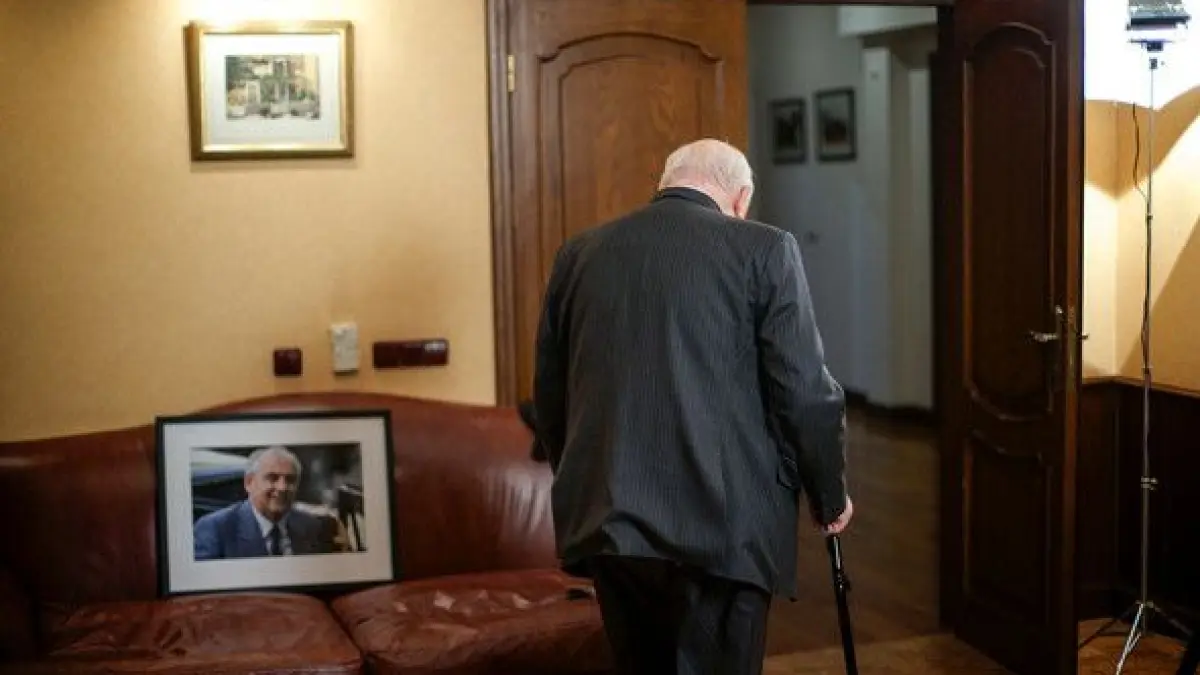
Mikhail Gorbachev, the last president of the USSR, has died in his 92nd year after a prolonged illness. One may feel differently about him, but with him an era has gone.
Mikhail Sergeyevich Gorbachev was a Soviet and Russian statesman, political, party and public figure. The last General Secretary of the CPSU Central Committee. The last Chairman of the Presidium of the Supreme Soviet of the USSR, then the first chairman of the Supreme Soviet of the USSR. The only president of the USSR in history. Below we give the text of RBC, which quite neutrally describes the Gorbachev era.
Gorbachev took the general secretary's chair in 1985 after the death of his predecessor Konstantin Chernenko. “At five o'clock the plenum began, and I at once felt an atmosphere of complete support, made even firmer by the speech of Gromyko (Andrei Gromyko, head of the USSR Foreign Ministry), who on the instruction of the Politburo proposed my candidacy for the post of general secretary of the Central Committee,” Gorbachev described the vote. For a leader of the USSR he was quite young — 54. In addition, citizens were impressed by his manner of speaking without a prepared text, “without a piece of paper”.
Having taken the post of general secretary, Gorbachev announced the start of perestroika — a new political and economic course meaning a departure from the totalitarian system. One of the symbols of those years was glasnost, aimed at greater openness of the state and society. Even before the resolution “On Glasnost” was signed, foreign radio stations stopped being jammed in the country. In 1986 Academician Andrei Sakharov was returned from exile (the scientist and dissident had been sent without trial to the city of Gorky (now Nizhny Novgorod) in 1980).
In 1990 the Press Law abolished state censorship.
Gorbachev actively held meetings with Western leaders. As a result of talks with US President George H. W. Bush in 1989 the Cold War was effectively brought to an end. Gorbachev declared that the USSR was prepared no longer to regard the United States of America as a military adversary, which was followed by a similar statement from the White House. Shortly before the meeting of the US and USSR leaders the Berlin Wall fell (the physical border between the FRG and the GDR had been built between West and East Berlin in 1961, was breached after the easing of the regime for visiting the FRG and was finally demolished in 1990). “Having met President Bush in Malta a month after the fall of the wall, we also agreed on mutual conduct on the German question. And — which is symbolic in this connection — we announced the official end of the Cold War,” Gorbachev recalled. Of the wall itself he said: “It was an artificial formation, the direct child of the Cold War — the most tragic mistake that the nations that had defeated fascism allowed to happen after such a war.”
Also in 1988 Gorbachev began the withdrawal of Soviet troops from Afghanistan (the war there had lasted since 1979).
Gorbachev was criticised for measures taken in the economy. The ambiguous policy of fighting drunkenness also caused discontent among citizens. “Drinking brought many to ruin in those years. They drank everywhere. <…> They flooded the Central Committee and the government with indignant letters: ‘do at least something’. Even Leonid Ilyich, who himself liked a drink, gave instructions to find a way to save society from universal drunkenness,” Gorbachev later recalled. He also explained that the “dry law” was carried out not as intended: “We were going to introduce measures: regulate prices and the range — everyone drank only vodka, while there were almost no dry wines or even beer… Yegor Kuzmich (Ligachev, secretary of the CPSU Central Committee) and Mikhail Sergeyevich Solomentsev (a member of the Politburo) were responsible for fulfilling the plan. They botched it! It was a matter of replacing wine varieties [of grape] with table ones. And they turned everything inside out and took it to absurdity. I did not give the go-ahead to cut down the vineyards!”
In 1990 Gorbachev declared the need to abolish the provision of the Constitution on the leading role of the CPSU and to introduce the post of president in the country. Later, at the congress of people's deputies, he was elected president of the USSR — he became the first and only person to hold that post.
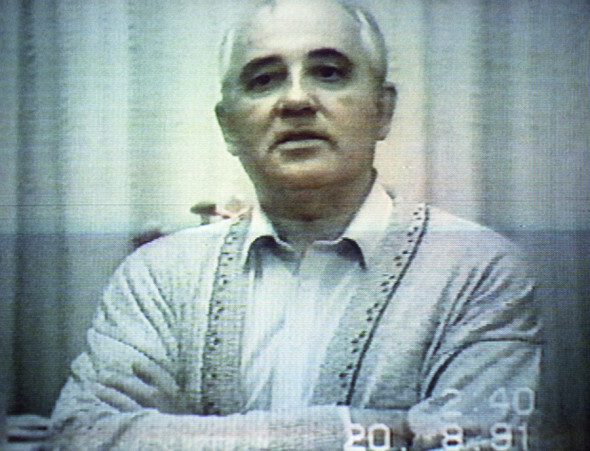
In 1990 Mikhail Gorbachev was awarded the Nobel Peace Prize for his role in the peace process on the international stage. “I take your committee's decision as recognition of the enormous international significance of the changes taking place in the Soviet Union. As trust in our policy of new thinking, which is based on the conviction that at the end of the 20th century force and weapons will have to make serious room as the main lever of world politics,” Gorbachev said in his Nobel lecture in Oslo in 1991. In his speech he also touched on the USSR's internal problems: “In six years we have discarded or destroyed much of what stood in the way of the renewal and transformation of society. But when society received freedom, having long lived as if ‘through the looking glass’, it did not recognise itself. Contradictions and vices spilled out, even blood was shed. Although we managed to keep the country from great bloodshed. The logic of reforms collided with the logic of their rejection and the logic of impatience, which turns into intolerance.” A still from the video address of USSR President Mikhail Gorbachev to the people, recorded on 20 August 1991 during his house arrest at the dacha in Foros.
Gorbachev left the post of USSR president in December 1991 after the formation of the CIS and the events that preceded it. In the late 1980s and early 1990s the situation in the Union republics worsened, mass demonstrations took place and the authorities used military force. In April 1991 Gorbachev and the leaders of ten republics agreed to draw up a new Union Treaty. In August, on the eve of signing the document, several senior officials from the president's closest circle announced the creation of the State Committee for the State of Emergency (GKChP), which demanded the introduction of a state of emergency in the country or the temporary transfer of power to Vice President Gennady Yanayev. Gorbachev, who was then on holiday in Crimea, refused and was isolated at the state dacha in Foros for three days. Major General Lev Tolstoy, who was guarding the president at the time, recalled in an interview: “Of course, they (the subordinates) had questions. One of them concerned how exactly to serve Mikhail Sergeyevich — as president or as someone else. We had to explain that nobody had deprived Gorbachev of his powers.” USSR President Mikhail Gorbachev (left) and Russian President Boris Yeltsin during the evening session of the extraordinary session of the Supreme Soviet of the RSFSR, 23 August 1991.
After returning to Moscow Gorbachev began preparing a project of reform of the state structure, and a meeting with the heads of the Union republics was scheduled for December. The heads of Russia, Ukraine and Belarus, without Gorbachev's participation, signed an agreement on creating the Commonwealth of Independent States. On 25 December Mikhail Gorbachev announced his resignation in an address to citizens: “In view of the situation that has arisen with the formation of the Commonwealth of Independent States, I am ceasing my activity as president of the USSR. I am taking this decision for reasons of principle. I firmly stood for the independence of peoples and for the sovereignty of the republics. But at the same time for preserving the union state and the integrity of the country. Events took a different path. The line of dismembering the country and disuniting the state prevailed, with which I cannot agree.” That same evening the flag of the Russian Federation was raised over the Kremlin in place of the state flag of the USSR.
By his last decree Mikhail Gorbachev created the Gorbachev Foundation on the basis of the former research institutes under the CPSU Central Committee and headed it. The foundation carries out socio-economic and political research. In 1993 Gorbachev became co-owner of Novaya Gazeta. Former USSR President Mikhail Gorbachev at polling station No. 2446, 16 June 1996.
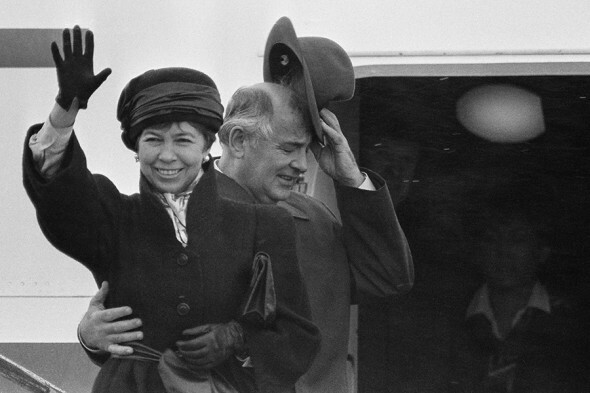
Mikhail Gorbachev's wife Raisa Maximovna was the first of the wives of Soviet state leaders to begin appearing in public with her husband. This caused an ambiguous reaction in society, including statements that she ran the country on a par with the general secretary. On the international stage she was warmly received: the openness of Gorbachev's personal life was also seen as evidence of a changing atmosphere and political course in the USSR. Raisa Gorbacheva engaged in public activity and charity. In the West her elegant image was noted, although, as Gorbachev later said, her clothes were sewn at one of the Moscow ateliers, not by famous designers. They married while still students: “The times were hard, post-war, we were both students at Moscow State University, I at the law faculty, she at the philosophy faculty. Money was short, I had to earn something for the wedding: I harvested potatoes on a combine. It was enough for the bride's white dress, of chiffon, sewn at an atelier. And Raisa had to borrow shoes from a girlfriend. We did not even exchange rings at the registry office — I gave her a ring years later,” Gorbachev recalled. Raisa Gorbacheva died in 1999 of leukaemia. The Institute of Children's Haematology and Transplantology, created in St Petersburg in 2007, is named after her. Mikhail Gorbachev did not marry again; he is survived by a daughter, two granddaughters and a great-granddaughter. “For almost 50 years Raisa and I were together, side by side, and never felt it a burden — on the contrary, we always felt good together. We loved each other, but even alone we spoke little of it. It seemed to us that the main thing was to preserve everything that was born in youth. We understood each other and guarded our relationship,” Gorbachev wrote in his book of memoirs “Alone with Myself”.
In 2011 a large charity evening, Gorby-80, timed to Mikhail Gorbachev's 80th birthday, was held at the Royal Albert Hall in London. The hosts were the actors Kevin Spacey and Sharon Stone. The event featured, among others, the London Symphony Orchestra and artists of the Bolshoi Theatre.


