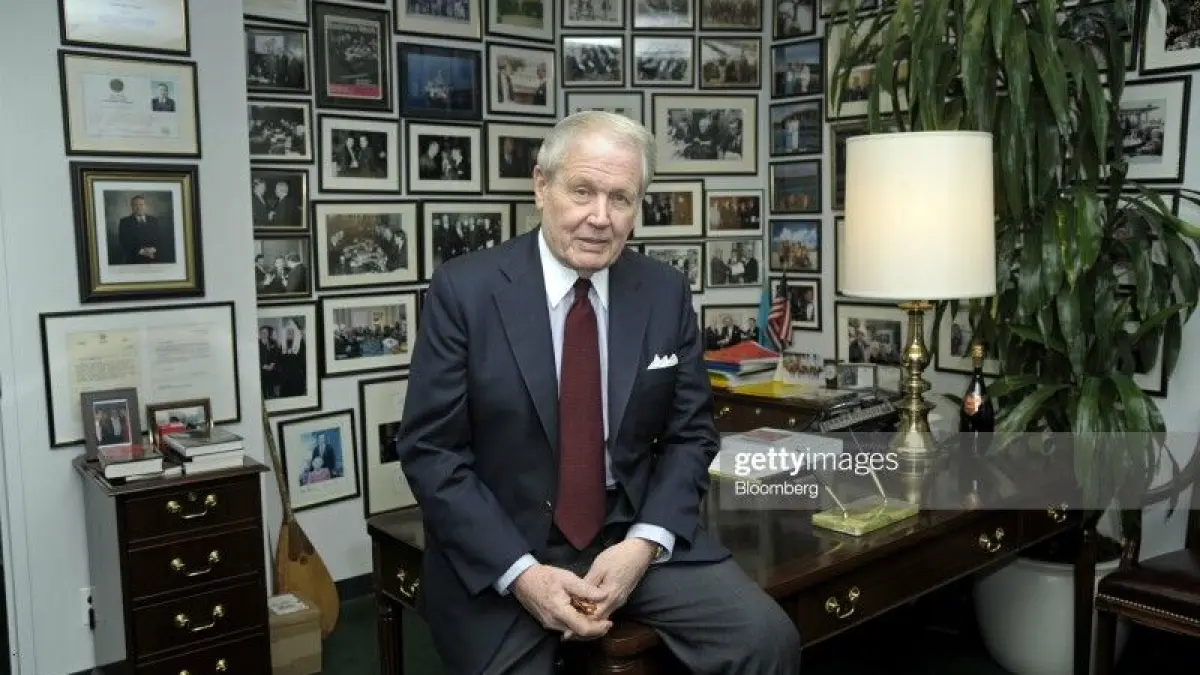
James Giffen died on 29 October 2022 in Manhattan. He was 81. VRKNews.kz reports, citing the New York Times, that the cause of death was cancer.
Recall that former adviser to the president of Kazakhstan James Giffen, who was arrested in 2003, was charged with paying bribes totalling 78 million dollars to senior Kazakh officials for the conclusion of oil contracts. But the US government, after a seven-year investigation, dropped the case in 2010 after a judge decided that he had acted with the approval of the CIA.
As the NYT reports, at the time of his arrest in March 2003 J. Giffen was one of the best-connected Americans working in the former Soviet Union. His merchant bank Mercator was the most important intermediary for Western energy companies seeking to develop Kazakhstan's vast, largely undeveloped oil fields. He was a close friend and adviser of the now ex-president of Kazakhstan N. Nazarbayev and had a luxurious apartment in Almaty, the country's largest city and former capital. All that time he was an operational agent of the CIA and the US State Department.
Chief specialist on the USSR and Gorbachev
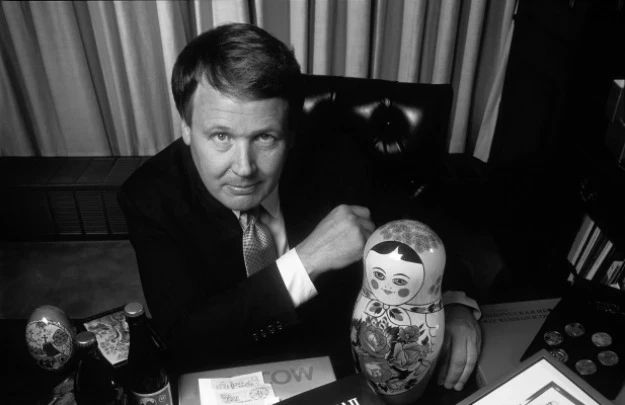
Washington sought to draw Kazakhstan and its resources into the sphere of influence of the Western world. And this is where Giffen's role proved useful: he briefed American officials on the latest developments in Central Asia, passed confidential messages between N. Nazarbayev and the White House, and was often the first American the Kazakhs turned to when they wanted to deal with the US government.
The American newspaper also reports in its obituary that Mr Giffen became interested in the Soviet Union after his father-in-law predicted that, despite the Cold War, trade between the communist bloc and the West would someday increase. Mr Giffen ultimately devoted his law school dissertation to the subject “Legal and Practical Aspects of Trade with the Soviet Union”, which was published as a book in 1969. During a research trip to the Soviet Union he met a Turkish-Armenian businessman named Ara Oztemel, who, among other things, imported precious metals from Kazakhstan. Mr Oztemel hired Mr Giffen to run his own consulting service for companies wishing to do business with the communist East. Over the next 20 years he became a leading expert on trade with the Soviet Union — and one of its main benefactors.
After working for several years with Mr Oztemel he became a vice-president of Armco Steel and founded Mercator in 1984. Mr Giffen was one of the first Western businessmen to meet Mikhail Gorbachev, discussing imports of agricultural products only a few months before he became general secretary of the CPSU in 1985. A few years later, as president of the American-Soviet Trade and Economic Council, which included about 350 American corporations, banks and various organisations, and on the Soviet side more than 250 agencies and enterprises, he chartered a large jet to take several hundred American businessmen to Moscow, where Mr Gorbachev joined them for dinner.
From the 1970s Mr Giffen became a key voice in the American government helping Soviet Jews to emigrate, ultimately helping to bring tens of thousands to the United States.
The collapse of the Soviet Union in 1991 opened up new opportunities, especially in Kazakhstan, where Mr Giffen's experience in the energy and metallurgical sectors brought him into close contact with Mr Nazarbayev. As the NYT goes on, “the two became close friends: Mr Giffen taught the president of Kazakhstan to play golf at the private Winged Foot golf club near his home in Westchester County, New York”.
In the original you can read the English version of the obituary here.
Giffen courted Nazarbayev very assiduously
We can note only the not uninteresting interview of Serikbolsyn Abdildin, now also deceased, an excerpt from which we give below:
“...I knew Giffen personally. At the dawn of independence and of his presidency Nazarbayev was keen on attracting foreign advisers. He thought that people in Kazakhstan did not grasp things, whereas foreign advisers could quickly prepare him for conducting economic policy, a market economy and other areas. We had several dozen such advisers. One of them was Giffen.
In May 1992 a Kazakhstani delegation headed by the president (I was also part of that delegation) visited America. The US president then was Bush senior. A reception at the highest level was organised for us. I even kept photographs with both Bush and Giffen. Giffen was very flexible. He courted Nazarbayev very assiduously.
He did not leave me out of his attention either. He came once and dropped hints about being friends with me. But I was brought up in the Soviet Union, we were taught to be cautious with capitalists, and I saw him off coldly.
— And how did Nazarbayev himself regard Giffen, his other advisers?
— Nazarbayev rated Giffen's work very highly. That was evident. All of Giffen's conversations with Nazarbayev began with the words that the president was a genius. Giffen compared him with Roosevelt. But I should note that Nazarbayev had many such assistants.
All these people lived in Kazakhstan. When I was chairman of the Supreme Soviet I could dispose of places at the third holiday home. Abykayev and Ni approached me, citing Nazarbayev, and asked me to house the president's assistants there. Giffen did not need a cottage, but the others had to be accommodated.
Sometimes, after listening to the advisers, Nazarbayev would say things like: “We will reform agriculture. There will be farmers. Farmers decide everything. The whole world has been through it.” I kept telling him: “Farmers in America now provide 4% of output. Everything else is agricorporations, agricultural associations which in the concentration of production and processing resemble our large collective and state farms. We should not break it up and give land and property to individual farmers.” But he stood his ground: “Listen to them, the whole world has gone down the path of farmerisation.” I replied: “America began farmerisation two hundred years ago. Why should we roll back two hundred years?”
In general I was suspicious of the purity of the foreign advisers' motives: they did not need a strong Kazakhstan. The more Kazakhstan depended even on their advice, the better it would be for the strong states.
— But the president did not doubt the purity of their motives?
— That is the point, he dropped all our specialists, criticised them, disbanded the Academy of Sciences, he treated the ideas of domestic specialists and scientists with contempt...”
* * *
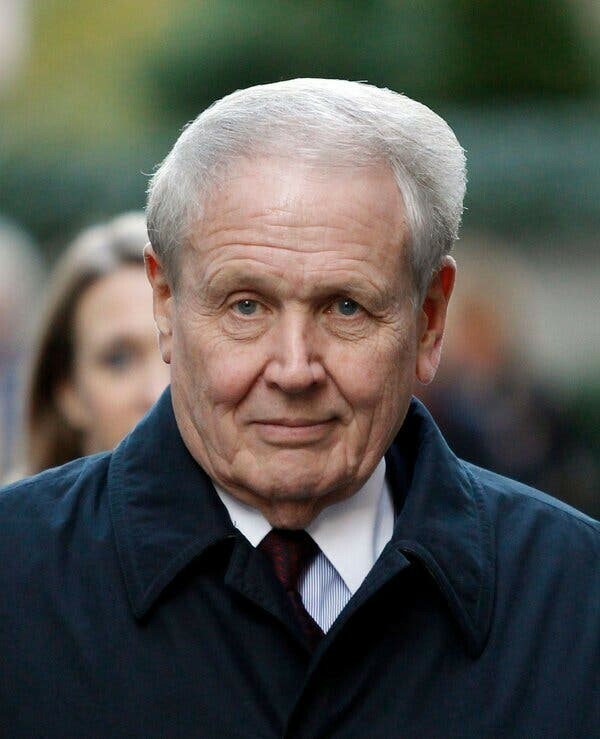
It is interesting, of course, that in examining the “Giffen case” it emerged that “Nazarbayev's honest adviser” was at the same time an agent of the American special services and dutifully supplied his own masters in the USA with confidential information about the affairs, contacts and plans of his patron. It is reported here that, in particular, the archive of US President George H. W. Bush holds (an exceptional case!) a separate “special collection” of James Giffen: 22 boxes of documents relating to Giffen himself and his trading company Mercator Corporation. These remain — for now — classified. Meanwhile no less interesting are the already declassified documents published by the library of former American president Bill Clinton, which tell how the relations of the USA and Russia with Kazakhstan took shape at the dawn of its independence. We recommend it, very useful information for reflection.


