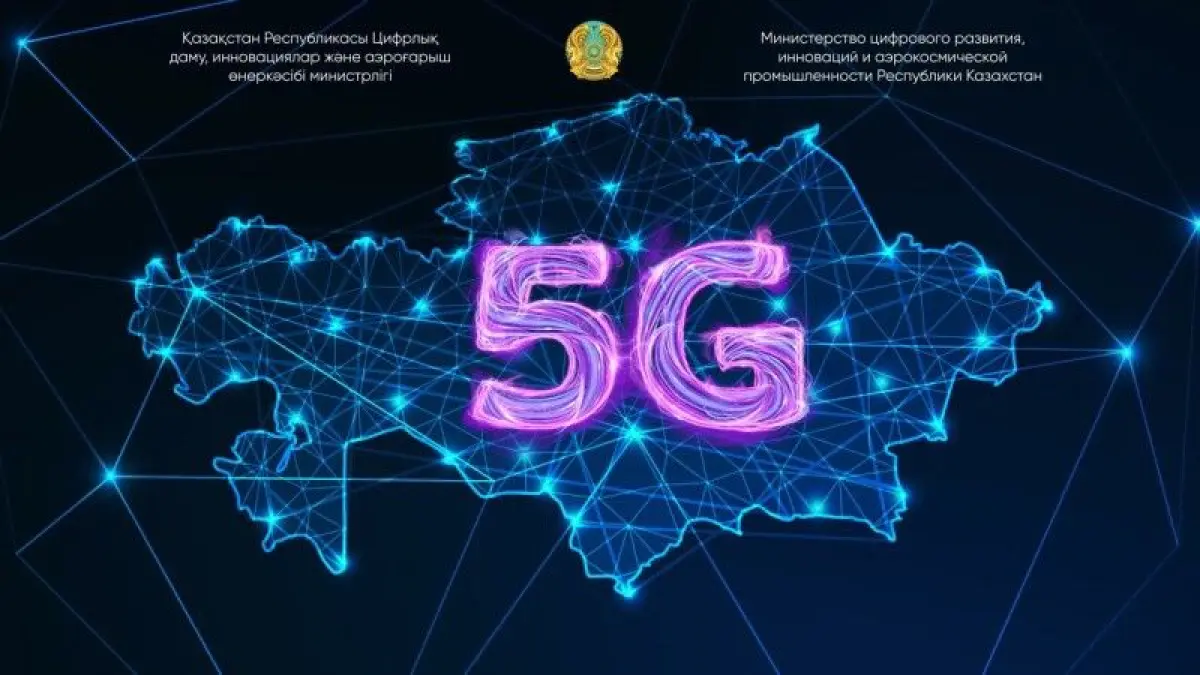
The first lot of Kazakhstan's 5G auction in the 3600–3700 MHz band was sold for 62.669 billion tenge (more than $133 million). This was announced by Bagdat Musin, Minister of Digital Development, Innovation and Aerospace Industry of Kazakhstan, VRKNews.kz reports, citing the ministry's press service,
The starting price of the lot was 1.761 billion tenge ($3.7 million).
“Today is a historic event in Kazakhstan's telecommunications industry — for the first time we are holding an open auction for radio frequencies for 5G. The price of the winning bid is 62.669 billion tenge. This case is a clear example of how an open and competitive auction for national resources can be a good source of replenishing the budget,” the minister said.
The frequencies were bought by a consortium consisting of Mobile Telecom Service LLP (under the Tele2 and Altel brands) and Kcell JSC (under the Kcell and Activ brands).
The auction winner will be responsible for the introduction and development of fifth-generation mobile communications (5G/IMT) in cities of republican significance and regional centres. Under its obligations, it must gradually activate a total of 3,527 base stations.
The second tender, for the next lot in the 3700–3800 MHz radio frequency band (100 MHz) for 5G technology, will take place today.
By 2027 it is expected that 75% of cities of republican significance and 60% of regional centres will be provided with 5G technology.
In the first year of the contract the winner will be required to install 91 5G base stations in cities of republican significance, and in each of the following four years of the contract to install 784 base stations annually.
The introduction of this communication standard has long become a vital necessity not only for ordinary internet users but for all of modern industry. The active introduction of the 5G standard began in the USA in 2018. Later all the leading countries of the world joined them, such as the EU countries, the UAE, Saudi Arabia, China, South Korea and others.
It is gratifying that the introduction of this standard in our country has been put on an honest competitive basis. The auctions for the allocation of radio frequencies for 5G are the starting point for a fundamentally new round of technological development both of the country's information industry and of the whole Kazakhstani economy. However, the form of open electronic bidding itself also proved no less important for the development of the industry. Never before had radio frequencies in Kazakhstan been put up for open tender.
Until this December, mobile operators received bands directly, “under clear state control”. As a result, the industry began to fall behind technologically.
And let us note separately that now, through the media and also through deputies' enquiries (Kanat Nurov, Madi Akhmetov), informational pressure is being put on the relevant ministry — “we don't really need all this, even 4G doesn't work everywhere”. Particular emphasis is placed on the fact that we have problems with mobile internet in cities that are not being solved. However, 5G is just what can solve them. 5G uses roughly the same frequencies as 4G, but thanks to higher spectral efficiency more data is transmitted. Thus the problem of slow mobile internet will also be solved.
Particularly surprising is deputy Madi Akhmetov (yes, yes, that one), who spoke against introducing 5G in Kazakhstan because “there is no point in doing so until 4G and 3G and wired internet in Astana are brought to perfection”. And he also asked the Ministry of Health “whether there are any studies of the effect of 5G on the health of Kazakhstanis”. As they say, a complete facepalm for such radiophobes. It is shameful for the level of education of such young statesmen, who clearly got fails in physics and whom one can quite fairly call neo-Luddites.
It is worth noting that every Kazakhstani updates their smartphone about once every year and a half, and as soon as 5G networks are on offer the number of users will grow. And in general 5G technology, which allows the internet to be used at an average speed of up to 1 gigabit per second, has long since been not only for ordinary users. The latest communication standards are needed for the development of modern production in various spheres, and falling behind in them could lead to complete uncompetitiveness of the already not very strong Kazakhstani economy. To say now that 5G standards are unnecessary in the country is really to deprive it, and all Kazakhstanis, of a future.


