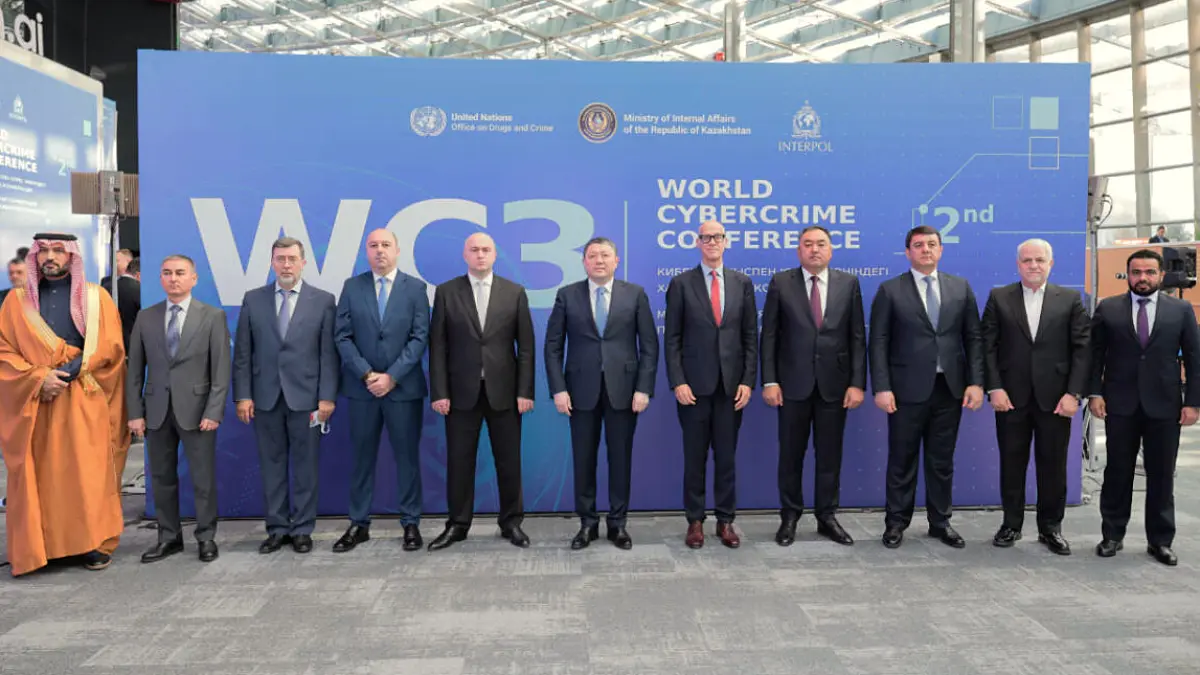
Astana, 5 November, . An International Conference on Combating Cybercrime was held in Astana with UN support and representatives of 27 foreign states: Kazakhstan proposed creating in the capital a Regional Centre of the UN Office on Drugs and Crime to counter cybercrime, the Interior Ministry said.
The conference was organised by Kazakhstan’s Interior Ministry with the support of the UN Office on Drugs and Crime and Interpol. Interior Minister Yerzhan Sadenov called cybercrime a global threat that cannot be resisted alone: criminal groups use artificial intelligence, voice and image substitution, anonymous platforms and cryptocurrencies, and the criminal, the victim and the money are often in different countries. Interior ministers Sulkhan Tamazashvili of Georgia and Ulan Niyazbekov of Kyrgyzstan and Russian deputy interior minister Andrei Khrapov spoke; heads of agencies of Iran, Saudi Arabia, Tajikistan, Uzbekistan and other countries took part.
Kazakhstan presented its results. On 30 September 2026 the country ratified the Council of Europe’s Budapest Convention on Cybercrime, and in October 2025 it was among the first to sign the UN Convention against Cybercrime, whose ratification is under way. Together with foreign colleagues dozens of fraudulent call centres have been closed; stolen funds worth 3.5 billion tenge were blocked and 5.6 billion tenge returned to victims, and in two years internet fraud fell by 21%. The centre in Astana, whose concept the Interior Ministry and UNODC are working out, is to cover the whole Eurasian region: analytics of cyber threats and transnational schemes, information exchange, investigations and training of specialists.
What it means: The centre is so far an idea: its concept is only being worked out, and UNODC welcomed the initiative but the report has no decision to create it. The figures on fewer frauds and returned money come from the Interior Ministry itself.
What we know now: The Interior Ministry and UNODC are working out the centre’s concept, and the report has no dates, budget or decision to create it. The directions named are analytics of cyber threats, information exchange, investigations and training of specialists.
Background: The Budapest Convention is a 2001 Council of Europe treaty that set common rules for investigating computer crimes and exchanging electronic evidence between countries. Electronic evidence is data by which an investigator proves a crime: correspondence, accounts, transfers. A fraudsters’ call centre is a group that phones people and cheats them of money.



