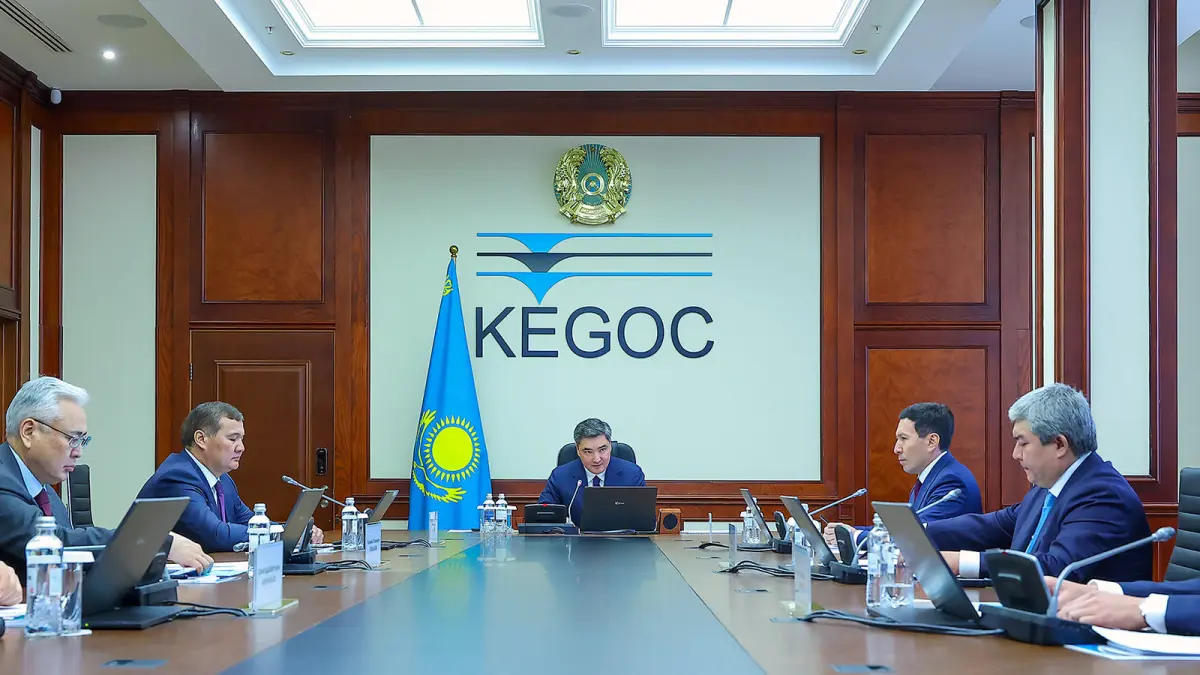
Astana, 5 November, . Prime Minister Olzhas Bektenov held a meeting on the power sector and demanded that the National Electric Grid be developed at an outpacing rate, the Government said.
He tied the task to the Address: the President declared 2027 the Year of Large-Scale National Construction and set the goal of reaching an energy surplus by 2029. “Against the background of economic growth, new industrial projects and the faster development of digital infrastructure, the load on the power system will rise significantly,” Bektenov said. To reach the goal, he said, generation, grids and consumption growth must be synchronised.
KEGOC chairman Nabi Aitzhanov reported on two projects. Strengthening the Southern Zone grid will raise the transit capacity of Almaty — Zhambyl — Shymkent by 440 MW; commissioning is set for July 2027. Linking Western Kazakhstan’s power system with the Unified Power System will raise capacity to 500 MW and relieve the Aktobe power hub: completion is planned for December 2027. A second stage, to be commissioned in 2035, will close the ring with high-voltage lines. Grid development in Almaty region and Zhetysu region for hydropower and new renewable plants was also reported.
Samruk-Energo chairman Ansar Aidarov described how the fund will step up its work after the President’s criticism. The projects include modernising Almaty CHP-2, reconstructing CHP-3, CHPs in Kokshetau and Semey, expanding Ekibastuz GRES-2, combined-cycle plants in Kyzylorda and Turkestan regions, renewables with storage and hydrogeneration.
The Ministry of Energy was instructed to complete updating the country’s energy balance by September 2027. Control over deadlines of energy projects will also be tightened. At the KEGOC site Bektenov learned about preparing the grid for the autumn–winter period. According to the company, digital technology and AI will give 5.5 billion tenge a year, about 3% of EBITDA, by optimising flows and cutting losses. Connecting power plants to automatic frequency and active power regulation will add about 4 billion tenge a year. By the editors’ calculation, together this is 9.5 billion tenge a year.
The National Dispatch Centre controls the equipment of all 83 KEGOC substations and updates more than 50 thousand indicators. Since the start of the year the North — South transit has seen more than 70 sharp load surges, and 95% of them were put out without cutting off consumers.
What it means: The Government confirms the dates of two grid projects, July and December 2027, and sets a condition: grids must grow faster than consumption. Money and contractors are not named in the report.
Who benefits: The South and West of the country, whose power systems will get additional links to the unified grid. KEGOC itself: the company estimates the effect of digitalisation at 9.5 billion tenge a year.
Background: An energy surplus is a state in which a country generates more electricity than it consumes; the opposite of a deficit. Transit capacity is the largest power a line can carry. MW is a megawatt, a million watts. EBITDA is profit before interest, taxes and amortisation. Automatic frequency regulation is a system that keeps the current frequency in the grid at the required level by adjusting power plants’ output.



