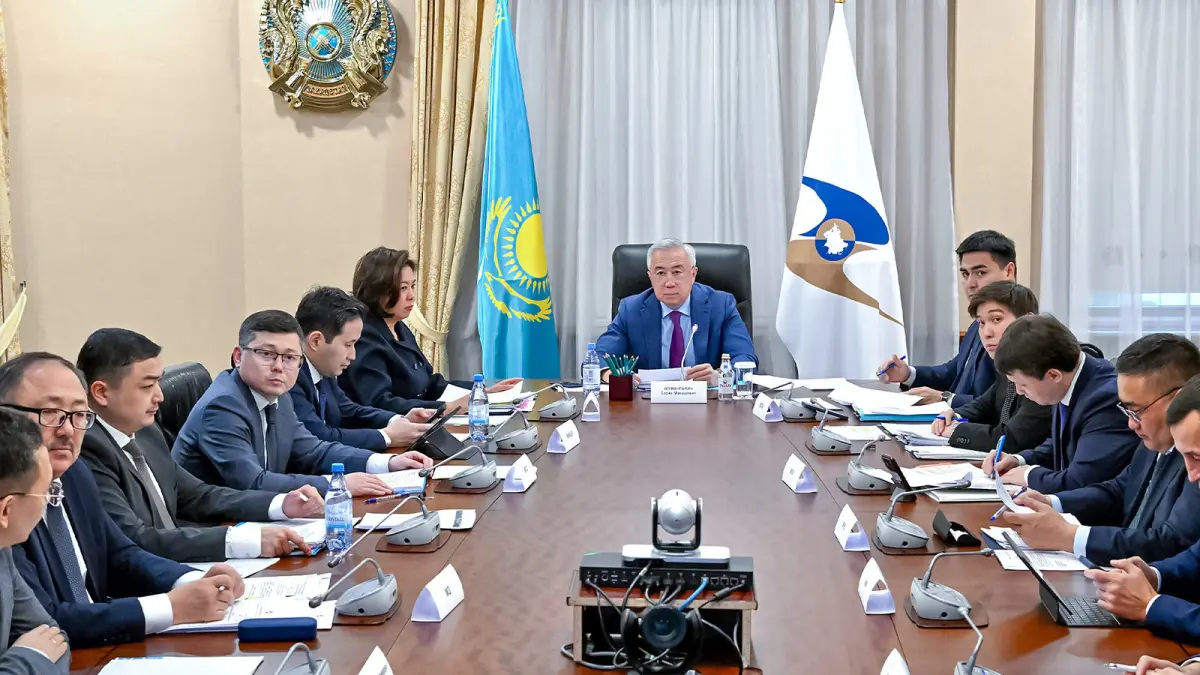
Astana, 5 November, . The Council of the Eurasian Economic Commission approved uniform rules for determining the country of origin of goods exported outside the EAEU and subject to certain regulatory measures, the Government said.
The meeting was held online on 4 November, and Deputy Prime Minister Serik Zhumangarin led the Kazakh side. For the five EAEU states the rules set common criteria of origin for such goods, a procedure for documentary confirmation and cooperation between customs bodies. This gives a single approach to control and, as the Government notes, will not allow national restrictive measures to be circumvented through the territory of other union countries. Special certificates of origin are provided, including for serially produced goods, as well as electronic confirmation and checking of documents.
It was also agreed to mark certain types of electrical products, lighting equipment and printed circuits: the list includes rectifiers, portable torches, incandescent lamps and luminaires. But each country will itself decide whether marking is needed and when and how to introduce it, after discussing it with business and checking the readiness of infrastructure.
The Council also considered trade with third countries: cooperation with Jordan, Pakistan and Tunisia, and agreements with the UAE and Indonesia. Amendments will be made to the free trade agreement with Serbia concerning confirmation of delivery terms.
What it means: The decision levels the rules for exporters of the five countries, but it commits no one to marking electrical products: each country sets the dates itself. When marking appears in Kazakhstan the report does not say.
Who benefits: Exporting manufacturers who need clear rules on a product’s origin, and customs, which gets common criteria and electronic confirmation. This protects the interests of their own producers, as the Government describes it.
Background: The country of origin of a product is the country where it was wholly produced or sufficiently processed; duties and restrictions depend on it. The EEC is the permanent regulatory body of the EAEU. The five EAEU members are Armenia, Belarus, Kazakhstan, Kyrgyzstan and Russia. Marking means putting a code on a product by which it is tracked from producer to buyer.



