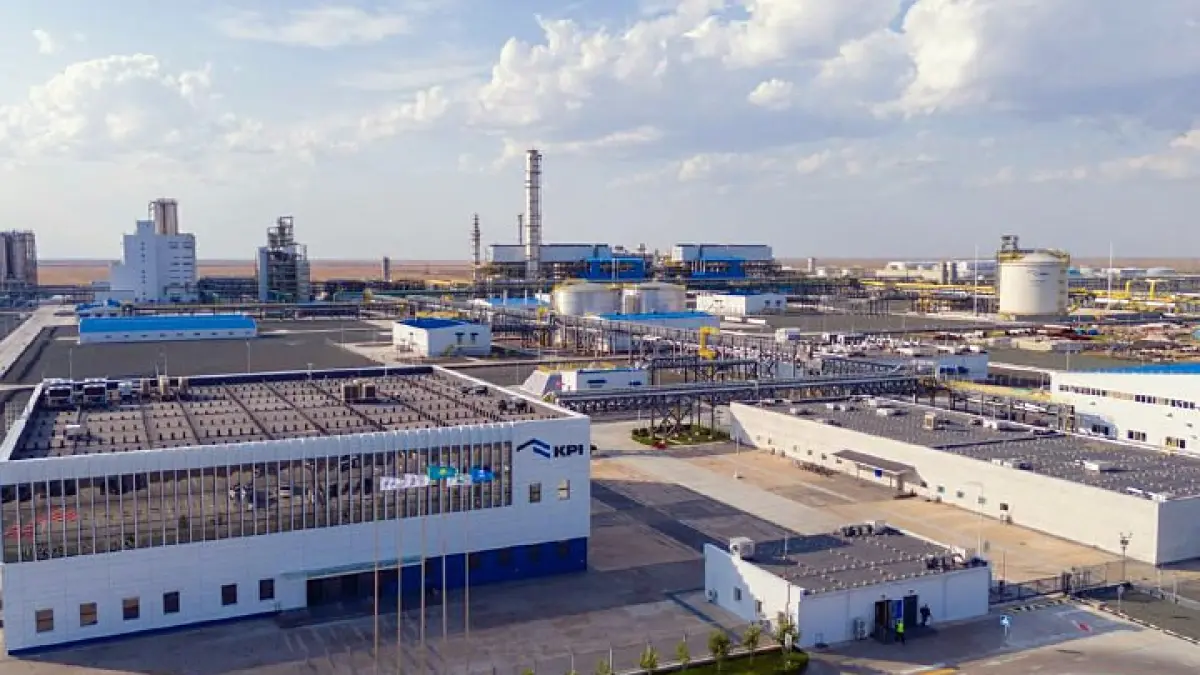
Almaty, 14 November. On 12 November the United Kingdom added the Russian petrochemical holding SIBUR to its sanctions list.
The holding is a co-owner of the Kazakhstan Petrochemical Industries (KPI) polypropylene plant and of the Silleno polyethylene plant under construction in the Atyrau Region. The entry on the company appears in the British government’s notice on additions to the list.
The notice contains 20 new entries, and the public joint-stock company SIBUR Holding is the second of them. The company is subject to an asset freeze, a ban on trust services, a director disqualification sanction and transport restrictions. The stated ground is its business in energy, a sector of strategic significance to the government of Russia. The package was announced by the office of the British Prime Minister, Andy Burnham: according to it, London was the first to sanction all ten of Russia’s largest oil producers.
The holding itself disagrees with that ground. As the Reuters news agency reported, SIBUR said that it does not work in the energy sector, does not own subsoil and does not extract minerals, but develops and produces synthetic materials. The company’s lawyers will examine London’s arguments, and it reserves the right to challenge the restrictions. The holding does not expect the sanctions to affect its stability.
In Kazakhstan SIBUR holds stakes in two petrochemical projects, both linked to the national company KazMunayGas (KMG). In the operating KPI polypropylene plant the holding owns 40%, KMG 49.5%, the company SK Ondeu 9.5% and Firma Almex Plus 1%. In the Silleno project SIBUR has 30%, KMG 29.9%, KMG PetroChem, the petrochemical arm of KMG, 10.1% and China’s Sinopec 30%. This breakdown of participants is given by the business outlet LS. The capacity of KPI is 500,000 tonnes of polypropylene a year, and the cost of the Silleno complex is about $7.4 billion, the Union of Oil Service Companies of Kazakhstan, KazService, said.
LS asked the industry expert Olzhas Baidildinov, author of the Telegram channel Baidildinov Oil, about the consequences. “Now, of course, the related risks will be reassessed,” he said. Buyers of polypropylene, in his view, may be wary of deals or ask for a bigger discount. But KPI’s output goes mainly to China, so sales are unlikely to suffer. For Silleno the expert sees risks in raising finance, in technology and in purchasing equipment that is made only in Europe.
The British sanctions, Baidildinov said, are not as sweeping as American or European ones: inclusion in the American list would mean far greater pressure. “For now one can say that this is, perhaps, only the beginning. Because, as a rule, first some countries impose sanctions, and only then does full blocking follow,” he added. KazService notes that the sanctions do not mean an automatic shutdown of the plants but may complicate international payments, financing and equipment deliveries.
By midday on 14 November KMG and KMG PetroChem had not reported on the consequences for the projects in their official channels.
Construction of Silleno, meanwhile, continues. On 10 November KMG reported the delivery of the first eight sections of loop reactors, the main equipment of the polymerisation unit; each section is more than 67 metres long and weighs up to 77 tonnes.
What it means: The British restrictions hit the Russian shareholder of the two Atyrau projects, while the plants themselves are not on the list. The expert does not expect sales problems for the operating KPI plant: its output goes mainly to China. Silleno, still under construction, is more vulnerable: it still needs money, licences and equipment.
Who benefits: The United Kingdom explains the sanctions as pressure on Russia’s energy sector. The expert names no winners in Kazakhstan: in his words, the sanctions stand-off affects the country both through direct restrictions and through higher costs of equipment, licences, technology and sales. For oil service companies, KazService estimates, it is a risk of delayed contracts and deadlines.
Background: SIBUR, as Reuters describes it, is Russia’s largest petrochemical company. Polypropylene and polyethylene are mass-produced plastics made from oil and gas feedstock. The KPI plant operates in the Atyrau Region, and the Silleno plant is being built in the National Industrial Petrochemical Technopark special economic zone near Atyrau. An asset freeze means that British companies and citizens are forbidden to deal with the funds and property of a listed person.
We have also reported on how Kurultai deputies spent two days inspecting the petrochemical industry of the Atyrau Region.



