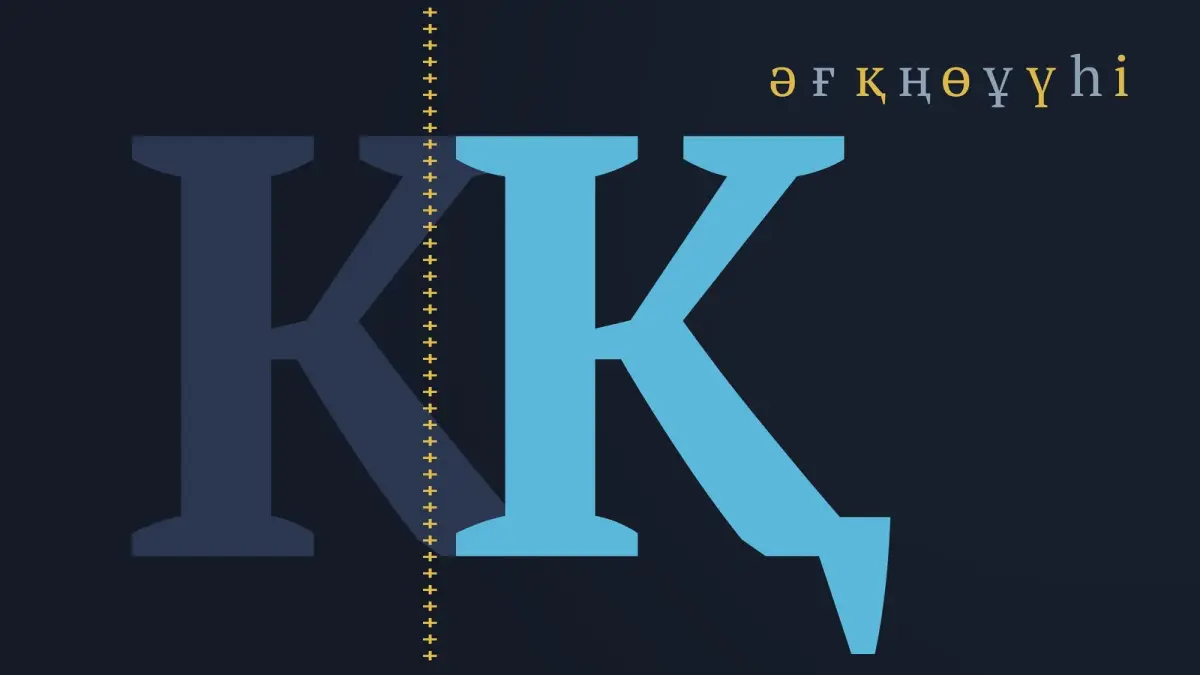
Astana, 13 November. VRK News has published an analytical report and an interactive longread on linguistic chimeras in Russian, Kazakh and English, the editorial team says in the longread.
The report is titled “Linguistic Chimeras. The Case of Kazakhstan”; together with the longread it shows how Kazakh letters and untranslated grammatical forms break official Russian-language texts, how coined everyday words hold back Kazakh itself, and which rules could separate the two problems.
The report calls a chimera a construction that joins elements of two languages in such a way that the receiving language cannot absorb the foreign element by its own rules and stops working properly: a word no longer declines, a sentence loses its links, a record cannot be found by search. The clearest example is the title of the decree renaming Kapshagay: in one line the old name is declined in Russian, «города Капшагая», while the new one is left in Kazakh script and without a case ending, «в город Қонаев» (Decree No. 885). In the Russian text of the constitutional law on the People’s Council, the Kazakh phrase «Қазақстан Халық Кеңесінің Төралқасы» and its short form «Төралқа» occur 18 times and almost always stand in a case they cannot express, although the same law gives the Russian equivalent «Президиум» (Law No. 298-VIII).
The report checks every claim against primary sources — the Constitution, laws, decrees, answers from government agencies, the Terminology Commission’s collections and building codes — and says openly where a check failed. It contains 81 verified facts, 15 disagreements between sources and 13 “blank spots”, questions for which there are no data. The editors made three measurements themselves and described them so that anyone can repeat them: a count of word forms in the Russian texts of the Constitution and Law No. 298-VIII, a breakdown of Kazakh and Russian letters under the Unicode standard, and a search experiment on six records of one avenue in the capital.
The report’s main findings concern three things. The first is selectivity. The same state bodies that write «теңге», «Қонаев» and «область Жетісу» in Russian write “the tenge”, “Konaev city” and “Zhetysu region” in English, even though a Latin Kazakh script with the letters Ñ and Q exists at least as a draft: a norm described as a legal requirement is applied to Russian text alone (English text of the Constitution). The second is a break with the country’s own tradition. In 1993–1999 Almaty, Kokshetau and Ereymentau were introduced as new Russian transcriptions, with case endings and adjectives, and Russian speech accepted them; in the 2020s transcription gave way to carrying Kazakh script over. The third is the digital cost. For the Unicode standard Kazakh ә, ң, і and Russian а, н, и are different letters, so an ordinary search finds one or two of the six records of Mangilik El avenue, while a normalising key finds all six.
The other side of the subject is Kazakh itself. On 10 November, at the 10th Kurultai of the “Qazaq tili” society, the President named 27 words that have entered everyday use and eight coined words whose necessity, he said, seems doubtful — күйсандық, қылтима, үнқағаз, жеделсаты and others — and instructed that spelling be put in order by the end of 2027; the last spelling dictionary approved at state level appeared in 1983 (the President’s speech). The report examines each of the eight words and finds a common pattern: all of them name household objects that have long had absorbed names, while there is not a single household word among the 27 that took root. A new word wins when it fills an empty place and loses when it pushes out an absorbed one.
The recommendations rest on one principle: separate three things that are now mixed up — the official name in the state language, its rendering in a text in another language, and its technical storage. For the state, the report proposes a single rule for rendering Kazakh names in Russian and English texts, with the Kazakh form in brackets at first mention; an official interpretation of Article 19 of the Law on Languages together with Article 21 on spelling norms; and «Президиум Народного Совета Казахстана», declined in every case, in the Russian text of Law No. 298-VIII. For linguists: change an approved term no more than once a generation, introduce new words for new concepts, publish a single method for the Terminology Commission’s statistics, which currently give shares of 35.3% and 12.3% for the same years, and prepare an instruction on rendering Kazakh place names in Russian. For newsrooms: an in-house standard and declining what can be declined. For developers: link records by individual and business identification numbers rather than by spelling, and keep words that mix Cyrillic and Latin out of registers.
The editorial position in the report and the longread is stated plainly. The status of Kazakh as the state language is fixed by the Constitution and is not in dispute. The subject of the report is the quality of texts: every language has the right to live by its own grammar, and Kazakh says Мәскеу and Орынбор just as freely as Russian said Alma-Ata and Kokchetav. The state may set the form of a name in the state language and offer another language a new transcription, as it did in the 1990s, but the rule breaks down where another language is denied transcription altogether. The editors do not see a campaign against any language here: it is a misunderstanding that grew out of a gap between norms, and the remedy is a rule, not a ban.
The longread is based on the report but written for a general reader: 12 chapters, each opening with a real case, with every term introduced as the answer to a puzzle. Readers decide for themselves where the chimera is, try to put a case ending on «Төралқа», switch a four-language table between official texts and the press, swing the pendulum of terms from музей to мұражай and back, search for an avenue in a simulator and check right in the browser whether a letter decomposes under Unicode. Kazakh letters in Russian examples are marked with a stitched “seam”, every footnote reveals the title of its source, and at the end readers repair the title of the Kapshagay decree themselves. As far as the editors know, it is the first piece in Kazakhstan’s media to examine linguistic chimeras from both sides at once — in official Russian text and within Kazakh — with conclusions readers can verify for themselves.
The report explains why the subject has not been raised as a whole until now. Debates ran separately: about new terms, around the Terminology Commission and the President’s list; about renamings, around bringing back the name Alma-Ata, which Seitkazy Matayev and Olzhas Suleimenov proposed. Nobody treated what happens to the grammar of official Russian text as one problem: it lies where law, linguistics and digital systems meet, no data on it had been gathered, and any remark about a Kazakh form in Russian text risks being read as an objection to the state language. The report tries to remove that fear by talking about the mechanics and costs of decisions and attributing intentions to no one.
The report can be downloaded in English, “Linguistic Chimeras. The Case of Kazakhstan” (PDF, 1.0 MB, 87 pages), in Russian, “Языковые химеры. Кейс Казахстана” (PDF, 1.1 MB, 89 pages), and in Kazakh, “Тілдік химералар. Қазақстан мысалы” (PDF, 1.1 MB, 89 pages).
Earlier we also wrote about how the President instructed that Kazakh spelling be put in order by the end of 2027.
What it means: Kazakh names in Russian text and new words in Kazakh do not break a language as such; they break the links within a text, search and the reader’s trust. The report proposes not choosing between languages but giving each a rule for rendering a foreign name by its own laws.
Who benefits: Judges, lawyers and translators, who need an unambiguous official text; newsrooms, which need a single standard; developers of state registers, where the same record now goes unfound under different spellings; and Kazakh itself, which gains more from an accurate word introduced in time than from a coined one.
Background: The new Constitution, adopted in a referendum on 15 March 2026, introduced the spelling «теңге» into the Russian text; since 1 July state bodies, according to the Justice Ministry, must use its terminology. The report reflects data as of 12 November 2026; its list of sources has 85 items.



