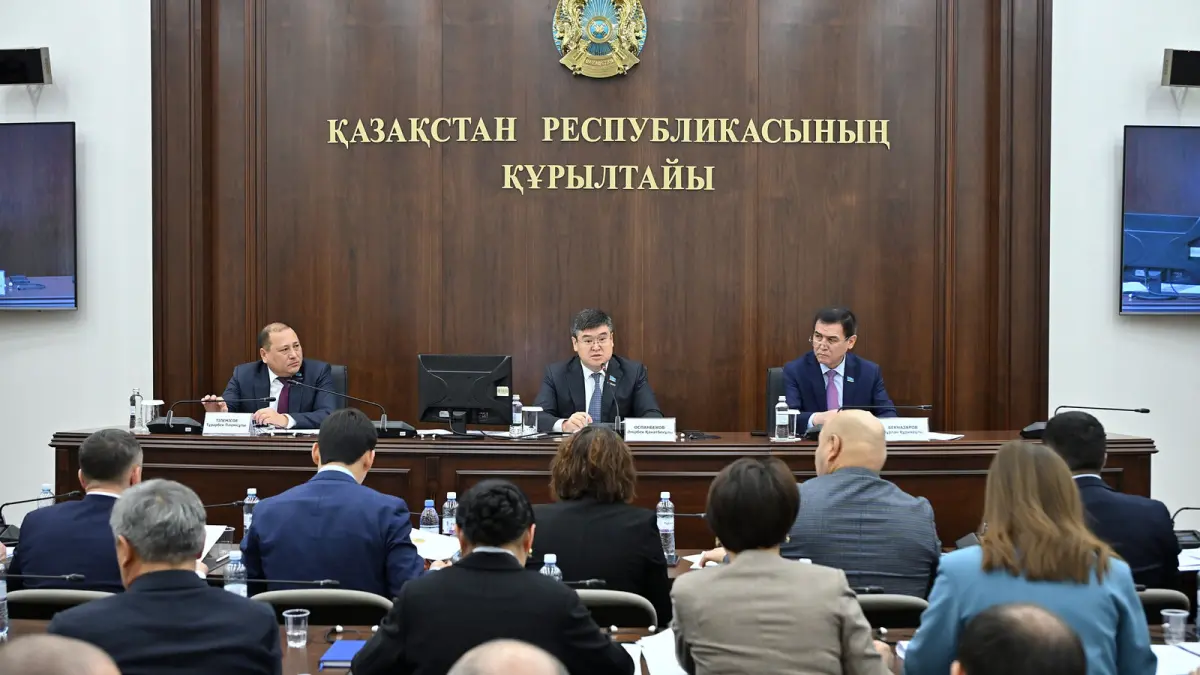
Astana, 26 November, . The Kurultai Committee on Regional and Infrastructure Development considered the bill “On the Development of Border Territories of the Republic of Kazakhstan”, the Kurultai press service reported.
The bill in figures
- 50 km
the strip along the border in which administrative units are proposed to be treated as border territories - 25 km
the strip in which remote villages are proposed to receive special support measures - 12
ministries took part in the meeting
Based on Kurultai press service data
- 50 km
The meeting was chaired by committee chair Amirbek Ospanbekov. He said the bill was drafted on the deputies’ initiative in fulfilment of an instruction from the President given at the fourth meeting of the National Kurultai; developing such territories, in his words, helps preserve demographic balance, ensure sustainable economic growth and raise citizens’ well-being.
The main goal, Ospanbekov said, is to create a self-sufficient economic environment in border districts, where residents can not just live but work permanently, start their own businesses, launch production and earn a decent income. Nurlan Beknazarov, Deputy Chair of the Kurultai, remarked that such territories should be seen as a full part of the country’s economic and social space, with potential in trade, logistics, production and international cooperation.
Deputy Yerlan Sayir presented the main provisions. According to him, the document fixes the legal status of border territories and provides for a register. It proposes to classify as border territories administrative-territorial units within 50 km of the state border. Special support measures are proposed for remote settlements within 25 km. At the same time, Sayir stressed, the geographic, demographic and socio-economic features of regions will be taken into account. The bill also defines the powers of state bodies and introduces mechanisms for planning, financing and lending; it rests on the principles of economic feasibility, consistency, fairness and security.
The development areas named include improving the quality of education, healthcare and vocational training, attracting specialists and young people, developing industry, agriculture, processing, small and medium-sized businesses, trade, logistics and tourism, and modernising transport, utility and social infrastructure. State support measures, according to the deputy, include financing of infrastructure projects, lending and promotion of entrepreneurship, investment support, subsidies, loan guarantees, and development of cooperatives and public-private partnership. The list also includes housing programmes, benefits and increased coefficients to the salaries of civil servants working in socially significant sectors in remote border villages.
In the discussion, deputies asked about the criteria by which settlements will be classed as border territories and about the possibility of adding to the list villages with socio-economic and infrastructure problems. The economic assessment of the tourism potential of border districts was also raised. Ospanbekov summed up: support for such territories should be a long-term priority of state regional policy, and the bill will provide a legal basis for systematic work. The meeting was attended by representatives of twelve ministries, the National Security Committee, the Atameken National Chamber of Entrepreneurs and specialised institutes. The questions and proposals raised at the meeting will be discussed at meetings of a working group led by deputy Turarbek Tlemisov.
What it means: The bill for the first time tries to make the borderland a separate object of policy: it would have a legal status, a register and its own set of measures, from loans to increased coefficients to salaries. Which villages end up in the register depends on the criteria deputies asked about at the meeting.
Who benefits: By the authors’ design, the winners should be residents of border districts, where jobs, housing and services are proposed, and businesses, which are promised loans, subsidies and guarantees. The cost of such measures is not stated in the report.
Background: The Kurultai is a unicameral parliament; the new Constitution came into force on 1 July 2026. The bill has been presented to the committee and will next be discussed by a working group; the report gives no date for its consideration at a plenary session.



