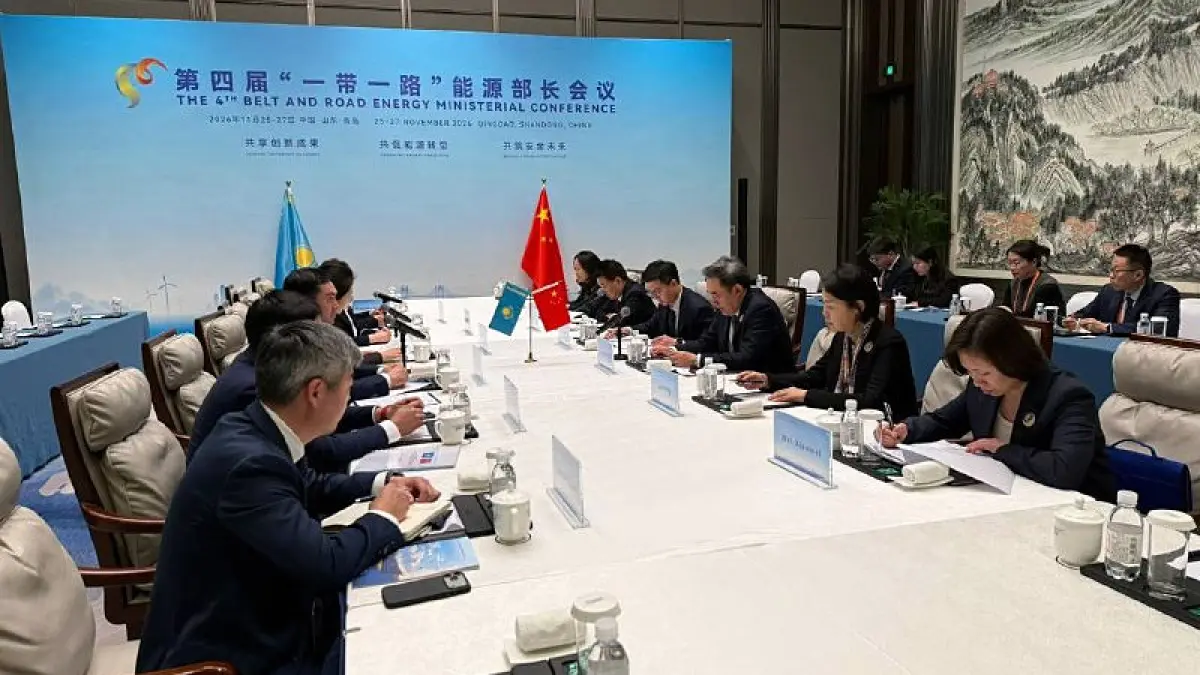
Qingdao is not a new city for Kazakh oilmen. In February the designers of the Shymkent refinery came here, and at the end of November Energy Minister Yerlan Akkenzhenov arrived for the 4th Belt and Road Energy Ministerial Conference. Between these two trips lie almost all the main Chinese themes of the Kazakh oil industry: a refinery that is to be doubled, pipelines that have to feed it, gas chemistry that is replacing raw material exports, and yuan money with which all this can be built. Each theme has been in the news separately. Together they show what Astana wants from Beijing and on what terms.
Kazakhstan and China in oil and gas
- 12 million tonnes a year
target capacity of the Shymkent refinery by 2030 - 9.477 million tonnes of oil
throughput of the Atasu–Alashankou pipeline in ten months of 2026 - 1.25 million tonnes a year
capacity of the Silleno polyethylene plant - 880,000 tonnes a year
design capacity of the KMG–CNPC urea complex - 3.5 billion yuan
Dim Sum bonds placed by KMG in August
Data: Ministry of Energy, KMG, KazTransOil, KASE
- 12 million tonnes a year
A refinery built a second time
The main topic of Akkenzhenov’s talks with Wang Hongzhi, head of China’s National Energy Administration, was the Shymkent oil refinery. The plan is to expand it from 6 to 12 million tonnes a year, and, according to the Ministry of Energy, as we reported on 26 November, the sides discussed completing the feasibility study and moving on to basic design, known in the industry as FEED. The difference matters. A feasibility study answers whether to build and at what cost; FEED already determines what exactly is to be built: the schemes, equipment and scope of work on which a contractor is then hired.
The refinery is owned jointly by KMG and CNPC, so every step on it goes through two corporations and two governments. The sides agreed to treat the expansion as a separate initiative during the Head of State’s visit to China in autumn 2025, as Akkenzhenov recalled to CNPC President Zhou Xinhuai at a meeting in Astana on 27 October. The configuration was chosen back in February, and in Qingdao. A Ministry of Energy delegation led by Daulet Arykbayev, director of the oil transportation and refining department, then agreed a “6+6” scheme with the Chinese designers: two process trains of 6 million tonnes each, fully integrated with the existing units. Put simply, a second refinery of the same size is being built next to the old one, rather than squeezing extra tonnes out of the existing one.
A pipeline needs oil
A doubled refinery will need double the feedstock, and Shymkent receives its oil by pipeline. That is why in Qingdao refining was discussed together with the Kazakhstan–China pipeline system. At the end of July in Beijing, KMG and CNPC started a feasibility study for expanding two of its sections: Kenkiyak–Atyrau to 15 million tonnes a year and Kenkiyak–Kumkol to 20 million tonnes. The second section, 794 km long, was built in 2009 and is designed for 10 million tonnes.
The current load on the system can be seen from KazTransOil’s report. In ten months of 2026 the Atasu–Alashankou pipeline carried 9.477 million tonnes of oil. Of this, 1.095 million tonnes were Kazakh oil exports, 28% more than a year earlier, while 8.383 million tonnes were Russian oil in transit to China. In other words, the main oil pipeline to China today mostly works for someone else’s oil. Wang Hongzhi and Akkenzhenov noted the importance of long-term agreements that guarantee the system’s load and transit to China until 2034. The pipeline itself is owned by KazTransOil and China’s CNODC on a parity basis.
A pipeline that carries more Russian oil to China than Kazakh oil is a good reminder that transit is also an export, only someone else’s.
Coal, petrochemicals and fertilisers
The Ministry of Energy reported that at the talks between Akkenzhenov and Wang Hongzhi the sides discussed, among other things, the introduction of clean coal technologies. The minister himself said that alongside reliable transport of energy resources Kazakhstan is focusing on deep processing of raw materials. This, he said, means expanding the Shymkent refinery to 12 million tonnes, building a polyethylene plant and “the introduction of coal chemistry and ‘clean coal’ technologies relying on our reserves of 33.6 billion tonnes”. On the first day of the trip the minister met the management of companies from Shandong province: Fuhai Group, Qingdao Junpeng, the investment platform Zhongxin United Energy and the design institute China United Northwest Institute. According to the ministry’s release, the companies presented proposals for producing specialised oil and gas and heat engineering equipment in Kazakhstan, opening service centres and training Kazakh engineers. The sides also considered deep petrochemistry, natural gas liquefaction and gas-fired generation, waste-to-energy and fertiliser production in the Atyrau special economic zone. Akkenzhenov named the requirements for investors: localisation of production, development of domestic services, decent pay and at least 30% local content in goods and 80% in works and services. All initiatives in petrochemicals and gas power, he said, will be assessed strictly with regard to the raw material base and the priority of the domestic market.
While the Shandong proposals remain proposals, KMG already has projects with Chinese partners in steel and concrete. The largest is the Silleno polyethylene plant in Atyrau Region with a capacity of 1.25 million tonnes a year, in which Russia’s SIBUR and China’s Sinopec own 30% each. As of 17 November, according to KMG, the project was more than 42% complete. More than 5,000 workers are on site, and the first major piece of equipment installed was a Kazakh-made ethylene fractionation column 101.8 m high. The feedstock will be ethane, a gas separated from Tengiz associated gas. It is split at high temperature into ethylene (a process called pyrolysis), and polyethylene is then made from the ethylene. Ethane and propane will be delivered to the plants by the country’s first trunk pipelines for these gases, from the gas separation complex near Tengiz to the Karabatan industrial zone. More than money is expected from Sinopec: following a meeting in Beijing in July, its trading and logistics network is to open the plant’s products to the markets of South-East Asia and China.
The second project is urea. The complex in the Mugalzhar district of Aktobe Region is designed for 880,000 tonnes of urea and 80,000 tonnes of methanol a year, KMG said. A framework agreement between the Ministry of Energy, CNPC, KMG and the regional administration was signed in July 2025 during the state visit of Chinese President Xi Jinping, and in March 2026 KMG CEO Askhat Khasenov announced the start of implementation. Urea is the most widely used nitrogen fertiliser, and, according to KMG, the country has no urea production of its own. The gas for the complex will come from the Urikhtau field: its gas condensate part, with reserves of 29.4 billion cubic metres, is to reach production of up to 1 billion cubic metres a year, and CNPC will invest $138 million in upgrading the Zhanazhol gas processing plant to take this gas.
Fertilisers have also become a topic for the Government. On 27 November First Deputy Prime Minister Nurlybek Nalibayev discussed with China Wuhuan Engineering and KazAzot an ammonia and urea complex in Mangistau Region worth about $1.6 billion. It is to produce 660,000 tonnes of ammonia, 577,500 tonnes of urea and 500,000 tonnes of ammonium nitrate a year. A week earlier the financing of this project was discussed by the Baiterek holding as well.
Yuan without intermediaries
Construction on this scale has to be paid for, and here the Chinese link has its own currency. In August KMG closed the order book for 3.5 billion yuan of Dim Sum bonds: a five-year tranche of 1.5 billion at 2.3% and a ten-year tranche of 2 billion at 2.8%. Orders peaked at over 25 billion yuan, more than seven times the offering, and, according to the company, the book was the largest in the history of such issues by borrowers outside China and Hong Kong. The coordinators were BOC International, Bank of China (Hong Kong), China CITIC Bank International, ICBC (Asia) and Citi.
Dim Sum is the name for yuan bonds issued outside mainland China, mainly in Hong Kong. It comes from the Cantonese dim sum snacks served in small portions: the first such issues were small too. For a Kazakh issuer it is a way to borrow in yuan directly rather than via the dollar, and so to pay Chinese contractors and suppliers in the same currency as the debt. KMG’s first issue in October 2025 was nearly three times smaller, 1.25 billion yuan at 2.95%. The Development Bank of Kazakhstan and the Samruk-Kazyna fund, whose debut issue was 3 billion yuan, have also entered this market.
What next
The nearest fork in the road is the Shymkent refinery. If the feasibility study is closed and the sides sign a decision to move to basic design, the project will for the first time get drawings on which money can be counted and contractors hired. The second is oil for it: the expansion of Kenkiyak–Atyrau and Kenkiyak–Kumkol is still at the feasibility stage, and without it twelve million tonnes have nowhere to come from. The third is the Shandong proposals. The minister named the requirements for them: at least 30% local content in goods and 80% in works and services, and assessment with regard to the raw material base and the priority of the domestic market. How many of the proposals clear it will be shown not by the next conference but by the first signed contract.
For now, the sides in Qingdao agreed to continue work at expert level, a formula that in energy usually means the hardest part is still ahead.



