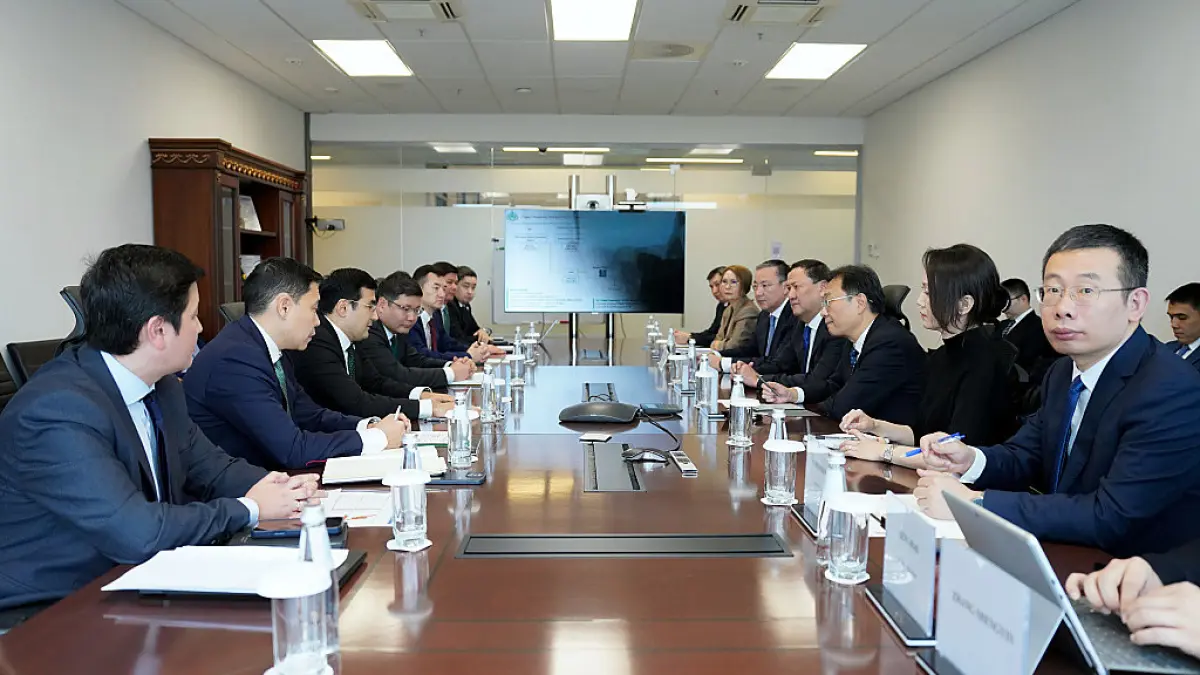
Astana, 25 November. Rustam Karagoishin, chair of the management board of the Baiterek holding, met Yu Xin, head of China’s Wuhuan Engineering, and Bakharidin Ablazimov, a shareholder of KazAzot JSC, the holding said.
They discussed the construction of KazAzot PRIME’s ammonia and urea complex in Mangystau Region. The main topic was a financing structure involving the financial institutions of the Baiterek group.
The heads of the holding’s subsidiaries, the Development Bank of Kazakhstan and Qazaqstan Investment Corporation, also attended. According to Baiterek, the parties discussed how the project is progressing, how the contractor is meeting its obligations under the EPC contract (a turnkey contract for engineering, procurement and construction), and the main stages and timing of construction.
The complex is to produce 660,000 tonnes of ammonia, 577,500 tonnes of urea and 500,000 tonnes of ammonium nitrate a year. About 568,000 tonnes of output a year is to be exported. The general contractor is Wuhuan Engineering, part of China’s state-owned China National Chemical Engineering Corporation (CNCEC).
The scale of the project is clear from a government decision in June. The government then approved an investment agreement between the Ministry of Industry and Construction and KazAzot PRIME. Investment was estimated at 804.2 billion tenge, commissioning is set for 2030, about 1,500 people will work on the construction and 700 after launch. Urea, one of the main nitrogen fertilisers, is not currently produced in Kazakhstan and is imported from neighbouring countries; the only domestic producer of nitrogen fertilisers is KazAzot JSC in Aktau.
The Mangystau plant is not the only one planned. KazESTA and KMG PetroChem LLP, together with CNPC-Aktobemunaigas, also intend to produce urea; taking all projects into account, the government forecasts that output of ammonia products will reach 2.3 million tonnes by 2030.
What it means: The ammonia and urea complex project in Mangystau has moved on to the question of money. The contractor has been chosen and capacities calculated, and the state holding is now discussing how its banks will take part in financing. Baiterek does not give the amounts or terms of the loans.
Who benefits: Farmers who now buy urea abroad, if the plant is launched; KazAzot PRIME’s shareholders, who need financing for construction; Baiterek’s banks, if they join the project; and the Chinese contractor building the complex.
Background: Baiterek is a national managing holding through which the state supports business with loans and investment; it includes the Development Bank of Kazakhstan and Qazaqstan Investment Corporation. The feedstock for ammonia and urea is natural gas.



