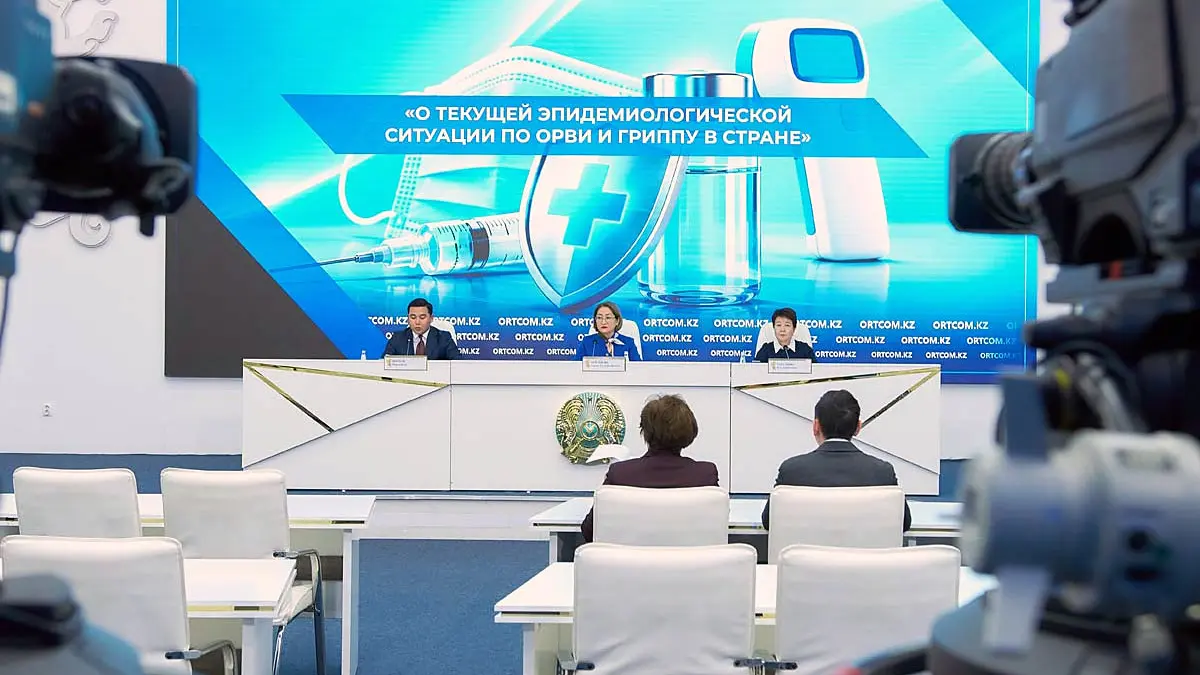
Astana, 25 November. The Ministry of Healthcare sees no grounds to move schoolchildren to distance learning, Sarkhat Beisenova, chair of the ministry’s Committee for Sanitary and Epidemiological Control, said at a press conference at the Central Communications Service (CCS).
In no class and no school in the country has the share of pupils ill with acute respiratory viral infections (ARVI) exceeded 20%.
Beisenova is also the country’s chief state sanitary doctor. According to her, about 1.5 million ARVI cases have been registered in Kazakhstan since the beginning of September. That is 28% fewer than in the same part of the previous epidemic season. Over the past week doctors recorded more than 133,000 cases, 2.7 times fewer than in the same week a year earlier.
Since the beginning of September there have been 297 cases of influenza: in 295 of them laboratories found the A(H1N1) virus, in two more influenza type B. Tests also confirm other respiratory viruses: rhinoviruses were detected in 345 cases, bocaviruses in 195 and adenoviruses in 189. “Similar symptoms can be caused by different viruses, so one must not diagnose oneself or prescribe treatment,” Beisenova said.
The press conference came amid complaints from residents of Astana and Almaty about high fever, a severe cough and queues at clinics; social media carried posts about some unusual virus and overcrowded children’s infectious diseases hospitals in Almaty. To check these reports, representatives of the city public health department and the Almaty public council visited the hospitals. The visit, according to Beisenova, showed that the situation in the video was due to the seasonal rise in ARVI and influenza and that the hospitals were operating normally.
City figures are also lower than last year. In Almaty, according to the sanitary service, 16,841 ARVI cases were registered in a week, against 43,225 a year earlier, along with 25 influenza cases. In Astana there were 21,158 cases in a week, 1.6 times fewer than a year ago. The city has had 39 cases of A(H1N1) influenza since the start of the season, said Zhanna Pralieva, deputy head of the city department of sanitary and epidemiological control.
The ministry prepared this season’s measures with an eye on the previous one. Then the peak came in November: the country’s infectious diseases hospitals were 75% full, children’s infectious beds 84.9%, and in some regions occupancy exceeded 100%. With this in mind, the chief sanitary doctor signed a resolution on measures for the current season on 26 August 2026. Under it, regions drew up plans in advance to deploy additional infectious beds: new places open when bed capacity is 85% full. Schools and kindergartens are to keep daily attendance records, hold morning checks and temporarily isolate a child showing signs of illness until the parents arrive.
For the 2026–2027 epidemic season Kazakhstan bought 2.2 million doses of the Grippol plus vaccine, which protects against the A(H1N1), A(H3N2) and B strains. So far 2,065,000 people have been vaccinated, or 93.9% of the planned number; the campaign will run until 1 December. The state budget pays for vaccinating children under regular medical observation, orphans and children left without parental care, residents of medical and social institutions for the elderly, people with disabilities and medical workers. Pregnant women, military personnel, people with chronic heart and respiratory diseases and citizens over 65 can be vaccinated voluntarily.
Since the beginning of 2026, 381 cases of coronavirus infection have been detected, 2.6 times fewer than a year earlier, with no deaths. The XFG variant, known as Stratus, prevails: its RV.1.1 sublineage was found in 68.7% of the samples tested. According to the World Health Organization’s assessment cited by Beisenova, these variants pose no additional risk compared with other Omicron variants.
There are also no grounds yet to cancel New Year parties in schools and kindergartens, Beisenova said: the epidemic situation is at a seasonal level. If the incidence rises, restrictions on mass children’s events may be introduced.
What it means: This ARVI season is so far noticeably milder than last year’s, when hospitals in some regions were overcrowded in November. The threshold at which a class or school switches to distance learning, 20% of pupils ill, has not been reached anywhere, and regions have a plan to deploy extra beds if cases rise.
What to do: The Ministry of Healthcare asks parents not to send a child showing signs of illness to school or kindergarten. It advises airing rooms regularly, washing hands and wearing a close-fitting mask when one has to be around other people while ill. The ministry advises pregnant women, parents of young children, the elderly and people with chronic diseases not to put off seeing a doctor. Difficulty breathing, chest pain, impaired consciousness or marked weakness in a child are reasons to call for urgent medical help. Antibiotics must not be taken without a prescription: they do not work against viruses. Flu vaccination is available until 1 December.
Background: The CCS is a service under the President that holds press conferences of state bodies for journalists. In Kazakhstan the ARVI and influenza epidemic season is counted from September.
We have also reported that 313 people were being treated in Astana hospitals for influenza and ARVI.



