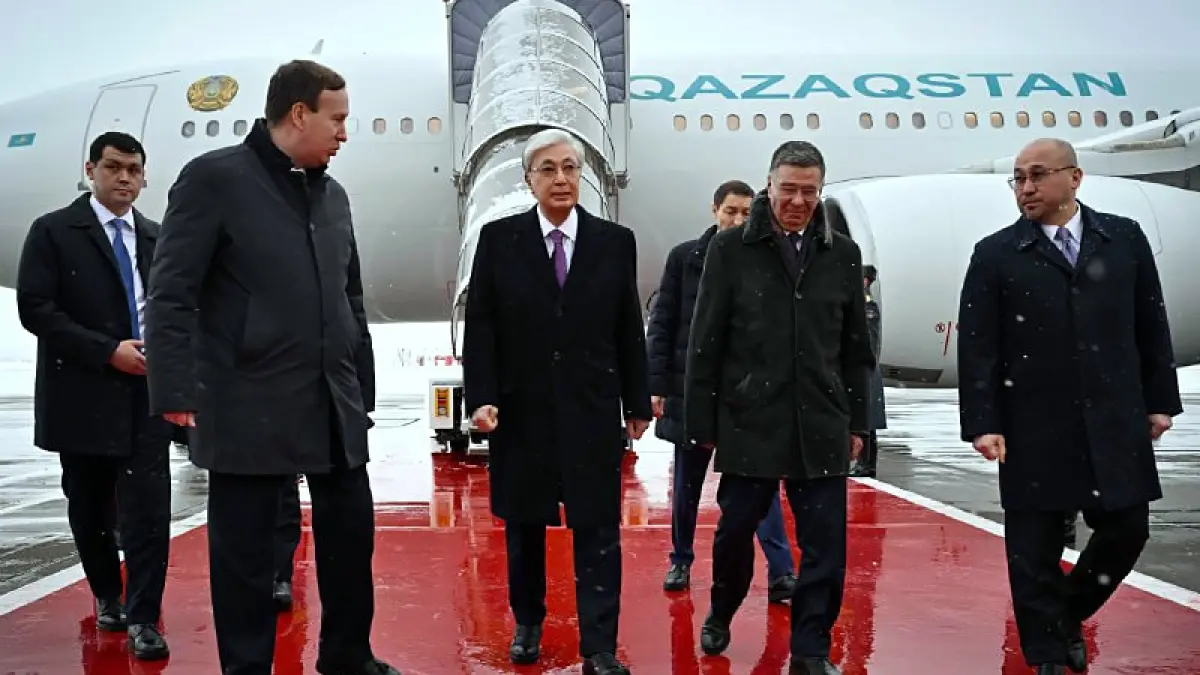
Wednesday evening passed under the sign of winter, although it has not yet arrived outside. While the plane of President Kassym-Jomart Tokayev of Kazakhstan was landing in Moscow, Astana and Almaty were talking about what the cold season tests first. The talk was of viruses in schools, of pipes and wires that need replacing, and of turbines that are to give the city heat and light without coal smoke.
The evening in figures
- 1.5 million
ARVI cases since early September, 28% fewer than last year - 20%
share of pupils ill in a class at which a school switches to distance learning - 822.6 billion tenge
cost of network modernisation projects for 2027 - 471 million tenge
financial violations in employment measures - 30 November
first electricity from the renovated CHP-2 - 458.37 tenge
weighted average dollar rate on KASE
According to the Central Communications Service, the government, the Supreme Audit Chamber, Samruk-Energy and KASE
- 1.5 million
Moscow: the first day of the visit
Tokayev arrived in Moscow on a working visit and was met at the airport by officials of the Russian government, Akorda said. The programme of the trip is known from the announcements by Akorda and the Kremlin: the presidents will hold an informal meeting and on 26 November will together take part in AI Journey, an artificial intelligence conference held by Sberbank. Neither side has mentioned documents to be signed, so the main news of the visit will come on Thursday.
Winter: viruses, pipes and turbines
The Ministry of Healthcare chose the topic most worrying for parents for its press conference at the Central Communications Service (CCS) and answered it with figures. Sarkhat Beisenova, chair of the Committee for Sanitary and Epidemiological Control, said that in no class and no school had the share of pupils ill with ARVI exceeded 20%, so there was no need to move children to distance learning. Since early September about 1.5 million ARVI cases have been registered in the country, 28% fewer than a year earlier, along with 297 cases of influenza. The previous season was harsher: in November children’s infectious beds were almost 85% full, and in some regions hospitals took in more patients than their bed capacity allowed. The ministry put down rumours of an “unusual virus” in Almaty, after which officials and the public council visited hospitals, to the usual seasonal rise. Three days ago the Astana akimat counted 313 people with influenza and ARVI in city hospitals, so the ministry’s calm rests on the comparison with last year rather than on empty wards.
Pipes and wires were on the government’s agenda. Deputy Prime Minister Kanat Bozumbayev chaired a meeting of the project office of the national project “Modernisation of the Energy and Utilities Sectors” and ordered amendments to its rules to be prepared by 15 December. Procurement is to be simplified, utility companies with the most worn-out networks are to be drawn into the national project more widely, and project costs revised when expenses rise for good reason. Projects for 2027 are valued at 822.6 billion tenge, and 366 of them are ready to go. “We must clearly set the rules of the game,” Bozumbayev said. The akimats of Almaty, Almaty Region and Atyrau Region have been told to sign contracts for all of next year’s projects by the end of December.
The turbines are turning in Almaty. At CHP-2, which is being converted from coal to gas, the third gas turbine was fired up on 25 November, and Samruk-Energy set the first supply of electricity to the grid for 30 November. The plant’s new hot-water boiler house has been supplying heat since 31 October. At CHP-3 the picture is more modest: installation of the first gas turbine unit is 69% complete, and Ansar Aidarov, chair of the company’s management board, demanded faster progress. Three weeks ago Energy Minister Yerlan Akkenzhenov named 25 December as the date for the full launch of CHP-2 and the end of 2027 for CHP-3.
Money and oversight
The Supreme Audit Chamber looked at how the state spends money on employment and found financial violations worth 471 million tenge and 519 million tenge of inefficiently planned funds. The main finding lies not in the violations but in the proportions: of the 163 billion tenge allocated to employment measures in 2025, 89% went on subsidised jobs and only 2% on vocational training. Unemployment fell from 4.7% to 4.6% over three years, and the Ministry of Labour recorded some measures as completed without a confirmed result. The audit came in the week when the President ordered the launch of a digital employment regime, and the auditors noted that platform work is growing without full record-keeping.
Vitaly Tutushkin, deputy chair of the National Bank, spoke about money in a broader sense. In an interview with BES.media he explained that slowing inflation, now 9.2% year on year, does not yet guarantee a cut in the base rate on 4 December: before the meeting the regulator is revising its forecasts three years ahead. “If inflation continues to slow, it will be one of the possible factors for us to move on the rate. But, again, it is not a necessary decision,” Tutushkin said. The decision on 4 December will be the last this year; the National Bank published its schedule for 2027 on Monday.
Business, meanwhile, brought the government its own list. Aslan Kaligazin, deputy chair of the management board of the Atameken National Chamber of Entrepreneurs, spoke on the sidelines of the chamber’s congress. The day before, he said, a list of 157 problems had been sent to the government, including proposals to amend the Tax Code.
Plants and subsoil
The Baiterek holding discussed with the Chinese contractor Wuhuan Engineering the financing of KazAzot PRIME’s ammonia and urea complex in Mangystau Region. The plant, with a capacity of 577,500 tonnes of urea a year, is to reduce dependence on imports of a fertiliser not currently produced in Kazakhstan. The holding did not give the amounts or terms of the loans; in the morning Baiterek said it had earmarked 4.1 trillion tenge to support bank lending under various programmes.
With the subsoil, things are more cautious. Alibek Kuantyrov, Minister of Ecology and Natural Resources, met Suzanne Coogan, head of Shell in Kazakhstan, and discussed exploration at the Zhanaturmys block in Aktobe Region. The ministry pointed to the underground sources of drinking water and the forests in the area and proposed working through the admissibility of exploration further with the body responsible for water resources. Shell signed its contract with the Ministry of Energy back in March; now the final word belongs to the environmental review.
The exchange and the neighbours
The trading evening turned out calmer than the morning. The KASE index fell by 0.71% to 7,733.68 points, and Kazatomprom shares again accounted for the largest trading volume, 588.3 million tenge. During the day these shares dropped to a 52-week low, on the day it became known that a member of the company’s management board had been detained. The tenge strengthened by 1.06 over the day: the weighted average dollar rate at 17:00 was 458.37 tenge.
For the neighbours the day ended with a school reform. Uzbekistan’s Legislative Chamber passed in the third reading a law under which a year of preparation for school becomes the first stage of compulsory education, and sent it to the Senate. In the morning the border with Uzbekistan opened at the renovated Zhibek Zholy and Gisht-Kuprik checkpoints, and travel between the two countries is again possible by the familiar road.
Wednesday’s evening news turned out to be about housekeeping: officials counted beds, kilometres of networks, turbines and jobs. How accurately they counted will become clear in December. The project office will review how its instructions were carried out, the National Bank will decide on the rate, and CHP-2, according to the energy minister, is due to run at full capacity.



