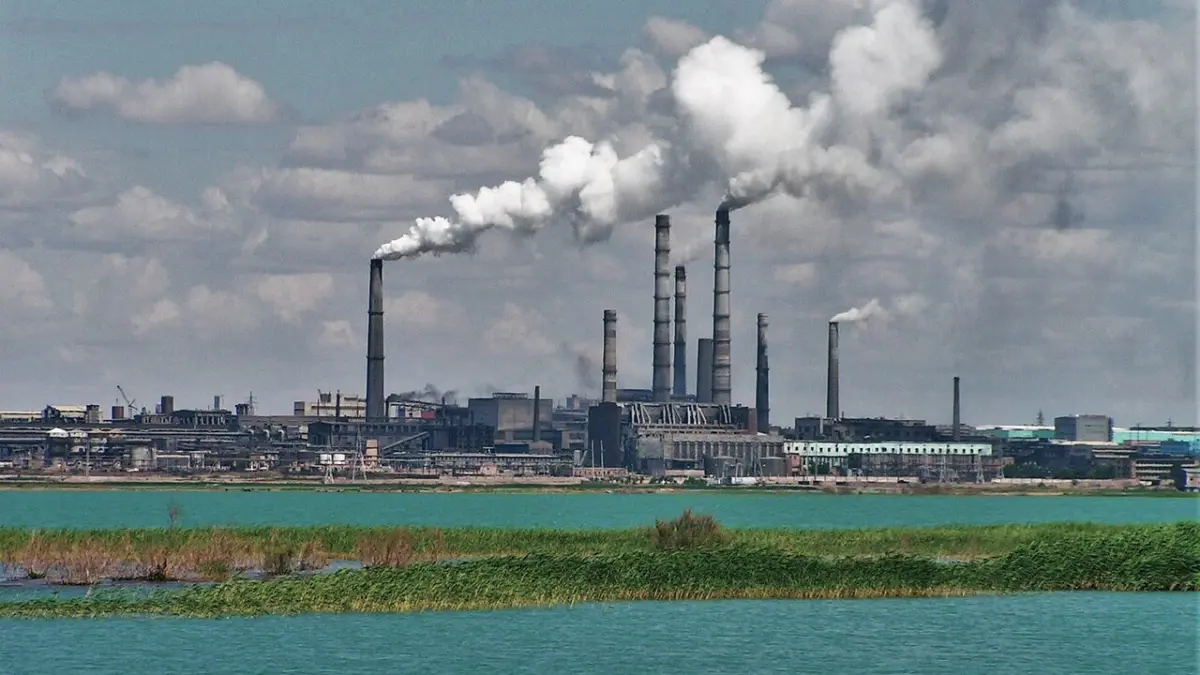
Kazakhstan is more deeply integrated into the world economy than its Central Asian neighbours, but it is integrated at the very start of the production chain: value added in the country and exported as raw materials and semi-finished goods amounted to 21.5% of GDP in 2024, while value added exported as finished goods came to 5.3% of GDP, economists at the Eurasian Fund for Stabilization and Development (EFSD) have calculated [1][2]. The paper appeared on 15 October, in the same week as a report of 19.5% export growth over eight months and Kazakhstan's accession to a World Bank initiative promising help in attracting about $20 billion into the mining and metals sector [3][7]. Together the three reports pose one question: where does Kazakhstan's share of the value end, and who earns from the rest?
What was measured and how
The EFSD study draws on the Asian Development Bank's multi-regional input-output tables for 2024 and breaks gross exports down by source of value added using the Koopman–Wang–Wei method [2]. Such a breakdown answers not "how much was sold" but "whose work is contained in what was sold": a tonne of cathode copper carries Kazakh mining and concentration, while its further path into wire, a motor or a car is credited to the countries where that path is travelled [2].
Note. Value added is the difference between the price of a product and the cost of what was bought from others to make it: raw materials, energy, components. The concept comes from the system of national accounts and underpins GDP: adding up the value added of all producers gives GDP without counting the same thing twice. Global value chains is a term that spread widely in the 2000s, when economists and international organisations noticed that the "exporting country" in trade statistics is often only the last link in assembly, while a product's value is created in several countries. Peredel, the Russian word behind the phrase "depth of processing", comes from metallurgy: it named each stage in the transformation of metal (ore, pig iron, steel, rolled products), hence "peredelny chugun", pig iron intended for conversion into steel. In economic usage the "depth of processing" means how many such stages raw materials pass through inside the country before leaving it.
Four to one
Domestic value added in Kazakhstan's intermediate exports reached $62.6 billion in 2024, and in final exports $15.58 billion [2]. About 72% of exports consist of domestically produced intermediate goods and 18% of finished ones; foreign value added accounts for about 10%, which, in the authors' assessment, points to a limited role for imported components in exports [2]. Half of the domestic value added in exports comes from mining, and about 14% more from basic metals [2].
The authors themselves call this an "almost classic" commodity profile, but they also note movement: in 2010 intermediate exports amounted to 30.0% of GDP and in 2019 to 22.0%, while the share of final exports rose from 2.2% to 5.3% of GDP [2]. The shift is slow, and the ratio of the intermediate link to the final one is still about four to one [2].
A separate indicator is the value that direct buyers of Kazakh raw materials process and re-export to third countries: $16.06 billion in 2024, about 5.5% of GDP, against $9.79 billion in 2010 [2]. According to EFSD calculations, the output of Kazakhstan's mining industry goes through about three more stages of production, mostly abroad, before it reaches the consumer [1][2].
The short chain of metallurgy
The production chain length index shows how many stages, on average, an industry's product passes through. For Kazakhstan's basic metals it is 1.99, of which the domestic part accounts for 1.65; the authors call this one of the lowest values in the entire database [2]. For comparison they cite China, where the same industry has a chain length of 3.1 thanks to blending imported ores, alloying and producing special alloys [2]. A short chain, they conclude, indicates insufficient depth of processing and means the main technological rent is earned abroad [2].
The latest trade statistics do not contradict this. In January–August 2026 exports of copper and copper cathodes rose by 55.7% to $3.9 billion and uranium by 26.9% to $3.1 billion [4]. The Ministry of Trade and Integration separately highlights growth in processed farm products: sunflower oil, flour and ready-made animal feed together brought in $1.65 billion, about 48% more than a year earlier, and it calls this a sign of expanding value-added exports [3][5]. The scale differs markedly: this is less than half of the copper item alone.
Neighbours as suppliers and buyers
The study's second line concerns links within the region. Of the $48.6 billion of Kazakh value added that other countries use in their exports, only 1.6%, or $766 million, falls on the exports of Central Asian neighbours, and almost all of that ($579.7 million) is linked to Uzbekistan [2]. The flow in the opposite direction is smaller still: of $9.7 billion of Uzbek value added in other countries' exports, $132.8 million falls on Kazakhstan's [2].
The EFSD describes the neighbours' models as different. Uzbekistan keeps the ratio of intermediate to final exports at about three to one and is increasing imports of technology and components for car-making, engineering and textiles; basic metals account for about 41% of its export value added and textiles for about 14% [1][2]. Kyrgyzstan stands out for the region's highest export openness and reliance on imported components, while Tajikistan remains a supplier of raw materials [1].
What is proposed and what has already been promised
The EFSD authors propose four steps: build regional chains instead of bilateral trade in raw materials; trade raw materials for depth of processing, in Kazakhstan's case in petrochemicals and special alloys; attract foreign direct investment on condition that processing is localised and technology transferred, using world demand for lithium, copper and uranium as leverage; and align customs rules and cut the costs of trade within the region [2].
Part of this agenda coincides with the World Bank compact that Kazakhstan joined on 16 October: its three areas include attracting private investment into mining and deep processing, introducing modern metal-processing technologies and digitising geological data [7][8]. The $20 billion target for 2031, however, covers the whole mining and metals sector and includes expanding the mineral resource base and extraction; the published statements do not say what share of the sum will go to processing [7][8].
These figures do not cancel out overall economic growth: in the first nine months of 2026 the economy grew by 4.2% and manufacturing by 8.6%, according to analysts at Ranking [6]. But the EFSD study measures not the pace but the position in the chain, and by that measure, as the Telegram channel Tradereport puts it, the question remains the same: how much longer will the country earn from extraction while leaving the income from processing to others [9]. The answer depends on what the promised investment turns into, and it can be checked against the next calculations of the same kind.
List of sources used
- EFSD: "EFSD economists assess Central Asian countries' participation in global production chains", 15.10.2026 — primary source, fund announcement; accessed 18 October 2026.
- EFSD: working paper WP/26/2 "Participation of Central Asian countries in global value chains" — primary source, study; accessed 18 October 2026.
- Ministry of Trade and Integration of Kazakhstan: "Kazakhstan's export growth more than four times faster than import growth", 17.10.2026 — primary source, ministry data; accessed 18 October 2026.
- Ministry of Trade and Integration of Kazakhstan: on copper, uranium and equipment imports, 17.10.2026 — primary source, ministry data; accessed 18 October 2026.
- Informburo: "Export growth in Kazakhstan four times higher than import growth", 17.10.2026 — report on ministry data; accessed 18 October 2026.
- Zakon.kz: "Which industries drive Kazakhstan's economic growth", 17.10.2026 — report on Ranking analysis; accessed 18 October 2026.
- Kazakhstan Today: "Kazakhstan intends to attract $20 billion of investment into the mining and metals industry", 16.10.2026 — report on government statement; accessed 18 October 2026.
- 24KZ: "Kazakhstan becomes first in Central Asia to join World Bank global initiative", 16.10.2026 — report on government statement; accessed 18 October 2026.
- Tradereport: "Kazakhstan supplies raw materials, while others earn from processing them abroad", 17.10.2026 — channel author's opinion; accessed 18 October 2026.
Artificial intelligence was used in preparing this material.


