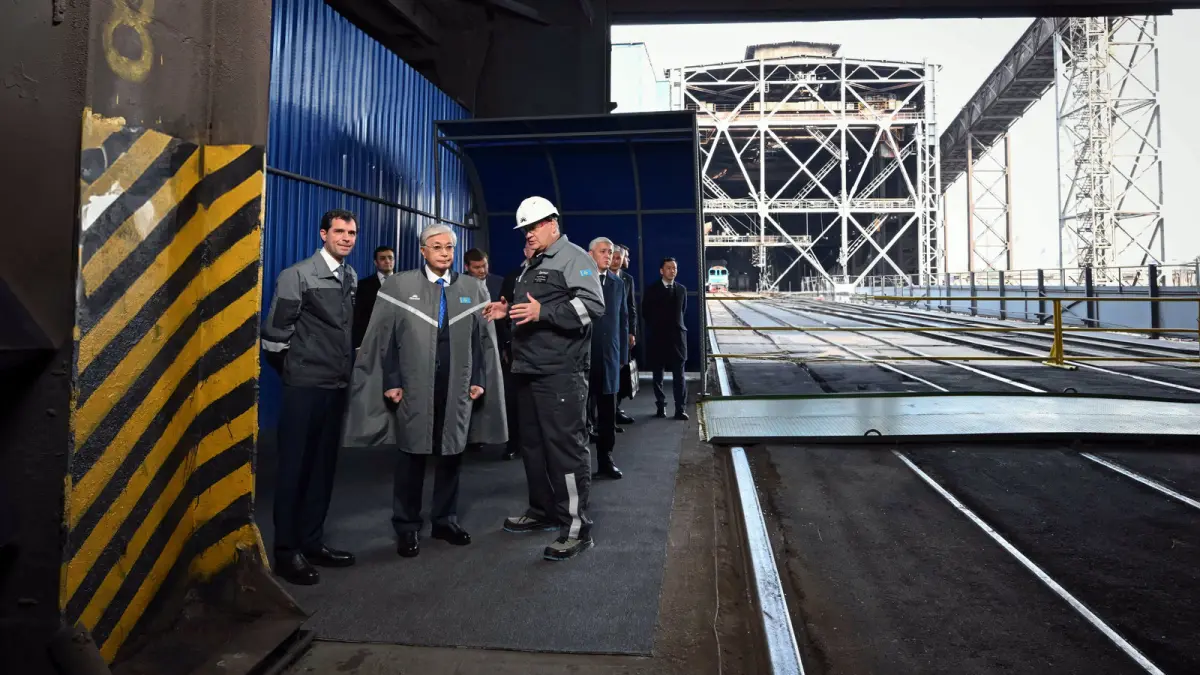
Temirtau, 2 November. The Qarmet steelworks plans to produce 4 million tonnes of steel this year: the company’s management reported this to Kassym-Jomart Tokayev, the Khabar TV channel said in its report on the President’s trip; the channel calls it a record for eight years, the report says.
Qarmet board chairman Andrey Lavrentyev explained the goal this way: “If in 2023 steel production was 3 million, this year we are fighting for 4 million of steel.” Growth in output, according to Khabar, began three years ago, when the plant, then still ArcelorMittal Temirtau, passed to a new investor; 2.7 billion dollars has been invested since. Managing director Yerbol Ismailov said the holding has 35,000 employees and “every second family” in Temirtau is in one way or another connected with the plant.
On the wear of the old batteries, Qarmet’s hot-repair consultant Gennady Vodovozov said: “A good service life for a coke battery is 30–35 years. The third coke battery, whose reconstruction began in 1990, is 36 years old now. That is, the batteries have outlived their time.” He speaks of what he knows from the inside: Gennady Anatolyevich is 71, has worked at the plant for 49 of those years and, Tengrinews writes, took part in the reconstruction of all the coke batteries. In his words, some batteries passed the 35-year mark long ago: the old ones have passages where two workers cannot pass each other, and in summer rooms are above 30 degrees, and ventilation and air conditioning do not always help. Workers greeted the decision to build new batteries with relief. “I am even grateful to fate that I am allowed to take part in building coke batteries No. 8 and No. 9,” Vodovozov admitted; the veteran is helping to build a replacement for batteries he once reconstructed himself. They are being built with a Chinese company: in July in Shanghai, at Tokayev’s meeting with Chinese business, an agreement on cooperation in building the batteries and a gas-cleaning system was exchanged, and the project is due to be completed in 2027. The two new batteries being built to replace them will be able to produce 1.5 million tonnes of coke a year; capital construction director Alexey Sidorenko explained that Karaganda coking coal is heated in the batteries above 1,500 degrees: the gas released goes into production and the dry coke into the blast furnaces. According to the correspondent, some of the old batteries have worked since the 1960s. Every day 2,800 builders arrive at the site, more than 300 contractors work there, and “in every tenth family, probably” in Temirtau there is a person from such a company.
Steelmaker Vladislav Balymbekov (Tengrinews spells his surname “Baumbekov”) said that recently the plant made steel for Iran and Uzbekistan, with “new trade routes” appearing. The new section-rolling shop will be able to produce 540,000 tonnes a year: rebar, angles and channels. Its foreman Yelena Chiprina said staff view modernisation positively: “our plant is very old. We would like to work in beautiful shops.” On workplace safety, the chairman of the coal miners’ union Korgau, Yevgeny Buslayev, said methane control has been stepped up and digital technology makes it possible to track workers’ positions in the mine.
Khabar recalls the President’s words about 3.5 billion dollars for modernisation to 2028 and the company’s return to net profit after several years of losses; last year’s revenue, by its account, exceeded 1 trillion tenge. Among those decorated, the channel showed security service employee Igor Ivanov: “Through me the whole team I work in was decorated.” In the list of those decorated on Akorda’s website, Igor Ivanov appears as a Qarmet engineer. The tram, stopped in Temirtau in 2023, was restored by the company: 30 kilometres of track and eight cars, payment through the ONAY system, and free for employees; driver Aigul Lingenau noted heated seats and summer cooling, and trams, according to Khabar, remain in only three cities of Kazakhstan. On the region, the channel said machine building grew 26% and more than 800 billion tenge of investment has been attracted since the start of the year; a slide of the region’s presentation, published by Akorda, shows 46 projects worth 328 billion tenge for 2026.
What it means: The main figure of the report is the move from 3 million tonnes of steel in 2023 to a target of 4 million in 2026; the rest is told by workers and engineers: the age of the coke batteries, the number of builders, new markets. Figures for regional investment differ between the report and the Akorda slide, and the difference is not explained.
Background: In Akorda’s reports of the same trip the 2026 targets are 4 million tonnes of steel, 3.6 million tonnes of coal and 3.9 million tonnes of iron ore concentrate; Qarmet, it says, restored the tram service in 2024.



