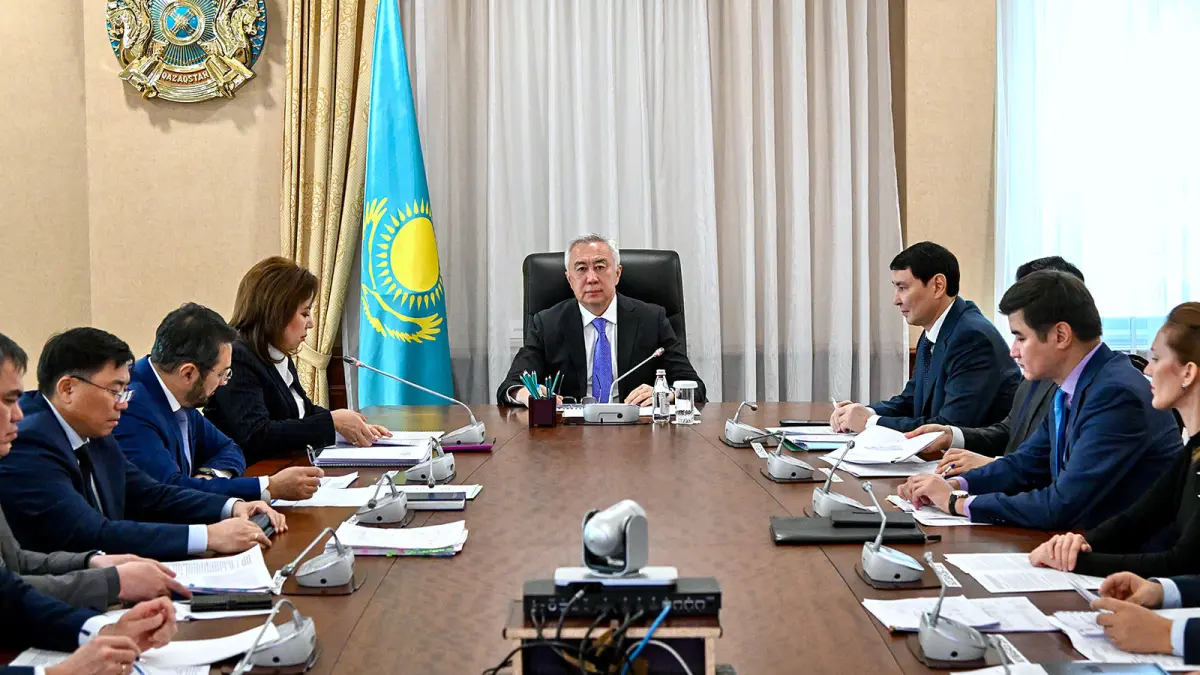
Astana, 5 November, . The Government, chaired by Deputy Prime Minister Serik Zhumangarin, reviewed the Capital Market Development Programme to 2030 and the draft law “On the Capital Market”, the Government said.
Nurzhan Tursunkhanov, deputy chair of the financial market regulator, gave the figures. In five years the market for shares and bonds nearly doubled: from 51.1 trillion tenge in 2021 to 99.8 trillion in 2025. Share capitalisation is 41.8 trillion tenge, or 26% of GDP, and the bond market 58 trillion, or 36% of GDP. The main growth, he said, came from placements of shares of quasi-public companies and revaluation of issuers.
Government securities dominate the bond market: 59% of the volume. Another 30% are bonds of the quasi-public sector and only 11% of private business. By the editors’ calculation, 11% of 58 trillion is about 6.4 trillion tenge, or roughly 4% of GDP. Trading activity is low: share turnover is 1.4% against a benchmark of 5–10%, and bond turnover about 9% against 20–25%.
The new law will replace the 2003 law “On the Securities Market” and bring the rules closer to the standards of the European Union and the International Organization of Securities Commissions, IOSCO. It will cover derivatives and digital financial assets. To protect investors, uniform criteria of a qualified investor are introduced and brokers will have to execute client orders on the most favourable terms for them. The institute of financial and investment advisers is also developed.
Companies’ entry to the market will be eased by a “single window” principle at the Central Depository and new requirements for prospectuses. Securities lending and covered short selling will appear, market makers’ work will improve and independent investment analytics will be supported. Access of international investors to Kazakh shares will be widened.
What it means: The market has grown mainly thanks to state-linked companies, and trading on it is rare: share turnover is several times below the benchmark. The law and the programme are meant to change this, but private business must be persuaded to come to the exchange.
Who benefits: Companies that need long financing, and investors: they are promised uniform criteria for a qualified investor and order execution on the best terms. By design, citizens whose savings can be invested for the long term also gain.
Background: Turnover is the share of securities that changed hands over a year in the total market volume; the higher it is, the easier it is to buy and sell a security without a discount. Securities lending is a deal in which an owner temporarily hands securities to another participant for a fee. A short sale is selling borrowed securities in the expectation of a fall in price; “covered” means the securities were borrowed in advance. A qualified investor is a person or company allowed by law to make complex and risky deals. A market maker is a participant that constantly quotes buy and sell prices.



