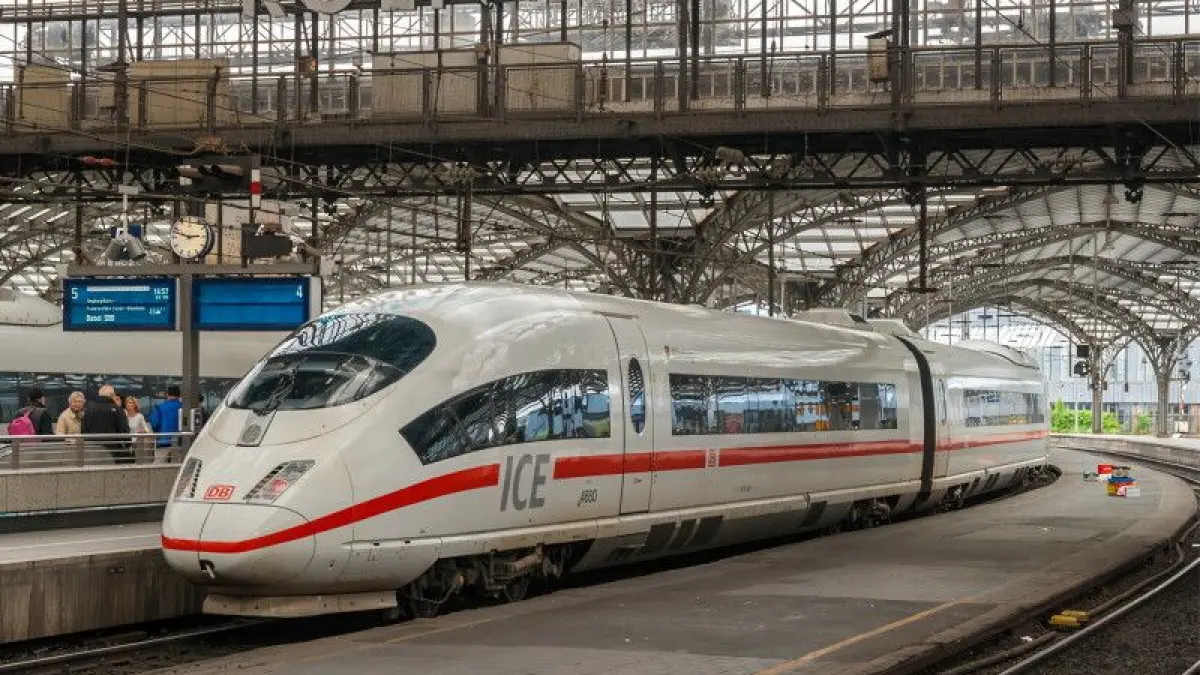
Instead of Russia, nine of the thirteen Sapsan high-speed trains made by the Siemens group will most likely go to Kazakhstan, VRKNews.kz reports.
The industrial group, through its subsidiary Siemens Mobility, already on 12 May announced a near-complete withdrawal from the Russian market. The Siemens subsidiary produced Lastochka electric trains and freight electric locomotives in Russia and also serviced the Sapsans. Siemens Mobility linked its departure from the country to Western sanctions against Moscow.
Kazakhstan to get the Sapsan high-speed trains
Russian Railways (RZD) has already confirmed that the Germans have terminated the contract for supplying new trains and servicing existing ones. For Siemens Mobility itself this is a serious step, since the company considered the Russian market promising. RZD currently uses 16 Sapsans (you can read detailed information about these trains here) and more than 250 Lastochkas (1.4 thousand carriages); these trains will remain in Russia and continue in operation. However, the painful question of servicing and repairing these trains arises.
As the business weekly WirtschaftsWoche writes, the trains intended for Russia are now planned to be resold to Kazakhstan or Ukraine. Of the 13 third-generation trains (ICE 3, short for the English Intercity-Express) that belong to the Siemens Velaro family and were built under a contract with Russia, only four were shipped. The remaining trains, because of Siemens' departure from the Russian market, were nevertheless decided to be completed for a potential buyer who, by acquiring the nine remaining trains, would also get a huge discount.
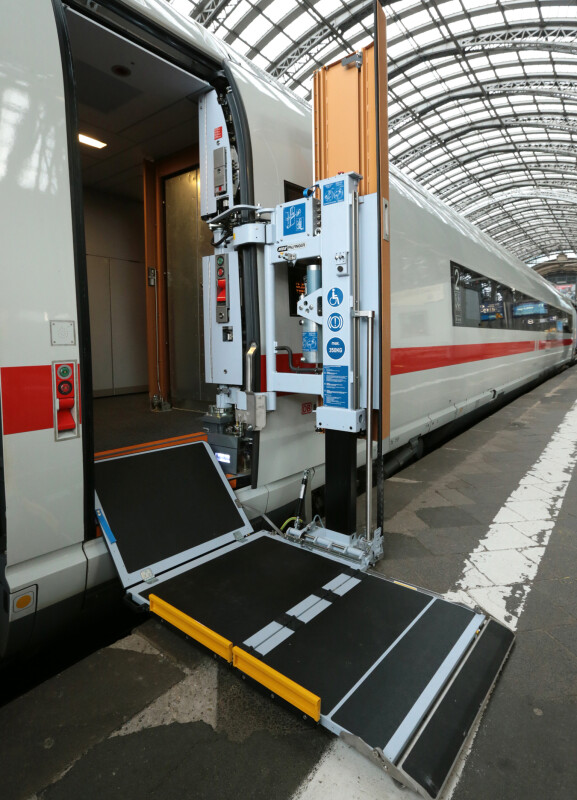
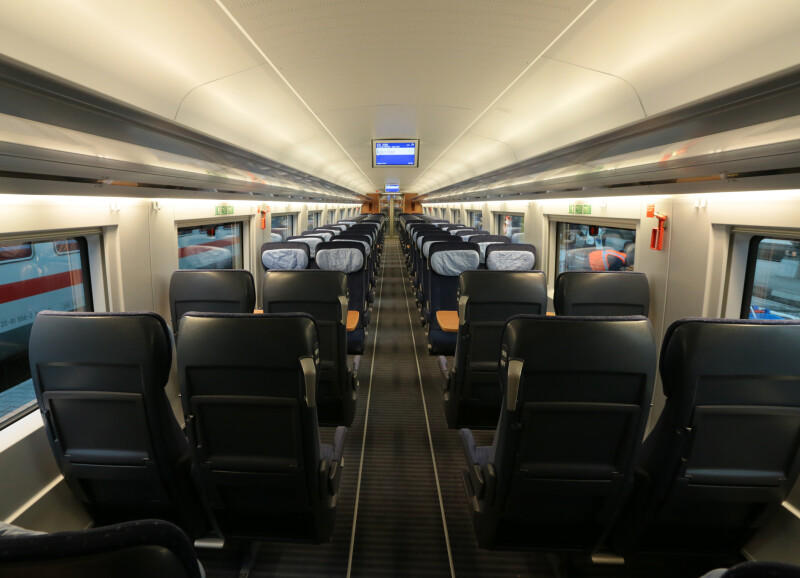
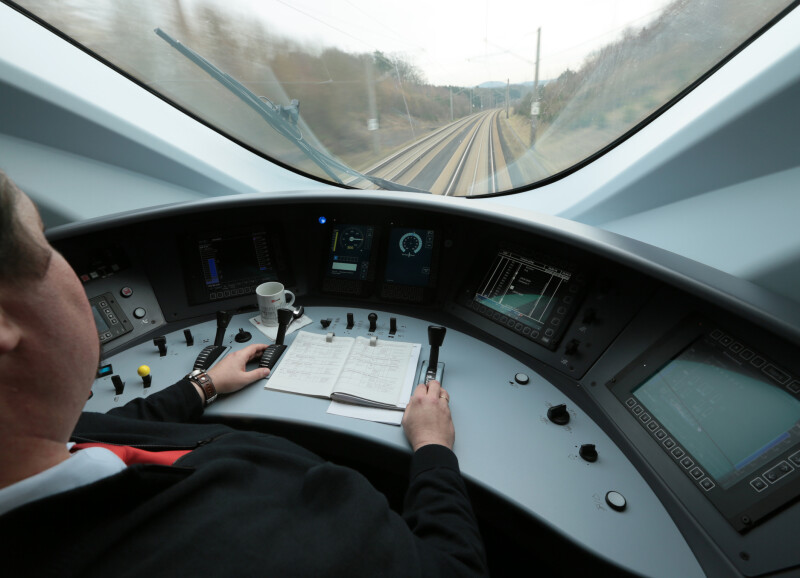
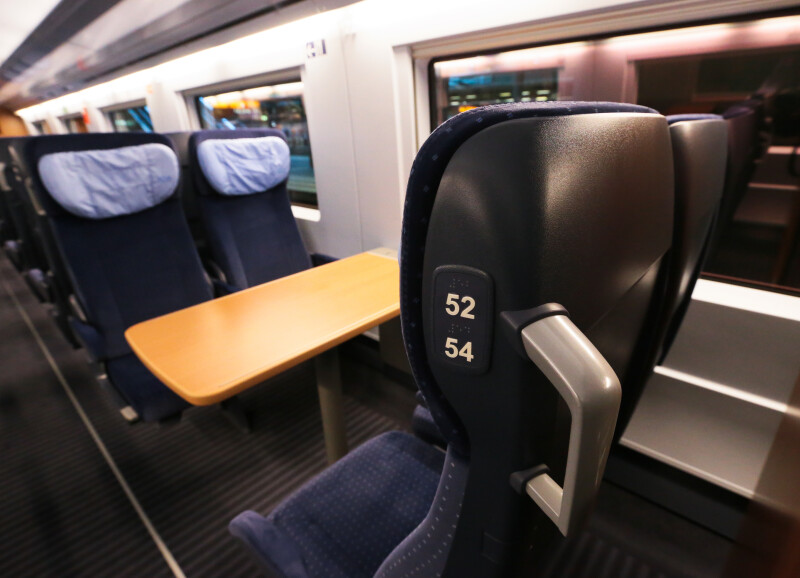
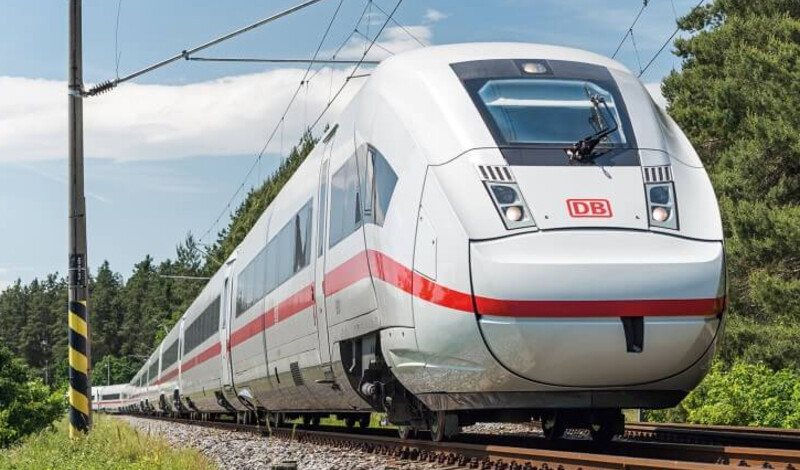
The order volume for all 13 trains came to about 1.1 billion euros, of which just over 510 million is the cost of the trains themselves and 583 million is servicing and repair over 30 years. These trains can reach speeds of up to 320 km/h and were originally aimed at people who often make business trips or travel long distances. Thus the ICE is the main type of train on long-distance routes in Europe, providing both maximum speed and maximum travel comfort and becoming a good alternative to air travel.
The point is that on 12 May the Kazakh-German business forum was also held in Nur-Sultan with the participation of First Deputy Prime Minister of Kazakhstan Roman Sklyar, at which a memorandum of understanding was ceremonially signed between Siemens LLP, represented by director Diyas Assanov, and JSC “Kazakhstan Centre of Industry and Export ‘QazIndustry’”, represented by chairman of its board Berik Bekenov.
The parties agreed on promising areas of cooperation. It is planned to provide educational support and upgrading of skills for representatives of the industrial sector of Kazakhstan, as well as to integrate Siemens' training courses and best practices on the digital transformation of industry into the existing doctrine of JSC “Kazakhstan Centre of Industry and Export ‘QazIndustry’”. In addition, joint events and projects are planned aimed at developing the professional knowledge and skills of representatives of Kazakhstan's industrial sector.
Of course, a memorandum, and moreover one of mainly educational character, is still far from a contract. The government concludes any number of memoranda. For example, a memorandum was concluded last year with the Russian Sber, and where is it now? Though here the Russians themselves created a force majeure for themselves, thanks to which work with the Sber platform became problematic.
As for Kazakhstan precisely buying nine high-speed trains from Siemens, the likelihood of this is very high, especially in view of recent events. After all, the Germans in effect have few options, or more precisely just one. First, these particular trains under construction are aimed at post-Soviet markets with the same railway gauge as in Russia. Second, Ukraine is ruled out purely for economic reasons — it is unclear how long the war will last, and the Germans are unlikely to want to give away their product at dumping prices. True, malicious tongues say that the German group “pushed” its trains on the Russians, on the contrary, at an inflated price, almost double the market price.
Confusion over the “Tulpar” plant
It would not hurt to look back and understand what is now happening with carriage production in the country itself. And a great deal that is unclear is happening.
Production of high-speed passenger carriages using the technology of the Spanish company Patentes Talgo has been carried out in Kazakhstan since 2011 by Tulpar Railway Carriage Plant LLP. The enterprise was built in what was then Astana as part of the state programme of accelerated innovative industrial development with the support of the first president of Kazakhstan. The sole owner of Tulpar Railway Carriage Plant LLP was JSC Remlokomotiv (a subsidiary of JSC NC Kazakhstan Temir Zholy), which by decision of the board of directors of JSC NC KTZ of 8 April 2016 was liquidated, and its subsidiaries were transferred on 9 June 2021 to JSC Kaztemirtrans — the largest operator of the freight carriage fleet of Kazakhstan, also a subsidiary of KTZ.
The design capacity of the Tulpar plant is 150 carriages a year. In 2012–2017 the plant produced 614 carriages using Spanish technology. Since June 2019 the plant has been producing items using the technology of JSC Tver Carriage Works. Three years ago the enterprise produced 63 carriages, and 146 carriages were planned for 2020. Servicing each Tulpar-Talgo carriage, as Orda.kz writes, cost 40 thousand euros a year. In all, the enterprise's fleet numbers over 600 carriages. Considerable funds therefore went on their servicing. But credit must be given to the Spaniards: although they were enriching themselves at the expense of the Kazakhstani side for six years, they at least built the plant.
However, in autumn 2019 the Ministry of Industry and Infrastructure Development of Kazakhstan unexpectedly announced that it would give up Talgo carriages altogether for “economic reasons”. The situation with the country's carriage fleet was commented on in this way by the then vice minister of industry and infrastructure development Berik Kamaliyev:
“As for the Talgo plant, we have terminated the contract with the Spanish investor. The Spaniards — Talgo — will be no more. Now we are working with Tver's Transmashholding; today we potentially have three companies that want to come into this plant as investors. We give them the technical specification, a modification, to move away from coal, so that the train is electrified, with air conditioning and so on.”
The “investors”, in Kamaliyev's phrase, are the Swiss company Stadler, whose “prices” proved too “expensive”, a certain “Chinese investor” (China Railway Rolling Stock Corporation — note by VRKNews.kz), whose “prices are cheaper but there are still questions on parameters”, and the Tver Carriage Works.
The outcome of the tender held made it clear that JSC Passenger Transportation intends to buy Russian carriages from the carriage works in Tver — the Tulpar plant was reoriented to cooperation with Russia and leased to the Russian machine-building giant Transmashholding (which includes the Tver Carriage Works). And soon 63 carriage kits were received through BRK Leasing. In all, from 2019 to the end of 2020 the Tver plant supplied Kazakhstan with two hundred passenger carriage kits under the contract.
The carriages assembled at the Tulpar plant from these kits are designed for speeds of 160 to 200 kilometres an hour and service of at least 40 years. They will be equipped with air conditioning, video cameras, Wi-Fi routers, sensors of a centralised fire-protection system, and water and air disinfectors. For charging passengers' mobile devices, personal sockets and USB connectors are provided. The ventilation systems have modern disinfection units similar to equipment for disinfecting hospital rooms.
Kazakhstan is acquiring Tver carriage-kit sets within the Strategy for renewing the rolling stock of JSC Passenger Transportation for 2020–2029. Over this period it is supposedly planned to buy 469 new passenger carriages and 26 power-generator carriages. Modernisation of old carriages is also envisaged.
However, no more deliveries from Tver have so far arrived. The Tulpar plant now, it seems, deals only with the maintenance of its carriages.
But now it is wanted to sell the Tulpar enterprise to those very Swiss whose “price lists are expensive”. The Swiss group Stadler Bussnang AG is the world leader in the production of passenger rail transport and number one in the world in the production of rolling stock for rack railways.
The Tulpar plant was due to be handed into the trust management of the Swiss company on 15 March 2022.
But the contract for the sale and purchase of the Tulpar plant has not yet been concluded, its deadlines are being postponed. At the beginning of March, as the same Kazakhstani publication Orda.kz writes, Stadler Bussnang owner Peter Spuhler announced the relocation of part of the project production to Poland and Switzerland because of international sanctions linked with the Russian-Ukrainian military conflict.
How he now wants to develop carriage production in Kazakhstan, if he had initially intended to bring technologies and specialists from Belarus, is absolutely unclear.
Instead of wells — only pits
The fleet of Kazakhstan's national carrier JSC Passenger Transportation itself numbers, in all, more than two thousand carriages. By 2029 about 945 carriages will be withdrawn from service because of age. In that time a whole set of measures to modernise and renew the rolling stock fleet will be carried out. Since 2019 work has already begun on replacing existing trains with new, more comfortable carriages. Each year the national carrier plans to buy about 100 new carriages.
We of course understand everything, including that the carriage fleet needs replenishing, and even that the people's money exists for this multibillion business. But how can mechanical engineering be built in a country when such strategic lurches occur, which destroy previous groundwork at the root? If you dig a well in a new place every day, instead of one well you will have only solid pits and no water.


