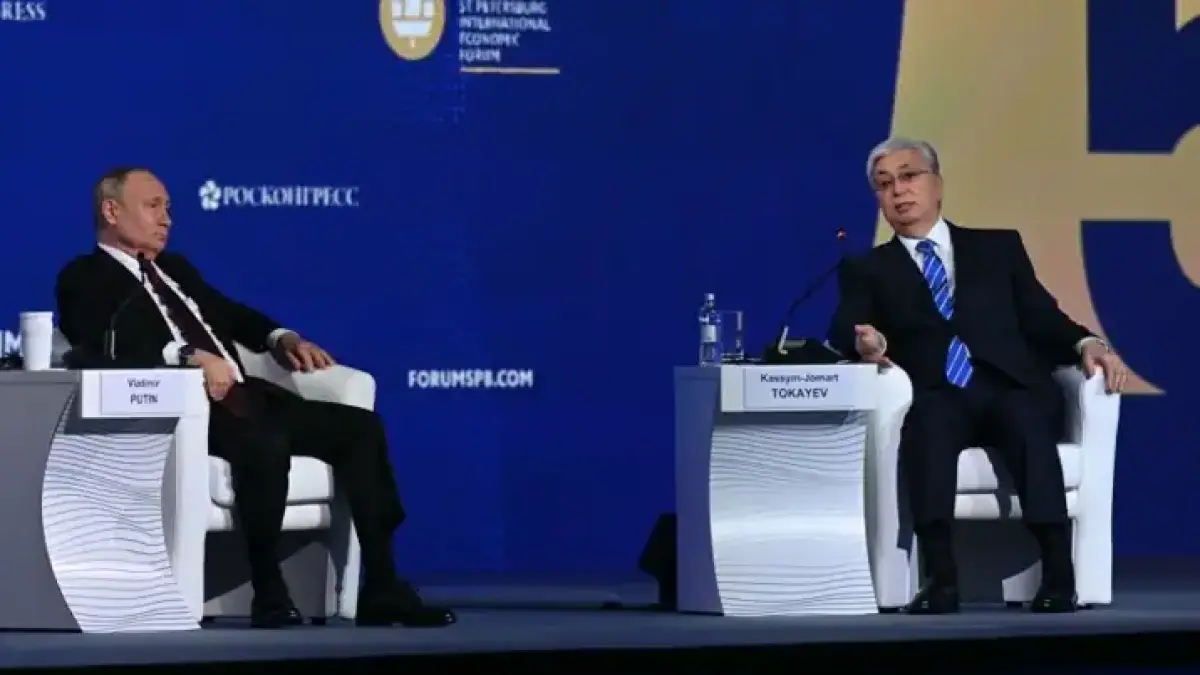
Kazakhstan does not recognise Luhansk and Donetsk, Taiwan, Kosovo, South Ossetia and Abkhazia, citing the principle of the territorial integrity of the state enshrined in the UN Charter. This was stated in his speech on 17 June at the jubilee St Petersburg International Economic Forum by President of Kazakhstan Kassym-Jomart Tokayev, VRKNews.kz reports.
Answering questions during an open question-and-answer discussion at the forum, the president of the country noted that opinions in Kazakhstan vary, since civil society is sufficiently mature.
“There are different opinions in Kazakhstan, our society is open. Modern international law is the UN Charter. But two principles of the UN have come into contradiction — the integrity of the state and the right of a nation to self-determination. And since these principles contradict each other, there are different interpretations,” Kassym-Jomart Tokayev said.
And he noted that Kazakhstan is against the chaos that could arise from a fantastical realisation of nations' rights to self-determination.
“If the right of a nation to self-determination were realised, more than 500 states would appear on earth, and there would be chaos. For this reason we recognise neither Taiwan, nor Kosovo, nor South Ossetia, nor Abkhazia. Apparently this principle will be applied to quasi-state entities, which, in our view, Luhansk and Donetsk are,” the head of state said.
In essence, as one of the political analysts, Nikita Shatalov, put it, the Kazakhstani president used the St Petersburg forum to set out key emphases on the subject of cooperation with Russia.
“In the most accessible form and in Putin's presence, Tokayev explained our position on the LDNR, relying on his own interpretation of the UN Charter, which has obvious contradictions. Whether anyone likes it or not, there are no longer any politicians in the region who in Putin's presence could call the DNR and LNR ‘quasi-state entities’. The president also once again explained our position on sanctions and the unreasonableness of Russia's use of counter-sanctions, offering the Russian Federation deeper cooperation with Kazakhstan's special role as a buffer for the movement of goods and services. The same applies to the mention of the Urals water problem, because of which a drought occurred in the west of Kazakhstan,” the expert noted in his Telegram channel.


