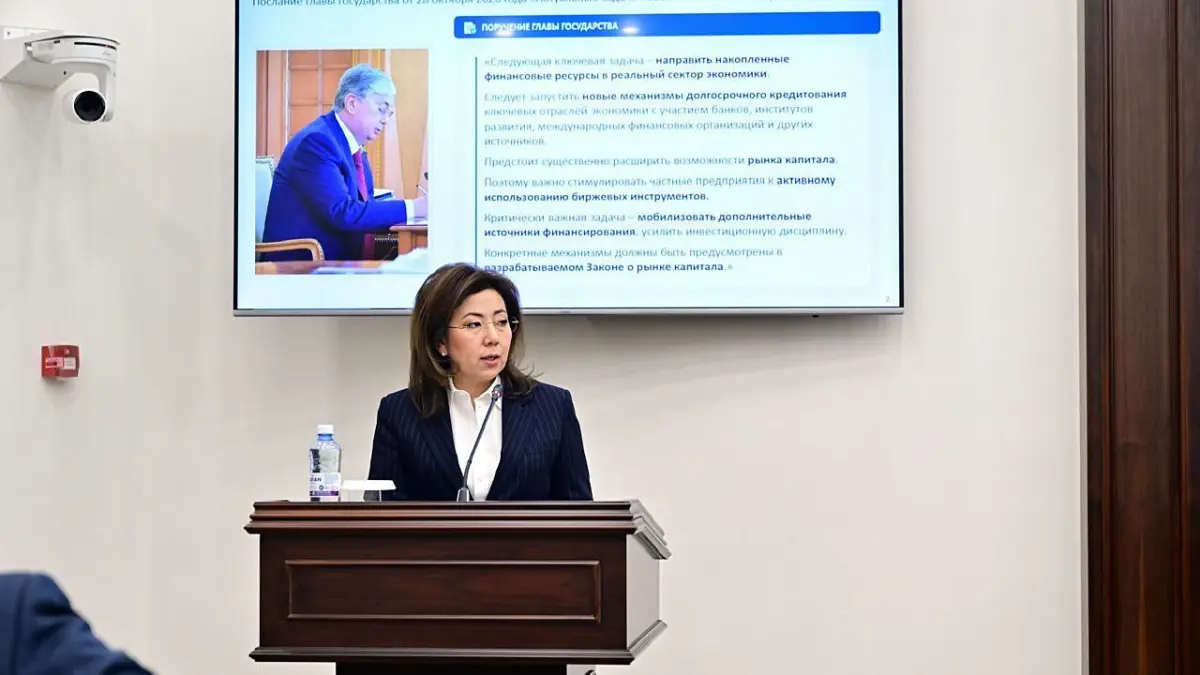
Astana, 5 November, . Madina Abylkassymova, chair of the Agency for Regulation and Development of the Financial Market, presented to Kurultai deputies the Capital Market Development Programme to 2030 and the main provisions of the draft law “On the Capital Market”, the agency said.
She spoke at a meeting of the Kurultai’s Committee on Finance and Budget, chaired by Deputy Chair of the Kurultai Dania Yespayeva. The leadership of the National Bank, the Association of Financiers, KASE, the AIFC and Atameken took part. The agency drew up the programme with the National Bank on the Head of State’s instruction. In the Address of 28 October the President demanded that accumulated financial resources be directed to the real sector, new mechanisms of long-term lending to industries be launched and private enterprises be encouraged to use exchange instruments.
In five years the capitalisation of the stock market more than doubled: from 19.1 trillion tenge in 2021 to 41.8 trillion in 2025. In 2025 the bond market raised 17 trillion tenge; 59% were government securities bonds to finance the budget and 30% were bonds of the quasi-public sector for investment projects.
The programme has seven directions, 35 initiatives and 171 measures. The first widens the circle of institutional investors: it proposes developing a competitive model of managing pension assets. The second develops the debt securities market, securitisation and risk hedging. The third simplifies issuing corporate bonds and preparing for an IPO. The fourth raises liquidity through a larger free float and market making. The fifth supports digital financial assets, ESG bonds and Islamic securities. The sixth introduces faster approval of a debtor’s restructuring. The seventh is risk-based supervision and the fight against market manipulation.
The regulatory requirements of the national jurisdiction and the AIFC are to be brought closer: they will first be compared and priorities set. The draft of the new law sets common rules for securities, derivatives and digital financial assets.
What it means: The state wants part of long-term financing to go not only through banks but through shares and bonds. That needs a law, work with pension assets and an easier way for companies to reach the exchange.
Who benefits: Companies that need long money and can more easily issue bonds or go public. Private investors get stricter supervision, and pension assets get a competitive management model.
Background: The capital market is where companies and the state raise long-term money by selling shares and bonds. An IPO is a company’s first public offering of shares on an exchange. Securitisation is turning future loan payments into securities that can be sold to investors. A market maker is a participant that constantly quotes buy and sell prices and so keeps trading going. Hedging is insurance against price changes.



