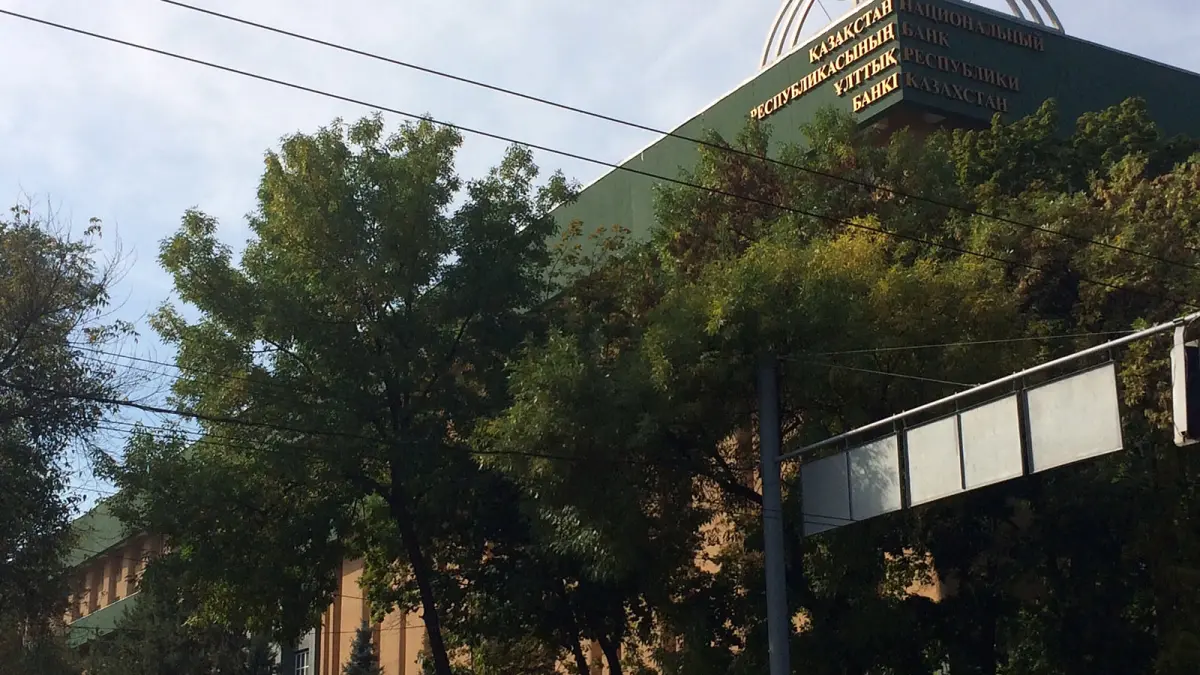
Almaty, November 5. The National Bank has named its planned withdrawals from the National Fund for 2026–2029, from 4.3 to 3.6 trillion tenge a year, and said the stabilisation part of the fund will cover them.
Batur Vakhidov, director of the bank’s monetary operations department, said this at a meeting of the National Bank’s discussion club at Narxoz Business School.
The schedule is 4.3 trillion tenge in 2026, 3.93 trillion in 2027 and 3.6 trillion each in 2028 and 2029. “In nominal terms it is still less than in previous years,” Vakhidov said. The stabilisation part of the fund is meant, among other things, to finance state projects, including the infrastructure construction the President announced in his Address at the end of October.
All current withdrawals, Vakhidov told Vlast, come from the stabilisation portfolio, which now holds 7–7.5 billion dollars. He does not expect withdrawals from the savings portfolio: they are possible if the oil price falls sharply and revenue drops. The fund’s assets are about 67 billion dollars; at an expected long-term return of about 6.5% that yields roughly 4.2 billion dollars a year, while the oil sector brings in another 4–5 billion. Vakhidov put the annual withdrawals of about 4 trillion tenge at roughly 8 billion dollars; by the editorial office’s calculation, at about 450 tenge to the dollar it is closer to 8.9 billion dollars. Investment income plus oil revenue comes to 8.2–9.2 billion dollars, comparable to the withdrawals. “We do not expect the National Fund to be eaten up,” Vakhidov said, adding that the fund could be topped up by privatising the state sector, a “people’s IPO” (a sale of state-company shares to citizens) and growth in oil output.
The risk of the fund turning into a source of off-budget spending, Vakhidov said, is covered by budget rules that limit guaranteed and targeted transfers, and by rules for selecting and appraising projects financed from the fund through bond loans. National Bank Chairman Timur Suleimenov added that the fund cannot be strictly a savings one: the oil sector provides a large part of budget revenue, and if all of it went into the fund, taxes on the rest of the economy would have to rise. That is why a guaranteed transfer, which returns part of oil rent to the budget, has operated since the late 2000s. Suleimenov compared transfers with the size of the economy. During the pandemic they were 4.6–4.7 trillion tenge, about 4.5 trillion is planned for the next three years, and gross domestic product (GDP) will be 180–190 trillion this year and exceed 200 trillion next year. By his estimate there will be an effect on inflation, but not a strong one; the quality of projects and spending matters more.
The same meeting discussed an investment-partnership programme using the fund’s money. As Suleimenov and Vakhidov explained in reply to a question from Ulysmedia, the state will set the directions, selection criteria and restrictions, while international asset-management companies will decide on each project. Money cannot go into shopping centres, oil derricks or ordinary roads: the aim is new-economy sectors that add value and diversify. The money will be spread across different projects, and nobody can guarantee a profit.
What it means: The National Bank sets withdrawals of about 8 billion dollars a year against investment income and oil revenue and concludes that the fund will not be “eaten up”. The calculation rests on the oil price: if it falls sharply, the savings part would be hit too.
Who benefits: Programmes financed from the fund, above all the “People’s Construction”, and the construction sectors. By the National Bank’s account, future generations also gain, because the savings portfolio is protected. Losses are possible where investments prove unprofitable: the National Bank does not rule that out.
Background: The National Fund is divided into two portfolios. The stabilisation one serves to finance spending and smooth oil swings; the savings one holds savings for future generations. The guaranteed transfer is an annual sum the fund passes to the budget under a rule set in advance; targeted transfers go to specific projects. A portfolio is a set of assets managed together.
We have also reported on the model the National Bank uses to calculate inflation and the base rate and on the decision to postpone the debt-burden ratio.