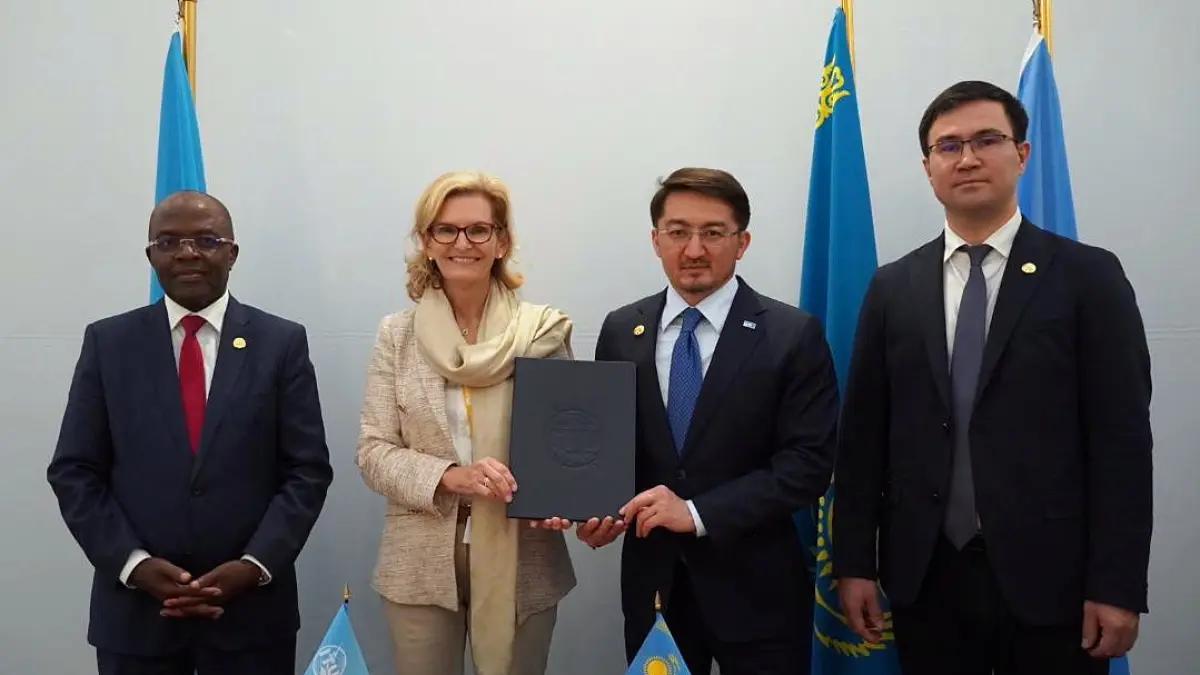
Astana, November 7. Kazakhstan has signed an agreement with the International Telecommunication Union (ITU) to join its Junior Professional Officers (JPO) programme, under which young Kazakh specialists will be able to work at the organisation, the Ministry of Artificial Intelligence and Digital Development reported.
The agreement was signed in Doha by Deputy Prime Minister and Minister of Artificial Intelligence and Digital Development Zhaslan Madiyev and ITU Secretary-General Doreen Bogdan-Martin. Kazakhstan will back the programme with a contribution equal to 0.6 of a “contribution unit”; Kazakh telecom operators helped to allocate these units. Young specialists will gain practical experience, work with international experts and take part in ITU projects, and will later apply what they learn in digital projects in Kazakhstan.
A second document provides for 100 free training places for participants from African countries. Training in digital technologies, programming and artificial intelligence will be organised drawing on Kazakh educational initiatives: Astana Hub, alem.ai, Tech Orda, TUMO and Tomorrow School. The document was signed by Deputy Minister of Artificial Intelligence and Digital Development Doszhan Musaliyev and Cosmas Zavazava, director of the ITU Telecommunication Development Bureau.
The third step is a letter agreement between the ITU and the Kazakh side on developing and validating a model of an ITU Acceleration Centre in Kazakhstan. The ministry and the ITU signed an agreement on creating the centre itself on July 5, 2026, and the new letter provides for targeted funding to develop its design. The centre will work from ITU methodological materials (ITU Playbooks) and key performance indicators, pass the results of using them back to the union, and is meant to support cooperation not only in Kazakhstan but across Central Asia.
Madiyev said the agreements “link the development of professional opportunities in Kazakhstan with a readiness to share our experience with partners,” and that Kazakhstan and the ITU expect to begin implementation and determine further steps to launch the programmes.
What it means: In these documents Kazakhstan plays two roles at once. It sends its young specialists to train at an international organisation and at the same time offers African participants its own educational projects. The Acceleration Centre is still at the design stage: what is being worked out is a design, not a launch.
Who benefits: Young Kazakh specialists, for whom a path into the ITU opens. Participants from Africa, who get 100 free places. Kazakh educational projects which, in the ministry’s words, cement the country’s role as a provider of digital knowledge.
Background: The ITU is the United Nations specialised agency for information and communication technologies. Junior professional officer programmes in the UN system work like this: a country pays for a young specialist to work at the organisation, and the specialist gains experience to use back home.



